

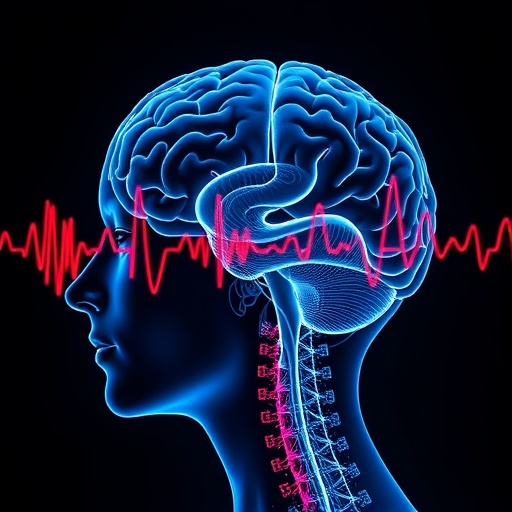
In a discovery that reshapes our understanding of the mind’s temporal architecture, scientists have captured the most conclusive evidence to date that human behavior is not a smooth, continuous stream but pulses with the unmistakable rhythm of the brain’s theta waves. The study, published in Communications Psychology, harnessed two massive datasets in which participants performed thousands of repetitive trials, allowing researchers to extract the subtle, periodic fluctuations that had long eluded definitive measurement. Led by M. Xu, E. Badaya, M. Senoussi, and colleagues, the work reveals that our perceptual decisions and actions oscillate with a regular beat in the 4 to 8 Hertz theta band—a frequency long associated with memory, navigation, and attention, but never before shown so robustly to sculpt the fabric of behavior itself.
For decades, neuroscientists have debated whether the brain’s intrinsic oscillations impose rhythmic samplings on our interaction with the world. Theta waves, prominent in the hippocampus and prefrontal cortex, are thought to coordinate information transfer across distant brain regions, yet the behavioral footprint of these rhythms has remained tantalizingly elusive. Isolated studies hinted that performance on visual or memory tasks might fluctuate at theta frequency, but noise, small sample sizes, and individual variability rendered the phenomenon controversial. The new research dissolves these doubts by deploying a dense-sampling approach: rather than testing many people briefly, each participant completed thousands of trials across multiple sessions, generating rich time series of accuracy and response times that could be spectrally unraveled.
The team applied rigorous time-frequency analyses to two independent datasets. The first involved a sustained attention task where participants responded to subtle visual changes, while the second featured a working memory paradigm requiring rapid comparisons of remembered and new stimuli. In both, a clear and replicable peak emerged in the theta band after accounting for 1/f background noise, a hallmark of naturalistic neural signals. This rhythmic signature was not a mere byproduct of averaging; it persisted when examining individual participants, demonstrating that the behavioral beat is a stable trait of each person’s cognitive machinery. The spectral coherence between performance fluctuations and the canonical theta frequency was so striking that the researchers describe the rhythm as a “temporal backbone” for perceptual updating.
What does it mean for behavior to have a theta beat? Mechanistically, it suggests that our brains do not process sensory information as a continuous influx but rather as discrete snapshots, each lasting roughly 125 to 250 milliseconds. During optimal phases of the ongoing theta cycle, perception is heightened and responses become faster and more accurate; during opposite phases, sensitivity dims. This rhythmic sampling may explain why even in highly controlled lab tasks, our performance naturally waxes and wanes with a predictable tempo—a phenomenon that until now might have been dismissed as random noise. The finding aligns with the influential theory of rhythmic attention, which posits that theta oscillations create periodic windows of excitability in sensory and decision-making circuits.
Crucially, the use of dense-sampling resolved a major analytical hurdle. Behavioral time series are notoriously noisy, and detecting a weak oscillatory signal buried in a sea of neural and motor variability demands immense statistical power. By collecting upwards of 10,000 trials per participant, the team could cleanly isolate the rhythmic component. They also employed advanced statistics to control for autocorrelative artifacts and potential oscillatory confounds such as slow breathing or eye movements. The theta rhythmicity survived these controls, confirming that it originates from central cognitive processes rather than peripheral physiology. This methodological rigor is why many in the field are calling the paper a landmark in the study of behavioral oscillations.
The implications ripple far beyond basic neuroscience. A rhythmic organization of behavior could fundamentally alter how we design time-critical systems—from optimizing the timing of alerts in high-stakes environments like aviation to aligning learning modules with a student’s natural cognitive periodicity. It also offers a new framework for understanding cognitive fatigue, as the theta rhythm may shift its frequency or strength under prolonged mental load. Clinically, conditions such as ADHD or schizophrenia, which involve disrupted theta synchrony, might be recharacterized as disorders of temporal coordination where the behavioral beat becomes arrhythmic or mistimed. Non-invasive brain stimulation methods, such as transcranial alternating current stimulation at theta frequencies, could be refined to entrain and restore healthy rhythms.
Despite its robustness, the study leaves open the question of causality. Are these behavioral rhythms an active reflection of neural theta oscillations that causally gate perception, or are they a downstream echo of some other rhythmic biological process, such as neuromodulator release? The authors are careful to note that while the link is highly consistent, future experiments that directly manipulate theta phase—for instance, by presenting stimuli locked to different points of an inferred behavioral cycle—are needed to establish whether the rhythm truly drives performance. The datasets also relied on well-practiced tasks, so it remains to be seen how strongly the theta beat manifests in more naturalistic, unconstrained settings.
Nonetheless, the convergence of evidence from two large-scale, dense-sampling studies marks a turning point. The data vaults the theta rhythm from a neural curiosity to a fundamental property of the human cognitive tempo. As one reviewer noted, it is akin to discovering that the heart’s pulse has a measurable counterpart in the cadence of thought. The research team has made their analytical pipeline openly available, inviting other labs to hunt for similar oscillations in diverse tasks—from language comprehension to social decision-making—potentially revealing a universal clockwork that ticks beneath our every action.
With this work, the century-old quest to link brain waves to behavior achieves a new level of precision. The theta beat is no longer just an intracranial melody; it is the rhythm you dance to, perceptually speaking, thousands of times each second without ever knowing it.
Subject of Research: Robust theta-band rhythmicity in behavioral performance across two dense-sampling datasets
Article Title: Your Brain’s Hidden Metronome: Theta Waves Dictate the Rhythm of Your Thoughts, Landmark Study Confirms
Article References:
Xu, M., Badaya, E., Senoussi, M. et al. Robust evidence for theta-band rhythmicity in behavior across two dense-sampling datasets.
Commun Psychol (2026). https://doi.org/10.1038/s44271-026-00500-0
Image Credits: AI Generated
DOI: 10.1038/s44271-026-00500-0
Keywords: theta oscillations, behavioral rhythmicity, dense-sampling, cognitive tempo, spectral analysis, rhythmic attention, discrete perception, neural oscillations


