


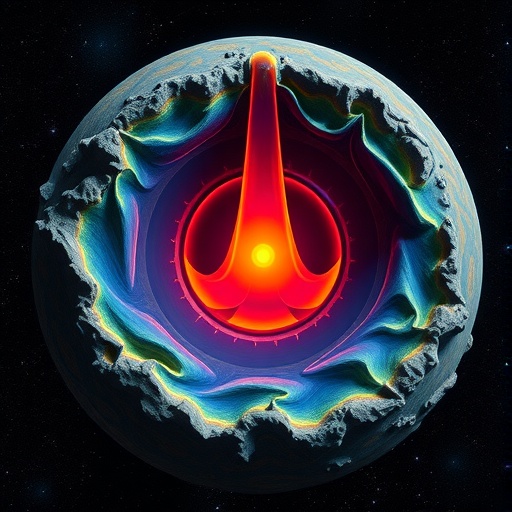
The Ontong Java Plateau, submerged within the western Pacific Ocean, claims the distinction of being the largest oceanic plateau on the planet. Despite its immense scale, the precise geodynamic processes responsible for its formation have remained elusive for decades. Traditional models have struggled to reconcile the plateau’s origin with observational data, prompting new research efforts to explore alternative formation mechanisms grounded in advanced geophysical modeling and geochemical analysis.
Oceanic plateaus, fundamentally, are vast regions of elevated seafloor characterized by volcanic crust that is significantly thicker than typical oceanic lithosphere. These features represent massive accumulations of igneous material, often attributed to anomalously high rates of magma generation and extrusion. Their submarine setting largely shields them from erosional processes that modify terrestrial volcanic plateaus, preserving a more pristine geologic record suitable for in-depth study.
Historically, two primary hypotheses have vied for acceptance in explaining oceanic plateau genesis: the mantle plume hypothesis and the rapid seafloor spreading hypothesis. The mantle plume hypothesis posits that buoyant, thermally anomalous plumes ascend from the deep mantle, impinging upon the base of oceanic plates. This ascent facilitates decompression melting, producing prodigious volumes of basaltic magma that coalesce into extensive volcanic plateaus over tens of millions of years.
Conversely, the rapid seafloor spreading hypothesis suggests that localized increases in spreading rates at mid-ocean ridges trigger enhanced decompression melting, responsible for the voluminous magma output that builds thickened oceanic crust. This mechanism inherently links plateau formation to ridge-centered tectonic activity, suggesting spatial and temporal correlations between plateaus and mid-ocean ridge systems.
However, the Ontong Java Plateau challenges these classical models. Widely accepted interpretations have favored a mantle plume origin, given the plateau’s extraordinary crustal thickness and voluminous basaltic coverage. Yet, the paradox arises because a purely thermal mantle plume would theoretically induce significant uplift above sea level due to thermal buoyancy, which contradicts the plateau’s predominantly submarine emplacement profile.
On the other hand, the seafloor spreading model fails to convincingly explain the plateau’s formation timeline. Radiometric dating of drilled basaltic sequences reveals ages that do not align with the magnetic anomaly patterns characteristically associated with seafloor spreading episodes. This decoupling implies the Ontong Java Plateau originated in an intraplate context, rather than within proximity to active spreading centers.
Addressing these contradictions, a novel study conducted by researchers at the South China Sea Institute of Oceanology, Chinese Academy of Sciences, introduces a refined explanatory framework. Published in Nature Geoscience on June 11, 2026, the investigation applies advanced thermodynamic modeling to interrogate mantle conditions during the plateau’s Early Cretaceous formation. This work evaluates both classical hypotheses under stringent thermochemical constraints.
Their approach incorporates coupled thermal and chemical dynamics of the mantle, accounting for heterogeneities such as compositional variations and fusible pyroxenite content—dense mantle lithologies capable of influencing melt generation and buoyancy. Through computational simulations, the team quantified the feasibility of thermal anomalies and compositional contributions necessary to generate the observed crustal structure and lava chemistry of the Ontong Java Plateau.
Results indicate that the seafloor spreading scenario demands unrealistic mantle potential temperatures or implausibly high fractions of fusible pyroxenite to replicate the plateau’s geology. In stark contrast, a thermochemical plume model, characterized by mantle temperature anomalies ranging from 135°C to 200°C alongside up to 13% dense fusible pyroxenite, convincingly reproduces spatial variations in both crustal thickness and basalt geochemistry.
Crucially, the thermochemical plume hypothesis also reconciles the plateau’s predominantly submarine topographic profile. The inclusion of compositional anomalies in the plume mitigates excessive thermal uplift, aligning with the bathymetric data indicating submergence rather than emergent volcanic landforms during plateau formation. This suggests a more complex mantle source region than previously considered, integrating both thermal and chemical heterogeneities.
Further synthesis led to a spatial evolution model describing the head of a thermochemical mantle plume as it interacts with the overlying lithosphere. Variations in crustal thickness and lava compositions across the plateau are interpreted as resultant from heterogeneous melting processes in a chemically enriched plume head, offering a coherent framework for oceanic plateau genesis.
The implications of this research extend beyond the Ontong Java Plateau. Given that numerous oceanic plateaus worldwide exhibit evidence of heterogeneous mantle sources, thermochemical plume dynamics may broadly govern the formation of large igneous provinces in oceanic settings. This paradigm shift challenges the long-held dominance of purely thermal plume models and suggests reevaluations of mantle convection and melt generation processes in oceanic intraplate volcanism.
Professor Zhang Jinchang, the study’s lead author, emphasizes this transformative perspective: “Our results introduce a fundamentally different mechanism from the traditional thermal plume model. Recognizing the role of compositional buoyancy and chemical heterogeneity in mantle plumes broadens our understanding of the mantle’s complexity and its surface expressions.”
As geodynamic modeling grows increasingly sophisticated, integrating thermochemical variables with geophysical observations promises to illuminate enigmatic volcanic features like the Ontong Java Plateau. This study thus marks a significant stride toward resolving longstanding debates and advancing comprehensive models of Earth’s interior dynamics and crustal evolution.
Cite Scienmag News
Violet Maxwell. (June 15, 2026). Thermochemical Mantle Plume Pinpointed as Source of Earth’s Largest Oceanic Plateau. Scienmag. https://scienmag.com/thermochemical-mantle-plume-pinpointed-as-source-of-earths-largest-oceanic-plateau/
Violet Maxwell. "Thermochemical Mantle Plume Pinpointed as Source of Earth’s Largest Oceanic Plateau." Scienmag, 15 June 2026, https://scienmag.com/thermochemical-mantle-plume-pinpointed-as-source-of-earths-largest-oceanic-plateau/. Accessed 4 September 2026.
Violet Maxwell. "Thermochemical Mantle Plume Pinpointed as Source of Earth’s Largest Oceanic Plateau." Scienmag. June 15, 2026. https://scienmag.com/thermochemical-mantle-plume-pinpointed-as-source-of-earths-largest-oceanic-plateau/


