


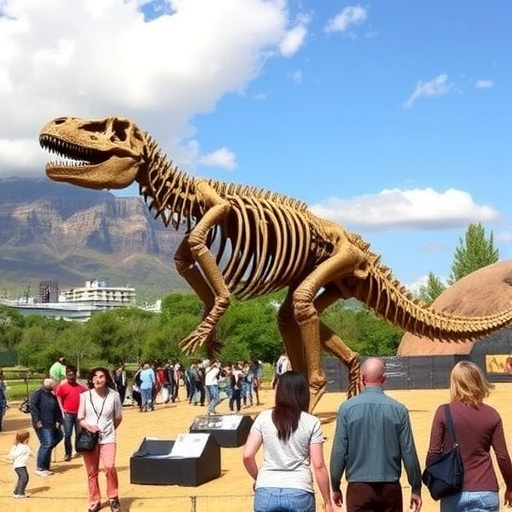
Cape Town to Host First International Palaeontological Congress in Africa
From 30 November to 3 December 2026, Cape Town will become the global centre of palaeontology as the University of Cape Town hosts the 7th International Palaeontological Congress. The meeting will bring together leading researchers, early-career scientists, educators, students, artists and museum professionals from across the world for four days devoted to the history of life on Earth. Organised under the auspices of the International Palaeontological Association, IPC7 will be the first International Palaeontological Congress held on the African continent and only the second to take place in the Global South. Its location is scientifically significant: South Africa contains one of the world’s most complete and important fossil records, preserving evidence of life from the earliest stages of Earth’s history to the evolution of relatively recent hominins.
The congress will provide a rare opportunity to connect discoveries from vastly different geological intervals within one scientific forum. Researchers will discuss evidence from the Archean, when some of the earliest signs of life formed, through the Precambrian, the Devonian, the Mesozoic Era and the Cenozoic, extending into the Holocene. This long perspective allows palaeontologists to investigate not only individual fossils but also the mechanisms that shaped biodiversity, extinction and ecological change over billions of years. Fossils function as more than preserved bones or shells: they are geological records of anatomy, behaviour, disease, reproduction, movement and interactions between organisms and their environments. By combining fossil evidence with sedimentology, geochemistry, developmental biology and computational analysis, modern palaeontology is increasingly reconstructing entire ancient ecosystems rather than describing isolated specimens.
IPC7 will feature 25 topic-specific symposia covering the full breadth of palaeontological research. Among the major themes are palaeoneurology, molecular palaeobiology, advanced imaging, vertebrate flight, dinosaur reproduction, fossil diseases and the study of ancient environments. Palaeoneurology uses the internal spaces of fossil skulls, often reconstructed through high-resolution computed tomography, to infer the size and organisation of brains and sensory systems. Molecular palaeobiology, meanwhile, examines chemical traces preserved in fossils and rocks to investigate biological processes that may have persisted long after DNA and soft tissues disappeared. Advanced imaging techniques can reveal microscopic structures hidden inside mineralised bones, eggs and sedimentary blocks without damaging the specimens, allowing scientists to examine growth patterns, blood-vessel networks and developmental anatomy in unprecedented detail.
One of the congress’s central strengths will be its emphasis on evolutionary processes rather than fossil collection alone. Sessions will examine how organisms originated, adapted and diversified under changing environmental conditions, and how major transitions altered the structure of life. Discussions of dinosaur eggs and reproduction, for example, can illuminate nesting behaviour, parental investment, growth rates and the biological factors that influenced dinosaur diversity. Research on the evolution of flight in vertebrates can reveal how anatomical features originally associated with climbing, gliding or display were transformed into aerodynamic systems. Studies of disease in the fossil record offer another unusual window into the past, showing how infections, injuries and pathological growth affected individual organisms and potentially influenced populations.
The scientific programme will be complemented by workshops designed to make palaeontology more accessible, reproducible and publicly engaging. Participants will be able to learn about R statistical software, a widely used tool for analysing biological and geological datasets, as well as fossil preparation, scientific communication and palaeoart. Statistical methods are increasingly essential in palaeontology because researchers often work with incomplete, unevenly distributed fossil records. Quantitative models can help estimate biodiversity through time, compare evolutionary rates and test whether apparent changes reflect genuine biological events or gaps in preservation and sampling. Public communication is equally important. Fossils attract enormous popular interest, but explaining uncertainty, geological timescales and the limits of interpretation is crucial for ensuring that spectacular discoveries are understood accurately.
The congress will also showcase professional palaeoartists and emerging young artists whose work translates technical research into visual narratives. Reconstruction art is not simply decorative; it is based on anatomical, ecological and geological evidence and often changes as new data become available. A restored dinosaur, synapsid or early mammal must be positioned within a scientifically plausible environment, with posture, musculature, skin or integument and behaviour inferred from comparative anatomy and trace fossils. Exhibiting this work alongside scientific research highlights the close relationship between evidence and imagination in palaeontology. It also creates a bridge between specialists and the wider public, allowing complex evolutionary ideas to be communicated through images as well as academic language.
Field excursions will extend the meeting beyond the university campus to some of South Africa’s most important fossil localities and museums. Planned destinations include the West Coast Fossil Park, the Karoo Basin, the Cederberg and sites around Makhanda. The Karoo Basin is particularly important for understanding the evolution of terrestrial vertebrates during the Permian and Triassic, including the rise of synapsids, the group that ultimately includes mammals. South Africa’s fossil heritage reaches back approximately 3.8 billion years, preserving evidence relevant to the early history of life, major changes in biodiversity and the development of complex ecosystems. It also includes hominin relatives dating back roughly four million years, making the country a key setting for research into human evolutionary history.
A major focus of IPC7 will be the exchange of results from scientists working at the frontiers of the discipline. Plenary speaker Paul M. Barrett of the Natural History Museum in London is known for research on dinosaur evolution and morphology and has contributed to more than 250 scientific publications and books. Johns Hopkins University researcher Jasmina Wiemann studies molecular signals preserved across Earth history, including biosignatures that may record biological processes associated with the origins of life. Gabriella Mángano of the University of Saskatchewan specialises in ichnology, the study of trace fossils such as burrows, footprints and feeding structures, which can reveal behaviour and environmental interactions even when body fossils are absent. Ornella Bertrand of the Institut Català de Paleontologia Miquel Crusafont investigates sensory evolution in mammals through an approach combining palaeontology, neurobiology and evolutionary developmental science.
The remaining plenary speakers bring expertise in dinosaur growth, vertebrate evolution and the origins of mammal-like animals. Kristi Curry Rogers, DeWitt Wallace Professor of Biology and Geology at Macalester College and president of the Society of Vertebrate Palaeontology, is widely recognised for research on sauropod dinosaurs and vertebrate growth patterns. Christian Kammerer, Research Curator of Palaeontology at the North Carolina Museum of Natural Sciences, studies Permo-Triassic synapsids and the evolutionary history of mammal-like animals. His recent work has contributed to new interpretations of the gorgonopsian Aelurognathus tigriceps from South Africa’s Daptocephalus Assemblage Zone. Together, the plenary programme reflects how palaeontology now integrates anatomy, behaviour, molecular chemistry, neuroscience, ecology and evolutionary theory to explain how ancient life responded to a changing planet.
The organisers have awarded 29 travel grants to support emerging researchers and professionals who might otherwise be unable to attend. This investment is especially important for a congress taking place in Africa, where participation can strengthen regional networks and give scientists working on African fossil records greater visibility within the international community. Early-bird registration closes on 31 August 2026, while exhibition space is being allocated on a first-come, first-served basis. Previous International Palaeontological Congresses were held in Australia, Beijing, the United Kingdom, Argentina, France and Thailand. By bringing the seventh congress to Cape Town, IPC7 will place Africa’s fossil record at the centre of global scientific discussion and demonstrate how discoveries from deep time continue to influence modern debates about evolution, biodiversity and the future of life.
Web References:
https://www.ipc7.site/
https://www.ipc7.site/programme.html
https://www.ipc7.site/committee.html
https://www.ipc7.site/sponsorship.html
https://www.uct.ac.za
https://science.uct.ac.za/department-biological-sciences/staff-academic-staff/professor-anusuya-chinsamy-turan
References:
https://www.tandfonline.com/doi/full/10.1080/14772019.2026.2678610
https://www.nature.com/articles/s44358-025-00095-0
https://www.biorxiv.org/content/10.64898/2026.05.27.727204v1.abstract
Cite Scienmag News
Violet Maxwell. (August 18, 2026). Cape Town Hosts Global Palaeontological Elite at Africa’s First International Congress. Scienmag. https://scienmag.com/cape-town-hosts-global-palaeontological-elite-at-africas-first-international-congress/
Violet Maxwell. "Cape Town Hosts Global Palaeontological Elite at Africa’s First International Congress." Scienmag, 18 August 2026, https://scienmag.com/cape-town-hosts-global-palaeontological-elite-at-africas-first-international-congress/. Accessed 4 September 2026.
Violet Maxwell. "Cape Town Hosts Global Palaeontological Elite at Africa’s First International Congress." Scienmag. August 18, 2026. https://scienmag.com/cape-town-hosts-global-palaeontological-elite-at-africas-first-international-congress/


