


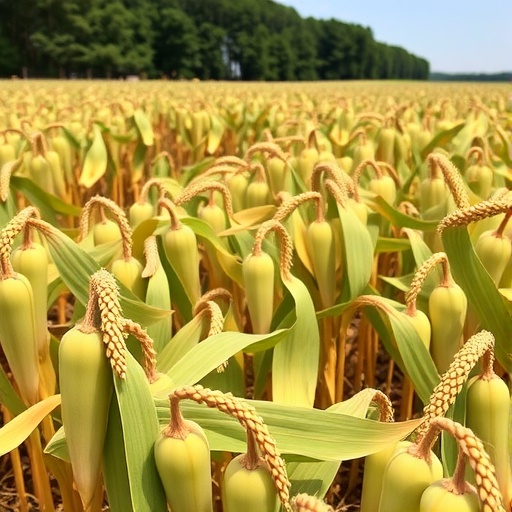
In a groundbreaking study recently published in Food Research International, researchers from the University of São Paulo have unraveled the multifaceted impacts of climate change on soybean production, blending innovative experimental techniques with cutting-edge artificial intelligence modeling. Their work, which uniquely integrates the intertwined effects of elevated carbon dioxide (CO₂), high temperatures, and drought stress, reveals startling insights into how these factors synergistically alter soybean yield and nutritional quality under future climate scenarios.
Soybean, a critical global crop serving as a fundamental protein and energy source for both human consumption and animal feed, faces unprecedented challenges due to climatic shifts. While elevated atmospheric CO₂ is known to accelerate plant growth via photosynthetic stimulation—a phenomenon often described as the “CO₂ fertilization effect”—the concurrent presence of high temperature and drought stresses complicates this dynamic. Researchers at the Laboratory of Ecological Plant Physiology (LAFIECO) at USP’s Institute of Biosciences have approached this complexity head-on, generating experimentally verified data and harnessing artificial intelligence (AI) to dissect the “triple effect” on soybeans.
Their investigation demonstrated that while elevated CO₂ alone can boost soybean seed production by as much as 142%, the introduction of high temperature and drought individually suppress yields by 91% and 60%, respectively. However, when these stressors converge—the real-world scenario anticipated under ongoing climate change—the response is far from a simple arithmetic sum. The AI-driven predictive models, built upon dual stress experimental datasets, forecast that soybean plants may paradoxically increase biomass and produce 50% more beans, but these gains come at a cost, notably a significant decline in the crops’ nutritional value.
A deep dive into seed composition reveals a complex metabolic shift. Under combined stress, starch content in soybean seeds diminishes by approximately 20%, while protein content decreases by 6%. Intriguingly, amino acid concentrations soar by an extraordinary 175%, a phenomenon that has left researchers puzzled regarding its implications for animal nutrition. These alterations suggest a metabolic rerouting where carbon assimilation favors cell wall construction—cellulose and hemicellulose—over energy-storing starch molecules, resulting in higher fiber content but reduced caloric density.
The experimental setup underpinning these revelations is itself a technical marvel. Using specialized open-top chambers that maintain precise atmospheric conditions—doubling ambient CO₂ to around 800 parts per million and elevating temperature by 5°C—the researchers meticulously simulated each stress factor both singly and in combination. Drought was replicated through controlled water deprivation. Such a controlled environment enabled them to monitor plant physiological responses with unprecedented granularity over 60 days, linking biomass accumulation directly to predicted seed yield at 125 days.
One of the pivotal findings challenges previous assumptions about stress interactions. Contrary to expectations that the combined stresses would neutralize each other or drastically impair growth, the triple stress combination actually enhanced biomass accumulation beyond individual stress effects. This suggests complex, nonlinear metabolic adaptations. Leaf stomatal behavior plays a crucial role; elevated CO₂ induces partial closure, reducing transpiration and protecting plants against water loss—mitigating drought’s impact. Similarly, high CO₂ can buffer temperature stress by modulating leaf starch accumulation and carbon metabolism, yet the combined metabolic pathway deviations under multiple stresses remain intricate.
The study’s utilization of AI, including machine learning algorithms such as XGBoost and CatBoost, exemplifies the growing synergy between biological experimentation and computational prowess. These models accurately predicted dual-stress outcomes and projected triple stress impacts, showcasing AI’s potential to forecast complex biological responses faster and more precisely than traditional methods. The capability to predict the agricultural consequences of multiple, simultaneous climatic stresses is poised to revolutionize crop management strategies and breeding programs under climate change.
Looking forward, the research team aims to delve into the genetic and molecular underpinnings driving these metabolic shifts. By identifying key genes linked to stress resilience and altered metabolic pathways, scientists envision bioengineering soybeans capable of maintaining high protein content while mitigating starch loss, enhancing adaptation to future environments. Parallel studies on other crops such as sugarcane are underway, leveraging the integrative approach of experimental validation and AI-assisted modeling to elucidate universal plant responses to climate stress.
This pioneering work, funded through support from the São Paulo Research Foundation (FAPESP) and involving multidisciplinary expertise from plant physiology to bioinformatics and statistics, underscores the importance of comprehensive, mechanistic understanding in preparing global agriculture for climate challenges. It warns of the tradeoffs inherent in seemingly optimistic yield gains, highlighting nutritional quality as a critical dimension often overshadowed by production volume metrics.
Beyond advancing scientific knowledge, these findings bear profound implications for food security and animal husbandry worldwide. As soybeans constitute a staple ingredient in feed formulations, dramatic shifts in protein and amino acid profiles could cascade through the food web, influencing livestock health and productivity. The unexpected rise in amino acids, despite overall protein decline, opens new avenues for research into metabolic biochemistry and nutritional outcomes.
The application of open-top chambers, precise environmental manipulation, and AI modeling marks a methodological tour de force. Open-top chambers are engineered tubes allowing for controlled atmospheric gas composition and temperature conditions, essential for simulating future climate environments realistically. The successful integration of these experimental settings with machine learning represents a significant leap in experimental plant science, offering scalable models capable of informing regional and global crop adaptation policies.
In summary, this landmark study illuminates the nuanced and often counterintuitive effects of climate change on soybean productivity and nutritional quality. Its interdisciplinary approach combining physiological experimentation, mathematical modeling, and artificial intelligence forecasts a future where strategic, data-driven interventions can safeguard crop utility amid environmental uncertainty. As global initiatives to combat climate change accelerate, these insights furnish vital tools to ensure that increases in crop quantity do not come at the irreparable expense of quality, securing a resilient food system for years to come.
News Publication Date: 18-Mar-2026
Web References: https://doi.org/10.1016/j.foodres.2026.119004
References: Food Research International, DOI: 10.1016/j.foodres.2026.119004
Cite Scienmag News
Sloane Callahan. (June 15, 2026). Climate Change Increases Soybean Yields but Compromises Bean Quality. Scienmag. https://scienmag.com/climate-change-increases-soybean-yields-but-compromises-bean-quality/
Sloane Callahan. "Climate Change Increases Soybean Yields but Compromises Bean Quality." Scienmag, 15 June 2026, https://scienmag.com/climate-change-increases-soybean-yields-but-compromises-bean-quality/. Accessed 4 September 2026.
Sloane Callahan. "Climate Change Increases Soybean Yields but Compromises Bean Quality." Scienmag. June 15, 2026. https://scienmag.com/climate-change-increases-soybean-yields-but-compromises-bean-quality/


