


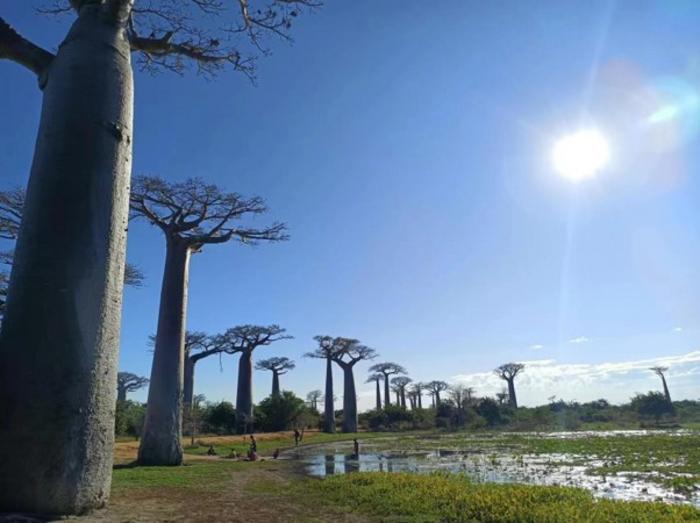
The iconic baobabs, also known as upside-down trees, or the tree of life, have much cultural significance, inspiring innumerable arts, folklore, and traditions. A research published in Nature, involving international collaboration between Wuhan Botanical Garden (China), Royal Botanic Gardens (Kew, UK), University of Antananarivo (Madagascar) and Queen Mary University of London (UK) reveal a remarkable example of species radiation in Madagascar followed by long distance dispersal to Africa and Australia. With speciation, an astonishing divergence of pollination mechanisms evolved, that exploit hawkmoths, bats and lemurs for a simple nectar reward.

Credit: Alex Antonelli (Royal Botanic Gardens, Kew)
The iconic baobabs, also known as upside-down trees, or the tree of life, have much cultural significance, inspiring innumerable arts, folklore, and traditions. A research published in Nature, involving international collaboration between Wuhan Botanical Garden (China), Royal Botanic Gardens (Kew, UK), University of Antananarivo (Madagascar) and Queen Mary University of London (UK) reveal a remarkable example of species radiation in Madagascar followed by long distance dispersal to Africa and Australia. With speciation, an astonishing divergence of pollination mechanisms evolved, that exploit hawkmoths, bats and lemurs for a simple nectar reward.
The charismatic baobabs have astonishing growth forms, reaching huge sizes with massive trunks, but apparently diminutive crowns, giving them their iconic appearance as upside-down trees. The team first assembled the genomes of the eight recognised species and worked out their patterns of speciation. They then analysed the genomes themselves and discovered that the ancestor of all eight species most likely radiated in Madagascar, where they made hybrids, before two species underwent astonishing long-distance travels, one to Africa and another to Australia. In that radiation the species evolved different flower structures to attract hawkmoths, lemurs and bats.
Quote: Professor Andrew Leitch at Queen Mary University of London said, “We were delighted to be involved in this project uncovering patterns of baobab speciation in Madagascar followed by the astonishing long-distance dispersal of two species, one to Africa and another to Australia. This was accompanied by the evolution of some fascinating pollination syndromes involving hawkmoths, lemurs and bats.”
Quote: Dr. Ilia Leitch at Royal Botanic Garden Kew said, “This work has uncovered new insights into the patterns of speciation in baobabs and shows how climate change has influenced baobab distribution and speciation patterns over millions of years.”
Quote: Husband and wife team Andrew and Ilia Leitch at Queen Mary University of London and Royal Botanic Gardens Kew said. ‘We were delighted to be involved in this project uncovering patterns of baobab speciation in Madagascar before the astonishing long-distance dispersal of two species, one to Africa and another to Australia. The work also provides new insights into how climate change has influenced baobab distribution and speciation patterns over millions of years’.
Journal
Nature
Article Title
The rise of baobab trees in Madagascar
Article Publication Date
15-May-2024
Cite Scienmag News
Sloane Callahan. (May 15, 2024). The origin and long-distance travels of upside down trees. Scienmag. https://scienmag.com/the-origin-and-long-distance-travels-of-upside-down-trees/
Sloane Callahan. "The origin and long-distance travels of upside down trees." Scienmag, 15 May 2024, https://scienmag.com/the-origin-and-long-distance-travels-of-upside-down-trees/. Accessed 3 September 2026.
Sloane Callahan. "The origin and long-distance travels of upside down trees." Scienmag. May 15, 2024. https://scienmag.com/the-origin-and-long-distance-travels-of-upside-down-trees/

