


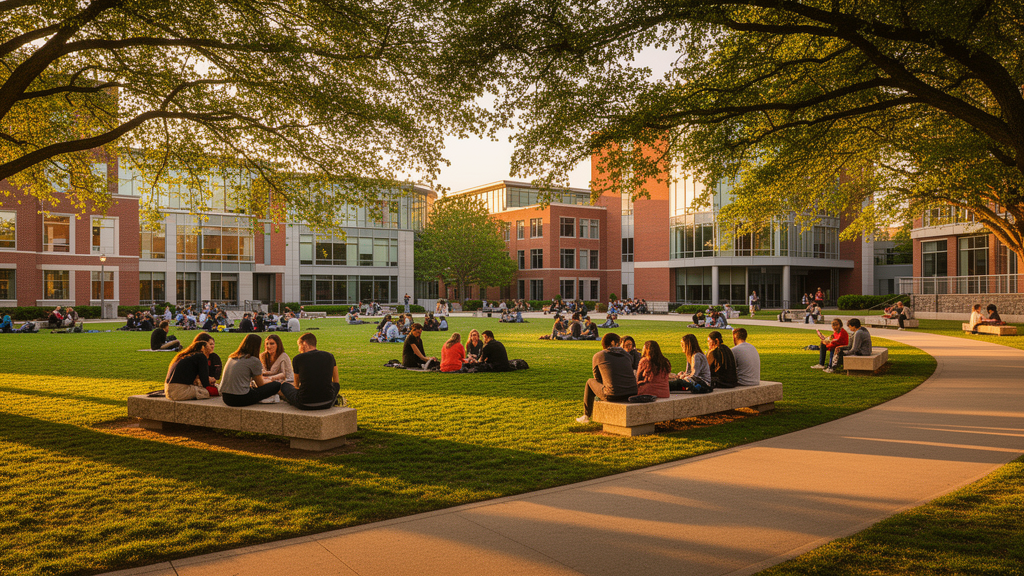
What if the most important feature of a university campus is not its tallest tower or its grandest facade, but a patch of grass at its geographic center? A new study published in Frontiers in Sustainable Cities argues that the open green squares at the heart of three universities on three continents function as the structural engines of student belonging, town–gown integration, and climate resilience. The research, an 18-year analytic autoethnography spanning Iowa State University, Makerere University in Uganda, and the University of California, Merced, suggests that when planners maximize built footprints and pave over central softscapes, they intensify urban heat island effects and fuel student alienation in equal measure.
The study’s author, Samuel Ikendi of the University of California’s Division of Agriculture and Natural Resources and the Merced Earth Institute, positions universities as proxies for evaluating what he calls Green Squares: central open softscape nodes that bring together ecological, social, symbolic, and institutional functions. Synthesizing architectural phenomenology, environmental psychology, and chrono-urbanism, the research uses the 15-Minute Campus framework as an interpretive temporal lens. Rather than treating proximity as a cold geometric distance, the framework shifts the analytical gaze to the fluid rhythms of daily life, recognizing that proximity is fundamentally an embodied experience structured by pedestrian routines, shifting user patterns, and institutional paces unfolding across the same landscape over time.
Methodologically, the inquiry is unusual. It spans an 18-year biographical continuum from 2008 to 2026 across three distinct campus design eras: the 19th-century agrarian park layout of Iowa State University in Ames, the 20th-century post-colonial urban hilltop of Makerere University in Kampala, and the 21st-century master-planned grid of UC Merced in California’s Central Valley. The researcher served as the primary analytical instrument, logging physical features into a four-tier qualitative matrix that separated observational notes on infrastructure and text, methodological notes, theoretical notes mapping elements to the spirit of place, and reflexive observer’s comments. Two-cycle thematic coding processed 184 individual raw text statements and landscape features captured across 64 pedestrian walkthrough traverses, with negative case analysis deliberately cataloging spatial friction, sensory shock, and design failures to prevent celebratory bias.
The empirical analysis reveals how built layouts function across five themes. First, historical anchors bind institutional identity. At Iowa State, the straight Curtiss–Beardshear axis connects the agricultural college to central administration along a non-motorable corridor, anchored by a central flagpole with a Class of 1876 bronze plaque and the historic Cooperative Extension plaque marking the 1906 birthplace of county agricultural extension work. At Makerere, the white-and-blue Main Administration Building, traditionally called the Ivory Tower, was meticulously reconstructed after a devastating 2020 fire gutted the historic structure, restoring its 1941 architectural form. At Merced, a founding chancellor plaque at the edge of the Carol Tomlinson-Keasey Quadrangle anchors institutional legitimacy directly into a landscape that was open pasture land only decades ago.
Second, processional rituals translate structural forms into what the study terms kinetic devotion. The 110-foot brick Campanile at Iowa State, housing a 50-bell carillon whose bells were added incrementally from 1899 to 1967, organizes graduation choreography around a bronze-and-walnut academic mace sculpted to mirror the tower’s geometry. Campus lore holds that a student officially becomes an Iowa Stater when kissed under the Campanile as the carillon tolls midnight, a tradition called campaniling that transforms the daytime thoroughfare into an intimate peer-bonding site. At Merced, the 40-foot stainless steel Beginnings arches bookend a student’s experience: incoming students march southwest across Scholars Bridge through the arches during Orientation’s Journey Inward, and seniors execute a retrograde processional through the same arches at Commencement’s Journey Outward.
Third, environmental markers operate as living policy texts. A single ‘Triumph’ Elm near Curtiss Hall at Iowa State carries a timeline plaque recognizing partnerships between the university and seven tribal colleges across Nebraska, South Dakota, and North Dakota, materializing structural equity through botanical form. At Makerere, the asymmetrical Makerere@100 monument features a ten-sided concrete foundation base, each side inscribed with a plaque documenting one decade of history from the 1922 technical college through the persecution-era 1970s to the modern collegiate transition, while an active meteorological station near Freedom Square materializes the central square as a living laboratory. At Merced, Toloma Grove, dedicated in 2010 with seven California valley oak saplings and indigenous flora, carries a plaque acknowledging the Miwuk and Yokuts peoples, establishing an indigenous land acknowledgment from the young campus’s inception.
Fourth, human-scale philanthropic rest stops humanize these squares. At Iowa State, concrete benches donated by the Class of 1916 and granite benches installed by the Class of 1910 beneath pine groves display past student custody on the lawn. At Makerere, the recovery of the fire-gutted administration building was heavily supported by localized alumni donor networks through a ‘Buy-a-Brick’ initiative with engraved recognition plaques, making intergenerational stewardship legible on the grass. At Merced, the massive Sierra granite Peterson Stone, inscribed for a regional philanthropic family who funded foundational initiatives when the campus lacked a donor network, serves as a sun-warmed informal bench that democratizes the modern plaza. Fifth, spatial containment dynamics emotionally heighten each square: at Makerere, student strikes mobilized on Freedom Square with the chant ‘Eh, Makerere Oyee!’ echoing off the Main Library and administration facades, forcing executives to walk down onto the grass to negotiate, while at Merced the Kolligian Library and the Science and Engineering arcade frame the quadrangle with floodlit safety perimeters.
The study is careful about its qualitative boundaries. It deployed no microclimatic instrumentation, no surface temperature sensors, no canopy closure measurements, and no student surveys, so all assertions about climate resilience and student psychology are positioned as literature-informed interpretations rather than measured outcomes. The research explicitly notes that the three landscape types possess different baseline conditions, such as canopy density and surface albedo, that alter their real-world biophysical performances. The mature interlocking canopy at Iowa State and Makerere blocks direct solar radiation, whereas Merced’s wide concrete panels create intense summer exposure due to elevated albedo and a lack of mature tree cover, generating localized thermal stress that only native microclimatic sanctuaries like Toloma Grove can relieve. The Fairfield Canal, with its waterfowl and open water, introduces biophilic vitality that softens hardscape glare during extreme midday heat.
The implications scale outward. The study argues that place-identity forged within micro-level nodes potentially extrapolates through campustown interface zones to intersect with municipal civic cores, exemplified by the 2024 municipal annexation that legally integrated Merced’s 1,140-acre campus grid into the city limits. The findings suggest open softscape midpoints function as adaptive chronotopes, localized timespaces where institutional history, cyclic rituals, and spontaneous daily cadences entangle and synchronize, supporting context-sensitive cooling, public inclusion, and temporal planning under the New Urban Agenda and Sustainable Development Goal 11. City planners are urged to establish strict softscape mandates protecting central lawns from densification.
Perhaps the most provocative recommendation concerns orientation rhetoric. The study critiques the top-heavy blindness of traditional welcome speeches, which almost exclusively direct attention upward toward monumental landmarks like the Campanile, the Makerere administration tower, or the soaring Beginnings arches. An over-emphasis on intimidating monolithic architecture is interpreted as potentially reinforcing displacement, imposter syndrome, and alienation among first-generation and low-income scholars. The author proposes Place-Based Contextual Orientation: administrators should rewrite orientation scripts to de-center architectural elitism and elevate human-scale micro-monuments flanking the same squares, from the tribal-college Triumph Elm at Iowa State to the Peterson Stone at Merced and the alumni-funded brick repairs at Makerere, so that a student’s daily fast-paced pathways are physically supported by the collective timeline of regional families, bridging historical town–gown divisions and helping diverse cohorts feel a deep, unshakeable sense of place.
Subject of Research: Urban Planning & Sustainable Cities
Article Title: Reading the midcampus core matters: autoethnographic reflexivity of ‘Green Squares’ as temporally integrated 15-Minute Campus nodes for student belonging, town–gown integration, and climate resilience
Article References: Ikendi, S. (2026). Reading the midcampus core matters: autoethnographic reflexivity of ‘Green Squares’ as temporally integrated 15-Minute Campus nodes for student belonging, town–gown integration, and climate resilience. Frontiers in Sustainable Cities, 8, Article 1962466. https://doi.org/10.3389/frsc.2026.1962466
Image Credits: AI Generated
DOI: 10.3389/frsc.2026.1962466
Keywords: 15-Minute Campus, chrono-urbanism, campus green space, student belonging, town-gown integration, urban heat island, climate resilience, autoethnography, place-identity, sustainable cities, Reading, midcampus
Cite Scienmag News
Sloane Callahan. (October 16, 2026). The Green Square at the Heart of Campus May Be the Secret to Student Belonging and Cooler Cities. Scienmag. https://scienmag.com/the-green-square-at-the-heart-of-campus-may-be-the-secret-to-student-belonging-and-cooler-cities/
Sloane Callahan. "The Green Square at the Heart of Campus May Be the Secret to Student Belonging and Cooler Cities." Scienmag, 16 October 2026, https://scienmag.com/the-green-square-at-the-heart-of-campus-may-be-the-secret-to-student-belonging-and-cooler-cities/. Accessed 16 October 2026.
Sloane Callahan. "The Green Square at the Heart of Campus May Be the Secret to Student Belonging and Cooler Cities." Scienmag. October 16, 2026. https://scienmag.com/the-green-square-at-the-heart-of-campus-may-be-the-secret-to-student-belonging-and-cooler-cities/


