


Feed is the single largest expense on a dairy farm, accounting for more than half of total production costs, yet one of the most important numbers in the entire enterprise — how much dry matter an individual cow actually eats each day — has long been effectively unmeasurable outside research facilities. A new study published in Frontiers in Animal Science reports the validation of a collar-based system that predicts individual dry matter intake (DMI) directly from behavioral data, milk production records, and basic cow descriptors, achieving an accuracy that matches or exceeds previous data-driven approaches while requiring no specialized intake-measurement infrastructure. The work, carried out by researchers at Afimilk Ltd. in Israel, also presents evidence that the predicted intake and the feed efficiency derived from it show familial variation in commercial herds, a finding with potentially far-reaching implications for breeding programs worldwide.
The central bottleneck the study addresses is well known in the dairy industry. Direct measurement of individual feed intake requires either tie-stall housing where each cow’s ration is weighed by hand, or automated electronic feeding systems that register every visit an animal makes to a feed bin. Both approaches are costly and labor-intensive, which is why they are confined to experimental facilities. On commercial farms, intake has typically been estimated with standardized prediction equations that rely on inputs such as body weight and milk composition. These equations have a well-documented weakness: they often lose accuracy at the extremes of production, particularly overestimating intake in high-producing cows, and they ignore the rich stream of behavioral data that modern wearable sensors now collect continuously.
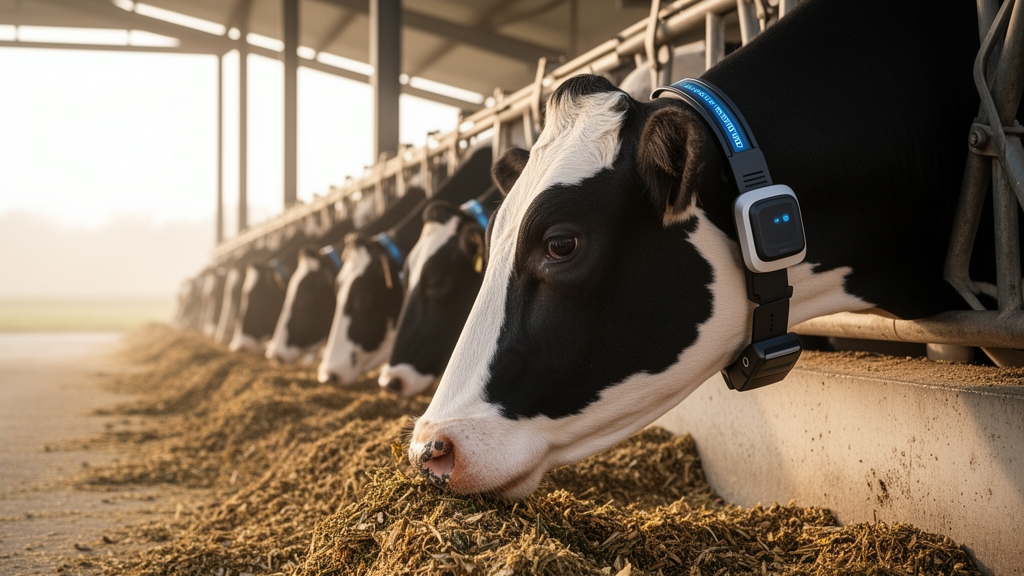
The sensor at the heart of the new pipeline is a commercial neck collar containing a three-dimensional accelerometer that monitors head movements and activity around the clock. From these signals, the system classifies and quantifies the time each cow spends eating, ruminating, and panting. A machine learning model combines these behavioral outputs with cow-status features — parity, days in milk, and pregnancy status — and with milk production data to estimate daily intake. The prediction methodology is protected under granted patents in Europe and the United States and is already embedded in the company’s commercial software, making this one of the first instances of a sensor-based intake prediction tool validated across multiple independent farms.
To train and test the model, the researchers assembled an unusually broad dataset: 16,888 weekly observations from 320 lactating cows across five international research farms — Michigan State University, Università Cattolica del Sacro Cuore in Italy, the University of British Columbia, Penn State University, and the Institute of Animal Science in Prague. Reference intake was measured manually in tie-stalls at Michigan State or automatically with electronic feeding systems elsewhere. The raw dataset of 21,550 daily records was rigorously filtered: cows receiving more than 1.5 kilograms of supplemental concentrate beyond a total mixed ration were excluded, days with partial collar data (less than 23 hours of coverage) were discarded, cows eating less than one hour per day were removed as likely artifacts, and only records beyond nine days in milk were retained to avoid the metabolic volatility of early lactation.
The validation design was deliberately stringent. Using leave-farm-out cross-validation, the model was trained on data from four farms and tested on the fifth, held-out farm, and this was repeated so that every farm served once as the independent test set. The result was strong agreement between predicted and measured intake, with a coefficient of determination of 0.77 and a root mean square error of 1.9 kilograms per day. Crucially, the decomposition of prediction error showed that almost all of it — 99.97 percent — was random rather than systematic: mean bias was essentially zero and slope bias contributed only 0.03 percent. The calibration regression of measured on predicted intake produced a slope of 0.992, marginally but not meaningfully different from unity, indicating only a faint tendency toward regression to the mean across the observed intake range.
Performance was also remarkably uniform in relative terms across herds that differed in country, housing, diet, and management. The coefficient of variation of the error ranged from 6.9 to 8.2 percent across farms, with a pooled value of 7.3 percent. Farm-level r² values spanned a wider range, from 0.45 in Prague to 0.78 at Michigan State, but the authors show this largely reflects differences in how much cows within each herd vary from one another rather than differences in prediction error. In Prague, where the herd had the narrowest intake distribution in the study, the model achieved its lowest absolute error yet the lowest r², because there was simply less variation to explain. In the final production model trained on all five farms, the three input categories contributed comparably: collar-derived behavioral features accounted for 36.9 percent of total feature importance, milk production data 34.0 percent, and cow-status features 29.1 percent.
With the pipeline validated, the team turned to the question that gives the study its broader significance: does the collar-predicted intake capture biologically meaningful variation, or is it merely a statistical artifact? To find out, they applied the model to data from 2,096 Holstein cows on five commercial Israeli farms, entirely independent of the research farms used for validation, and examined whether predicted intake and the feed efficiency derived from it resemble each other across generations. Feed efficiency was defined as energy-corrected milk divided by predicted intake, with energy-corrected milk calculated continuously from inline milk analyzers measuring fat, protein, and lactose. The analysis exploited 665 dam–daughter pairs for predicted intake and 617 pairs for feed efficiency.
The results were consistent across multiple lines of evidence. For predicted intake, the dam–daughter association remained significant at every step of a sequential adjustment that progressively accounted for farm, temporal herd effects, and daughter parity — a critical control, since parity exerts an enormous influence on intake, with multiparous cows predicted to consume roughly four kilograms more per day than first-lactation heifers. The fully adjusted analysis yielded an indicative heritability of approximately 0.15, toward the lower end of published estimates for measured intake in dairy cattle. For the derived feed efficiency phenotype, the dam–daughter association was even more robust, surviving all adjustments with an indicative heritability of about 0.21, squarely within the published range for related efficiency traits. Complementing this, a highly significant sire effect emerged across 44 bulls with 853 daughters, and it persisted in a subanalysis restricted to sires with daughters on at least two farms, ruling out the possibility that the pattern was an artifact of farm composition.
The authors are careful to frame these genetic signals as preliminary. Because the analysis rests on phenotypic parent–offspring resemblance rather than pedigree- or genomic-based animal models, it does not constitute formal heritability estimation, and precise genetic parameters would require such methods applied to herds with both sensor deployment and genotyped animals. They also note an important caveat about ratio traits: feed efficiency combines collar-predicted intake with independently measured milk output, so part of its familial signal originates in the milk component rather than in the collar-predicted intake itself, and direct selection on a ratio distributes selection pressure across its component traits in ways that are difficult to predict. Predicted intake, being a linear trait, is not subject to this complication.
Even before any formal genetic evaluation, the technology has immediate practical value. Because predicted intake can be estimated at the individual level from data already collected by modern dairy management systems — collar behavior, milk records, and basic cow descriptors — it enables cow-level decisions such as identifying inefficient animals, informing culling strategy, and calculating income over feed, a direct measure of each animal’s profitability. The cohort-level mean intake needed for the model’s normalization step can be obtained from routine group feed records, so no individual intake infrastructure is required. Looking ahead, the researchers identify clear priorities: validating the approach in grazing systems, which were not represented in the training data; extending it beyond Holsteins to other breeds and crossbreds; incorporating finer-grained inputs such as milk fatty-acid profiles, body weight, and health events; and ultimately linking the predicted phenotype to enteric methane estimation, connecting scalable efficiency phenotyping to the sustainability goals that motivate much of this research. If those steps succeed, the humble collar hanging around a cow’s neck could become the gateway to breeding dairy cattle that produce more milk from less feed — a win for farmers, and for the planet.
Subject of Research: Collar-based prediction of individual dry matter intake and feed efficiency in dairy cows
Article Title: Collar-based prediction of individual dry matter intake in dairy cows: validation across international research farms and evidence of familial variation in commercial herds
Article References: Yair, R., Arazi, A., Shabtai, V., & Katz, G. (2026). Collar-based prediction of individual dry matter intake in dairy cows: validation across international research farms and evidence of familial variation in commercial herds. Frontiers in Animal Science, 7, Article 1897979. https://doi.org/10.3389/fanim.2026.1897979
Image Credits: AI Generated
DOI: 10.3389/fanim.2026.1897979
Keywords: dry matter intake, feed efficiency, dairy cattle, wearable sensors, precision livestock farming, machine learning, heritability, dam-daughter regression, energy-corrected milk, Holstein, enteric methane, breeding
Cite Scienmag News
Alan Morgan. (October 16, 2026). Smart Collars Predict How Much Each Dairy Cow Eats, Opening the Door to Breeding for Feed Efficiency. Scienmag. https://scienmag.com/smart-collars-predict-how-much-each-dairy-cow-eats-opening-the-door-to-breeding-for-feed-efficiency/
Alan Morgan. "Smart Collars Predict How Much Each Dairy Cow Eats, Opening the Door to Breeding for Feed Efficiency." Scienmag, 16 October 2026, https://scienmag.com/smart-collars-predict-how-much-each-dairy-cow-eats-opening-the-door-to-breeding-for-feed-efficiency/. Accessed 16 October 2026.
Alan Morgan. "Smart Collars Predict How Much Each Dairy Cow Eats, Opening the Door to Breeding for Feed Efficiency." Scienmag. October 16, 2026. https://scienmag.com/smart-collars-predict-how-much-each-dairy-cow-eats-opening-the-door-to-breeding-for-feed-efficiency/


