


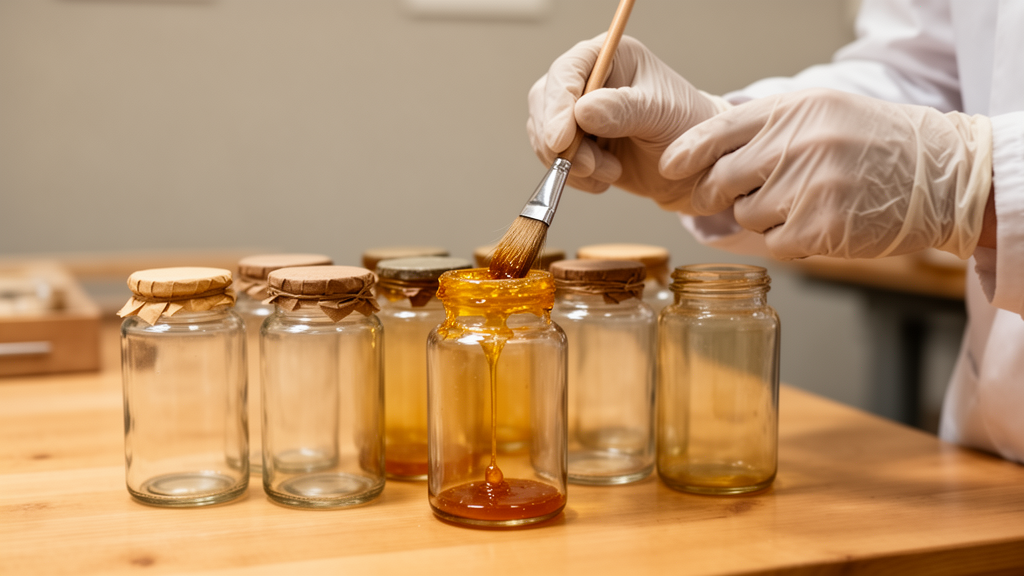
Behind the glass of every natural history museum display lies a quiet engineering problem: how to keep fluid-preserved specimens from slowly evaporating away. At the Croatian Natural History Museum (CNHM), curators preparing roughly 200 fluid-preserved specimens for a new permanent exhibition faced exactly this challenge. Their solution, described in a new study in Natural History Collections and Museomics, involved a hands-on comparison of nine different sealants and a carefully refined protocol for applying the winner: a traditional mixture of beeswax and colophony resin.
Wet collections are the fluid-filled heart of natural history museums, housing millions of specimens preserved in ethanol or formalin. They preserve morphological, anatomical and molecular data that underpin research in biodiversity, taxonomy, pathology and anatomy, and they include irreplaceable type series and specimens of rare or extinct species. Increasingly, they also serve the public, offering visitors a visually compelling window on rare and endangered animals. But the choice of container, lid and seal is crucial: effective sealing prevents evaporation, maintains chemical stability and ensures long-term specimen preservation.
The CNHM team decided to reuse glass jars with ground-glass stoppers from the museum’s inventory, valuing their historical character and visually appealing appearance. Such jars, once standard in wet collections, are increasingly difficult and expensive to obtain, and older stocks often show substantial variability in stopper fit due to manufacturing inconsistencies or mismatched stoppers and jars mixed over time. Detailed guidance on sealing this type of container is limited and scattered across sources, so the researchers compiled a list of candidate sealants from the literature and colleagues’ recommendations and put them to the test.
Nine sealants were grouped into three categories. The first comprised silicone-based materials, including SIM-772, Liqui Moly and three viscosity variants of Korasilon paste. The second included wax-based solid sealants melted before application: yellow beeswax, white beeswax and a commercial beeswax–colophony mixture. The third category covered everything else: Vaseline, a jelly-like blend of paraffin wax and mineral oils; Alsirol, a high-viscosity silicone-free rotating joint grease; and Terostat-IX, a stretchy, self-adhesive artificial rubber sealant. Application methods varied by group, with wax-based sealants requiring stoppers preheated to 110 °C and melted sealant applied with a heat gun.
Evaluation focused on three criteria relevant to long-term exhibition use: aesthetic appearance, handling properties and sealing performance. An initial hands-on assessment examined texture, viscosity, ease of use and whether each sealant spread evenly, adhered to both stopper and jar rim, tended to drip and produced a clean, visually acceptable seal. For the evaporation test, each sealant was applied to triplicate jars filled with 70% ethanol and no specimens, alongside unsealed control jars, all stored in the dark at approximately 20 °C and 40–60% relative humidity. Ethanol levels were checked after two months and again after 1.5 years.
The results revealed clear trade-offs. Silicone-based SIM-772 and Liqui Moly were easy to apply but looked untidy, tended to leak into the preservative and sometimes allowed stoppers to push upwards after sealing. All three Korasilon variants were easy to apply and formed clean, transparent seals that were visually acceptable for exhibition purposes, performing best on jars with a perfect stopper-to-jar fit; where the fit was imperfect, higher-viscosity Korasilon was the better choice. Vaseline was easy to apply but visually unattractive, with stoppers prone to popping up. Alsirol was hard to apply and looked lumpy. Terostat-IX, with its thick rubbery consistency, filled irregularities well and proved effective for jars with poor-fitting stoppers, though its sticky, grey-rubber appearance was unappealing.
Wax-based sealants demanded more time, effort and manual skill. Yellow and white beeswax produced visually acceptable seals but, being less viscous when melted, readily leaked into the preservative, forming wax beads that sank to the bottom. The beeswax–colophony mixture, by contrast, rarely leaked, thanks to its higher viscosity, and filled imperfections in jar and stopper fit well. In the evaporation test, all sealants held ethanol over two months, but after 1.5 years failures emerged: one Vaseline-sealed jar lost roughly 30% of its ethanol, one medium-viscosity Korasilon jar lost 100%, and one Terostat-IX jar showed 10% loss. The researchers attributed these failures primarily to very poor stopper-to-jar fit rather than sealant failure, as the gaps were too wide for the sealing material to bridge.
Based on these results and the mixture’s established use in other wet collections, the team selected the beeswax–colophony mixture for sealing around 200 exhibition jars. The refined protocol builds on the manufacturer’s instructions and earlier published approaches. Stoppers are heated in an oven to approximately 110 °C, checked with an infrared thermometer, then fitted immediately to the jar. Softened strips of the mixture are applied along the stopper–jar edge and melted with a heat gun from above, with the jar continuously rotated during hardening to spot bubbles and cracks. A hair dryer set to cold air can accelerate hardening if the molten mixture begins to drip into the preservative. The preservative level must be kept at least 1 cm below the lower edge of the stopper to prevent capillary action of the fluid between jar and stopper during sealing — a problem that ruins bonding and requires the whole procedure to be repeated.
The workflow enabled sealing up to ten jars per hour when jars, stoppers, specimens and tools were prepared in advance. Several months after restoration, two jars had to be resealed due to ethanol loss; after one year, nearly all of the 200 restored jars remained airtight, with only two showing 10% ethanol loss, both caused by visibly poor stopper-to-jar fit. Notably, such seals failed early, within about a month, rather than gradually over time. The researchers caution that 1.5 years remains a short observation period in museum preservation, where sealing performance is expected over much longer timescales, and the exhibition set of 200 jars will continue to serve as a long-term test under display conditions. An interesting hybrid also emerged: applying Terostat-IX as a thicker underlying layer with the beeswax–colophony mixture over the top achieved excellent airtightness on problematic jars with large gaps.
The study offers practical guidance for curators and collection managers weighing sealant choices, emphasising that the beeswax–colophony mixture’s advantages align primarily with exhibition purposes, where visual appearance and long-term airtightness are prioritised. Its time-consuming application and need for trained staff make it impractical for large research collections requiring frequent access to specimens. For display contexts, however, the mixture delivers visually neat seals with a historical aesthetic that complements the traditional design of ground-glass jars — a low-tech solution that, refined through systematic comparison, keeps museum treasures safely submerged for visitors and scientists alike.
Subject of Research: Comparative evaluation of sealants for ground-glass-stopper jars in wet natural history collections
Article Title: Comparative evaluation of sealants for exhibition glass jars in wet natural history collections: application and protocol refinement
Article References: Lukić, M., Bućan, D., & Grbac, I. (2026). Comparative evaluation of sealants for exhibition glass jars in wet natural history collections: application and protocol refinement. Natural History Collections and Museomics, 3, Article e188287. https://doi.org/10.3897/nhcm.3.188287
Image Credits: AI Generated
Keywords: wet collections, sealants, beeswax, colophony, ground-glass stoppers, museum conservation, ethanol preservation, exhibition jars, Croatian Natural History Museum, collection management, Comparative, evaluation
Cite Scienmag News
Margaret Porter. (October 16, 2026). Beeswax and resin seal the past: museum tests nine sealants to keep exhibition jars airtight. Scienmag. https://scienmag.com/beeswax-and-resin-seal-the-past-museum-tests-nine-sealants-to-keep-exhibition-jars-airtight/
Margaret Porter. "Beeswax and resin seal the past: museum tests nine sealants to keep exhibition jars airtight." Scienmag, 16 October 2026, https://scienmag.com/beeswax-and-resin-seal-the-past-museum-tests-nine-sealants-to-keep-exhibition-jars-airtight/. Accessed 16 October 2026.
Margaret Porter. "Beeswax and resin seal the past: museum tests nine sealants to keep exhibition jars airtight." Scienmag. October 16, 2026. https://scienmag.com/beeswax-and-resin-seal-the-past-museum-tests-nine-sealants-to-keep-exhibition-jars-airtight/


