


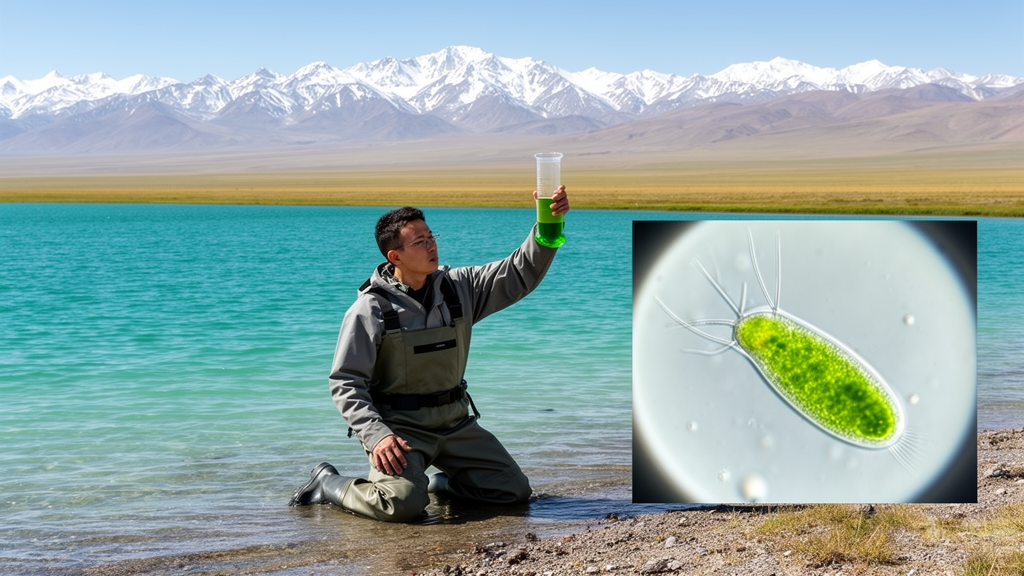
Scientists have discovered a previously unknown species of green alga thriving in the saline waters of Qinghai Lake, a high-altitude lake on the Qinghai-Tibet Plateau in China. The new species, named Pleurastrum gracilis, represents the first recorded member of its genus in China and was described in the journal PhytoKeys. The discovery highlights how much green algal biodiversity remains hidden in extreme environments, even as molecular techniques continue to reveal new evolutionary lineages across the Chlorophyta phylum.
The genus Pleurastrum is not a newcomer to science. It was first established by the botanist Chodat in 1894, more than 130 years ago. Yet despite its long taxonomic history, the genus remains remarkably underexplored. According to the AlgaeBase database, only eight valid species are currently recognized worldwide, and until now, no species of Pleurastrum had ever been documented in China. The genus is also notable for being the sole member of the Pleurastraceae family, a phenomenon known as single genus and single family, which further underscores the research gap surrounding its species diversity and evolutionary mechanisms.
The new species was isolated from two distinct locations. In September 2020, researchers collected algal material from the surface of Qinghai Lake at coordinates 36°39’N, 100°23’E, at an altitude of 3198 meters. In April 2021, the same algal species was obtained again from Ganjing River in Zhongxian County, Chongqing, at a much lower elevation of 269 meters. The isolates, designated FACHB-3462 and FACHB-3463, are now stored in the freshwater algal culture library of the Institute of Hydrobiology, Chinese Academy of Sciences, in Wuhan. The ability of this species to inhabit both high-altitude saline lakes and low-altitude freshwater rivers demonstrates a broad ecological range and tolerance to extreme environments.
Given the well-known limitations of traditional morphological identification in green algal classification, the research team adopted a multi-gene joint analysis strategy to define the species. They selected the nuclear 18S rRNA gene as a conserved molecular marker for higher-order taxa and combined it with the nuclear internal transcribed spacer (ITS) region, which has higher variation resolution, for sequencing. In addition, they conducted detailed annotation and comparison of the secondary structure of ITS2 to provide evidence from the perspective of functional and structural evolution. This comprehensive framework aims to break through the bottleneck of traditional classification and provide a more accurate analysis of species diversity within the genus.
The morphological characteristics of Pleurastrum gracilis are distinctive. The alga exists as single cells ranging from spherical to ellipsoidal in shape, with a thin cell wall, a single chloroplast, a smooth cell surface, and one pyrenoid. Spherical nutrient cells can reach a diameter of up to 11 micrometers, while sporangia can reach 18 micrometers. Ellipsoidal nutrient cells measure 9 to 12 micrometers in length and 6 to 9 micrometers in width. A particularly notable observation was that multiple ellipsoidal cells were frequently seen connected head to tail, a phenomenon not reported in other species within the genus. In culture, the cells often appear yellow-green in color, and asexual reproduction occurs through the production of 8 to 16 zoospores via sporangia.
Phylogenetic analysis based on 18S rDNA sequences revealed that Pleurastrum gracilis forms a highly supported monophyletic branch with other Pleurastrum species, clearly distinguished from related genera such as Protosiphon, Spongiochloris, and Spongioarcinopsis. The new species is most closely related to P. amblystomatis, P. aquaticum, and P. ellipsoideum, but forms an independent branch within the clade. The phylogenetic tree constructed from ITS sequences further confirmed this attribution and supported the phylogenetic independence of the new species at intra-species, inter-species, and closely related genus levels.
The ITS2 secondary structure analysis provided additional compelling evidence for the species status of Pleurastrum gracilis. Like the model species, the new alga exhibits a typical one-ring four-stem structure characteristic of eukaryotes. However, the researchers found a unique branching structure on Helix-1 that distinguishes it from all other known species in the genus. More significantly, comparison of the four main helix regions revealed that the new species has at least one compensatory base change (CBC) compared to other Pleurastrum species. Since the emergence of CBCs is widely regarded as an important indicator for defining species or genus-level taxonomic units, these structural differences further confirm the independent species status of the new alga.
The ecological context of the discovery adds another layer of interest. While species of Pleurastrum are known to inhabit both aquatic and terrestrial ecosystems, the isolates in this study were collected from environments spanning an extraordinary elevational gradient, from a saline lake at nearly 3200 meters above sea level to a freshwater river at just 269 meters. Previous studies have shown that green algae can thrive in high-altitude extreme habitats, and this characteristic of Pleurastrum gracilis endows it with potential ecological and economic research value. The Qinghai-Tibet Plateau is a unique and ecologically fragile area where extreme conditions may drive the evolution of distinctive algal lineages.
The research also sheds light on the broader challenges of green algal taxonomy. Traditional morphological criteria have repeatedly caused confusion and controversy in classification, partly because key morphological characteristics often appear only briefly at specific developmental stages of the cell growth cycle, creating extremely short observation windows that can lead to misjudgments. Furthermore, some morphological features used as identification criteria are convergent or conservative traits widely present within the Chlorophyta phylum, lacking sufficient evolutionary specificity. The integration of molecular markers with ITS2 secondary structure analysis provides a more objective perspective on genome evolution and RNA structure conservation, revealing hidden species diversity more realistically.
As the Chlorophyta phylum continues to yield new evolutionary clades and taxonomic units through the widespread application of molecular phylogenetic techniques, discoveries like Pleurastrum gracilis remind scientists that the overall species richness and phylogenetic diversity of green algae remain far from fully revealed. The researchers emphasize that as the only genus within its family, Pleurastrum covers a limited number of species, and there should be increasing research on the diversity of this genus and its family. The new species is currently known only from China, where it grows on the surface of saltwater lakes and freshwater rivers, and the holotype specimen is deposited in the Freshwater Algal Herbarium at the Institute of Hydrobiology, Chinese Academy of Sciences.
Subject of Research: Taxonomy and phylogenetics of a new green alga species from Qinghai Lake
Article Title: Phylogenetic and Taxonomic study of a new aquatic alga, Pleurastrum gracilis sp. nov. ( Volvocales , Chlorophyta ), from the Qinghai Lake
Article References: Phylogenetic and Taxonomic study of a new aquatic alga, Pleurastrum gracilis sp. nov. ( Volvocales , Chlorophyta ), from the Qinghai Lake. (n.d.). https://doi.org/10.3897/phytokeys.279.199681
Image Credits: AI Generated
DOI: 10.3897/phytokeys.279.199681
Keywords: green algae, Qinghai Lake, Pleurastrum gracilis, new species, phylogenetics, ITS2 secondary structure, Qinghai-Tibet Plateau, biodiversity, Phylogenetic, Taxonomic, aquatic, alga
Cite Scienmag News
Gavin Prescott. (October 16, 2026). New Green Alga Species Discovered in Qinghai Lake Reveals Hidden Diversity. Scienmag. https://scienmag.com/new-green-alga-species-discovered-in-qinghai-lake-reveals-hidden-diversity/
Gavin Prescott. "New Green Alga Species Discovered in Qinghai Lake Reveals Hidden Diversity." Scienmag, 16 October 2026, https://scienmag.com/new-green-alga-species-discovered-in-qinghai-lake-reveals-hidden-diversity/. Accessed 16 October 2026.
Gavin Prescott. "New Green Alga Species Discovered in Qinghai Lake Reveals Hidden Diversity." Scienmag. October 16, 2026. https://scienmag.com/new-green-alga-species-discovered-in-qinghai-lake-reveals-hidden-diversity/


