


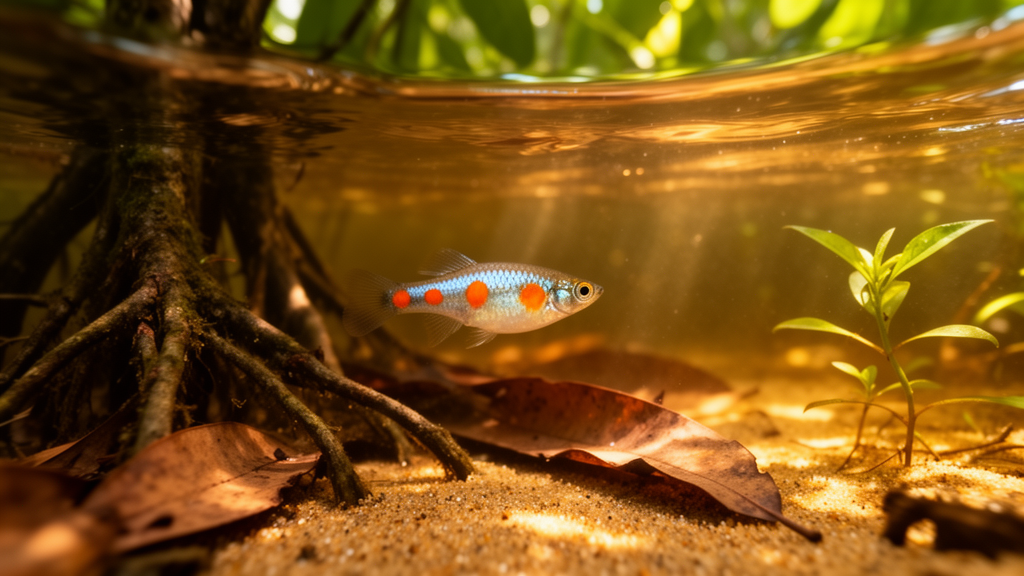
Deep in the flooded forests of southern Amapá State, northern Brazil, a small fish with glowing orange spots has turned out to be a species entirely new to science. Researchers surveying streams in the Rio Cajari drainage, a tributary of the Amazon River, have described Laimosemion laranja, a tiny rivulid killifish distinguished by rows of orange dots and chevron-shaped bars along the flanks of its males. The discovery, published in the journal Zoosystematics and Evolution, is based on both detailed anatomical comparisons and DNA sequencing, and it carries an urgent conservation message: the fish appears to be restricted to just three disturbed sites, and its closest habitats are already showing signs of deforestation, mining pollution, and urban encroachment.
The new species belongs to the genus Laimosemion, a group of small killifishes endemic to the Amazon Forest ecosystem and distributed across the ancient Guiana Shield, which spans French Guiana, Suriname, Guyana, northern Brazil, southeastern Venezuela, eastern Colombia, and Peru. The genus currently encompasses 35 described species and is notable for containing lineages with two very different life-history strategies. Some Laimosemion species are annual fishes whose embryos can enter diapause, pausing development to survive the drying of temporary pools, while others are non-annual. The genus represents one of the independent origins of this annual lifestyle within the family Rivulidae, which ranks among the ten most diverse groups of neotropical freshwater fishes.
Rivulids as a whole are characterized by restricted geographic distributions, limited dispersal capacity, small body size, rapid growth, pronounced sexual dimorphism, and life cycles closely tied to seasonal rainfall. These traits make them excellent models for studying how geography and ecology shape biodiversity, but they also make them vulnerable. Small fishes restricted to seasonally flooded habitats are often under-sampled across the Amazon, even though the basin hosts roughly 2,776 fish species, of which about 62 percent are found nowhere else on Earth. Historically, research attention has focused on larger fishes important for subsistence and commercial fisheries, leaving the diminutive seasonal-swamp specialists poorly documented.
The new species was assigned to the L. geayi species group, a monophyletic assemblage first proposed in 1992 on the basis of a distinctive combination of morphological characters. Members of this group share E- or F-patterned frontal squamation on the head, seven to eleven dorsal-fin rays, nine to fifteen anal-fin rays, thirty to thirty-seven scales in the longitudinal series, and a striking color pattern in both sexes: longitudinal rows of spots on the anterior portion of the flank and oblique chevron-like bars on the posterior portion. Before this study, the group comprised six species: L. agilae, L. cladophorus, L. dibaphus, L. geayi, L. mabura, and L. strigatus.
What sets Laimosemion laranja apart is a unique combination of anatomical details rather than any single dramatic feature. It has eight scales in the transverse series, a count not shared with any of its congeners, which have seven, nine, nine to ten, or nine to eleven depending on the species. The origin of its dorsal fin falls on a transverse plane through the bases of the fourth to sixth anal-fin rays, its frontal squamation follows the E pattern, and it possesses thirteen to fourteen anal-fin rays, twenty-eight total vertebrae, and only eight to ten neuromasts in the infraorbital sensory series on the head. It also lacks the parhypural process on the caudal fin that is present in its closest look-alike, L. dibaphus. The largest male examined measured just 27.8 millimeters in standard length, and the largest female 20.6 millimeters, underscoring how easily such small fishes can escape scientific notice.
The coloration of living males is what inspired the species name. The anterior flank is light gray and carries four to five incomplete longitudinal rows of sometimes coalescent orange dots, while the posterior flank bears five to six orange chevron-like oblique bars. The dorsal fin is orange with large blue spots, the caudal fin is light blue with orange vertical bars, and the anal fin is greenish orange with pale blue spots and a black distal stripe. Females are more subdued, with light gray flanks, irregular rows of orange spots, and greenish fins. The specific epithet laranja, the Portuguese word for orange, refers both to the male’s vivid coloration and to the municipality of Laranjal do Jari, the only place where the species is currently known to occur.
To test whether the new fish was truly distinct, the team sequenced 525 base pairs of the mitochondrial cytochrome c oxidase subunit I gene, the standard barcode marker for animal species identification. DNA was extracted from muscle tissue preserved in alcohol, amplified with fish-specific primers, and sequenced in both directions. Genetic distances were calculated using the Kimura two-parameter model, and phylogenetic relationships were reconstructed with Bayesian inference in Beast 2, using Anablepsoides jari as the outgroup. The results showed that L. laranja diverges genetically by 5.3 percent from its closest relatives, L. agilae and L. strigatus, by 9.2 percent from L. dibaphus, and by 12.3 percent from L. geayi, the most divergent member of the group. These distances, combined with clear morphological differences and marked geographic separation among river basins, firmly support the new species’ status.
The phylogenetic analysis recovered a close relationship among L. laranja, L. agilae, and L. strigatus with strong posterior probability support, while L. dibaphus, from the Rio Tapajós, emerged as the sister lineage to that three-species clade. Interestingly, L. dibaphus shows the greatest morphological resemblance to the new species in male color pattern, yet the genetic data reveal a much deeper evolutionary split. The authors caution that two members of the group, L. mabura and L. cladophorus, could not be included because no sequences or specimens were available, and that additional molecular markers would likely improve lineage delimitation, particularly in poorly sampled areas of the eastern Guiana Shield where the absence of genetic data may be masking undescribed species.
In the field, L. laranja was found in pools adjacent to the main course of streams at three forested sites in the municipality of Laranjal do Jari. These pools had floating aquatic vegetation, clear water with moderate currents, sandy or muddy substrates, and depths between half a meter and one meter. The region has a tropical rainforest climate with an average annual temperature of 26.4 degrees Celsius and roughly 2,500 millimeters of rain per year, with the heaviest rainfall between March and May. The species was collected alongside several other fish, including the rivulid Anablepsoides jari, the poeciliid Poecilia waiapi, the trahira-like Hoplerythrinus unitaeniatus, and a species of electric knifefish in the genus Brachyhypopomus.
The conservation outlook is sobering. Using the GeoCAT tool and IUCN Red List criteria, the researchers calculated an extent of occurrence of just 25 square kilometers and an area of occupancy of 12 square kilometers, both far below the thresholds for threatened status. All three known sites show environmental disturbance. The first lies on the boundary of the Reserva Extrativista do Rio Cajari, yet even there the habitat shows signs of deforestation and burned trees, and local residents identified some pools as remnants of mining activities, with water carrying high concentrations of suspended solids and an intense reddish color. The type locality sits 180 meters from an electric power substation near the city of Laranjal do Jari, and the third site, within the city itself, is losing habitat to urbanization and suffering plastic pollution in its wetlands. Given the continuous habitat decline and the species’ extremely restricted range, the authors classify it as Endangered under IUCN criteria B1ab(iii)+B2ab(iii). They recommend expanding the Rio Cajari extractive reserve to encompass the adjacent locality and call for additional sampling within and around the protected area to establish the species’ full distribution. With mercury contamination from mining documented across Amapá, including in legally protected areas, the survival of this newly described orange jewel may depend on how quickly its fragile forest pools receive protection.
Subject of Research: Description of a new killifish species, Laimosemion laranja, from the Rio Cajari in the Brazilian Amazon based on morphological and molecular evidence.
Article Title: A new killifish of the genus Laimosemion ( Cyprinodontiformes , Rivulidae ) from Rio Cajari in the Brazilian Amazon
Article References: A new killifish of the genus Laimosemion ( Cyprinodontiformes , Rivulidae ) from Rio Cajari in the Brazilian Amazon. (n.d.). https://doi.org/10.3897/zse.102.187659
Image Credits: AI Generated
Keywords: Laimosemion laranja, killifish, Rivulidae, Brazilian Amazon, new species, Amapá, Rio Cajari, DNA barcoding, conservation, biodiversity, genus, Laimosemion
Cite Scienmag News
Margaret Porter. (October 16, 2026). New orange-spotted killifish discovered in Brazilian Amazon. Scienmag. https://scienmag.com/new-orange-spotted-killifish-discovered-in-brazilian-amazon/
Margaret Porter. "New orange-spotted killifish discovered in Brazilian Amazon." Scienmag, 16 October 2026, https://scienmag.com/new-orange-spotted-killifish-discovered-in-brazilian-amazon/. Accessed 16 October 2026.
Margaret Porter. "New orange-spotted killifish discovered in Brazilian Amazon." Scienmag. October 16, 2026. https://scienmag.com/new-orange-spotted-killifish-discovered-in-brazilian-amazon/


