


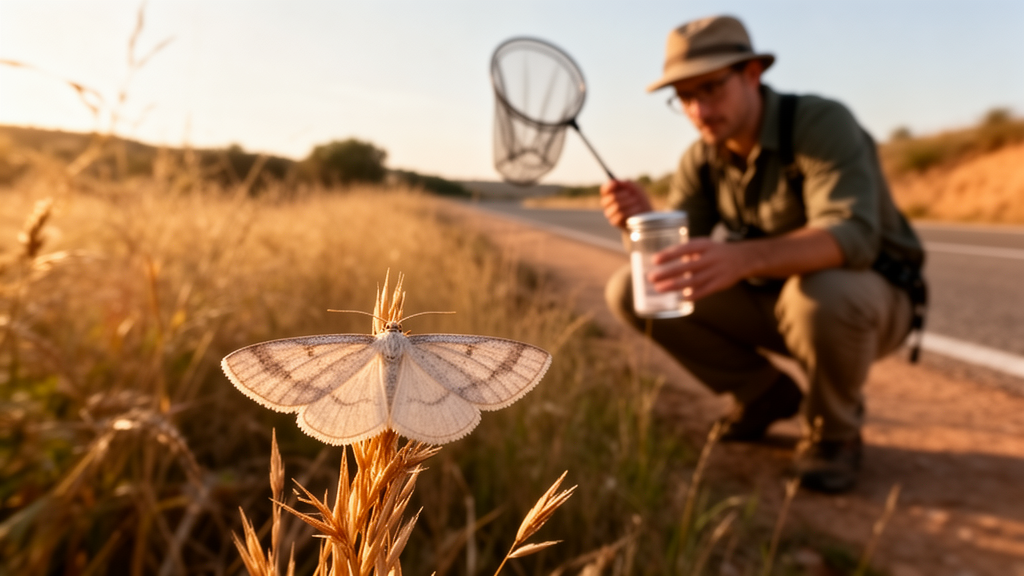
On a summer night in July 2020, at a small silting lake in central Portugal, a moth trap strung with a mercury vapour light began attracting a handful of tiny, unremarkable brown moths that no one could put a name to. Five years later, those anonymous little insects have a formal identity: Monochroa monellii, a species new to science, described in the journal Nota Lepidopterologica by Martin Corley and Jorge Rosete. The discovery is a reminder that even in well-studied western Europe, and even among the drab ‘small brown jobs’ that most casual observers walk straight past, entirely unknown species are still waiting a few metres from a tarmac road.
The genus Monochroa is a group of small moths in the family Gelechiidae, with roughly 60 described species distributed mainly across the Palearctic and Nearctic regions, about half of which occur in Europe. The larvae are miners, feeding inside leaves and stems of their host plants. Seven species have been recorded in the Iberian Peninsula, six of them in Portugal, and each of the Portuguese species belongs to a different species group within the genus. According to the classification of Gregersen and Karsholt, the European members of the genus fall into eleven groups, each tied to a particular plant family. That host-plant fidelity would prove to be a crucial clue in working out what the Portuguese moths actually were.
The story began on 29 July 2020, when Jorge Rosete ran a mercury vapour light at Lagoa de São José near Carriço in the municipality of Pombal, in the Beira Litoral province. Among the microlepidoptera drawn to the light were several small gelechiids that resisted identification. Further sessions at the same locality on 13 August and 3 September 2020 produced more specimens, and the pattern of repeated appearance at one site suggested this was not a stray but a resident population. Years of subsequent collecting, culminating in the rearing of a male from a pupa in June 2025, gave the authors the material they needed to make the case for a new species.
Externally, the new moth is almost indistinguishable from three close relatives: M. conspersella, M. servella and M. tetragonella. All four are fuscous brown moths with wingspans of just 8 to 10 millimetres, marked with a small blackish spot or short dash in the forewing fold and a spot at the end of the cell. The extent of pale scaling at the base of the forewing scales varies within each species, shifting the overall ground colour from uniformly dark brown to noticeably paler, so even wing pattern offers no reliable handle. Reliable identification, the authors conclude, depends on dissection of the genitalia, the standard last resort of microlepidopterists confronted with look-alike species.
The genitalia do deliver. In the male, M. monellii shows a valva whose costal margin is slightly concave in the middle, whereas in the three related species that margin is straight or slightly convex. The phallus carries a cluster of numerous cornuti, the small sclerotised structures within the aedeagus, and in the new species these differ little in size across the cluster. In M. servella and M. conspersella, by contrast, the cornuti increase considerably in size from one end of the cluster to the other, the longest being about three times the length of those in the middle; in M. tetragonella the size gradient is less marked. Differences in the shape of the valva apex, the length and shape of the sacculus, and the form of the female signum, a broad plate constricted in the middle by a pair of chess pawn-shaped structures, complete the diagnostic package.
DNA barcoding sealed the case. A barcode of the Folmer fragment of the mitochondrial cytochrome c oxidase I gene, generated through Portugal’s InBIO Barcoding Initiative, showed that the Portuguese specimens form their own cluster in the Barcode of Life Data System, currently represented by a single specimen under BIN BOLD:AGQ5413. Comparisons with sequences in GenBank and BOLD, calculated as uncorrected p-distances in MEGA v.12, placed M. conspersella as the closest relative at 4.4 percent divergence, followed by M. servella at 4.9 percent and M. tetragonella at 5.7 percent. Those levels of mitochondrial divergence, combined with consistent genitalia differences, are well beyond what is normally accepted within a single species of these moths.
The moth’s biology points to an intimate relationship with a single plant. Pupae were found beneath the sandy soil at Lagoa de São José, inside silk tunnels roughly one centimetre long, attached to Lysimachia monelli at the transition between stem and root. Although feeding larvae have not yet been observed directly, the position of the pupae leaves the authors in no doubt that this is the host plant, and the species name monellii honours it. Intriguingly, no signs of stem mining were detected on any examined plants, suggesting the larva feeds on the upper parts of the plant and then descends to pupate at the stem base. This fits a broader pattern: the three closest relatives all feed on Primulaceae, with M. servella on Primula, M. conspersella on Lysimachia vulgaris and M. tetragonella on Lysimachia maritima, and the recent expansion of the genus Lysimachia to absorb the former genera Anagallis and Glaux makes the new species’ host choice taxonomically coherent.
The habitat itself is modest: a roadside with limited vegetation beside a small lake that is gradually silting up, backed by coastal forest of maritime pine on sandy soil supporting shrubs such as Erica, Cistus, Halimium and the Portuguese crowberry Corema album, along with scattered larger shrubs including Morella faya, Rhamnus alaternus, Arbutus unedo and creeping willow. From March onwards, scattered clusters of Lysimachia monelli flower across the site. Adults of the new moth have been collected between 13 July and 3 September, a flight period consistent with its relatives.
There is, however, a conservation shadow over the discovery. After devastating wildfires in 2017, the Portuguese government introduced a law obliging landowners to clear combustible shrubs and herbage from their land. The roadside where M. monellii lives shows the marks of this policy: a tractor-drawn fixed tine cultivator has left longitudinal striations in the very sandy soil, and by May 2024 much of the ground was bare, with some Lysimachia monelli plants surviving while others had been ripped out and left to desiccate. For a species known from a single locality, apparently locally plentiful but dependent on a specific host plant at an actively cultivated site, such land management is an obvious risk, even if the moth’s long-term status remains unknown.
Why has such a distinctive insect gone unnoticed for so long? The authors note that it comes freely to light and appears locally abundant, while its host plant is widespread in south-west Europe, making its apparent restriction to one roadside all the more remarkable. A plausible explanation is simply that roadsides are not the kind of habitat that invites moth-trapping activity, and the authors predict that M. monellii will eventually prove far more widely distributed. The description also prompts a historical footnote: Mendes recorded what was then called Xystophora farinosae, now M. servella, as rare in June at São Fiel near Fundão in 1904, a record rejected in 2015 as improbable and unverifiable. With a second Lysimachia-feeding Monochroa now known from Portugal, that century-old record could conceivably refer to the new species, although Flora-on shows no records of Lysimachia monelli in the Fundão area. Either way, the message is clear: the next new species in Europe may be fluttering unnoticed around a lamp post, waiting for someone to look closely.
Subject of Research: Description of a new gelechiid moth species, Monochroa monellii, from central Portugal
Article Title: Monochroa monellii ( Lepidoptera , Gelechiidae ), a new species from Portugal
Article References: Corley, M., Rosete, J., & Ferreira, S. (2025). Monochroa monellii (Lepidoptera, Gelechiidae), a new species from Portugal. Nota Lepidopterologica, 48, 289-298. https://doi.org/10.3897/nl.48.173830
Image Credits: AI Generated
DOI: 10.3897/nl.48.173830
Keywords: Monochroa monellii, Gelechiidae, Lepidoptera, new species, Portugal, DNA barcoding, Lysimachia monelli, taxonomy, microlepidoptera, genitalia morphology, BOLD, habitat loss
Cite Scienmag News
Gavin Prescott. (October 16, 2026). Tiny new moth species hidden on a Portuguese roadside stuns scientists. Scienmag. https://scienmag.com/tiny-new-moth-species-hidden-on-a-portuguese-roadside-stuns-scientists/
Gavin Prescott. "Tiny new moth species hidden on a Portuguese roadside stuns scientists." Scienmag, 16 October 2026, https://scienmag.com/tiny-new-moth-species-hidden-on-a-portuguese-roadside-stuns-scientists/. Accessed 16 October 2026.
Gavin Prescott. "Tiny new moth species hidden on a Portuguese roadside stuns scientists." Scienmag. October 16, 2026. https://scienmag.com/tiny-new-moth-species-hidden-on-a-portuguese-roadside-stuns-scientists/


