


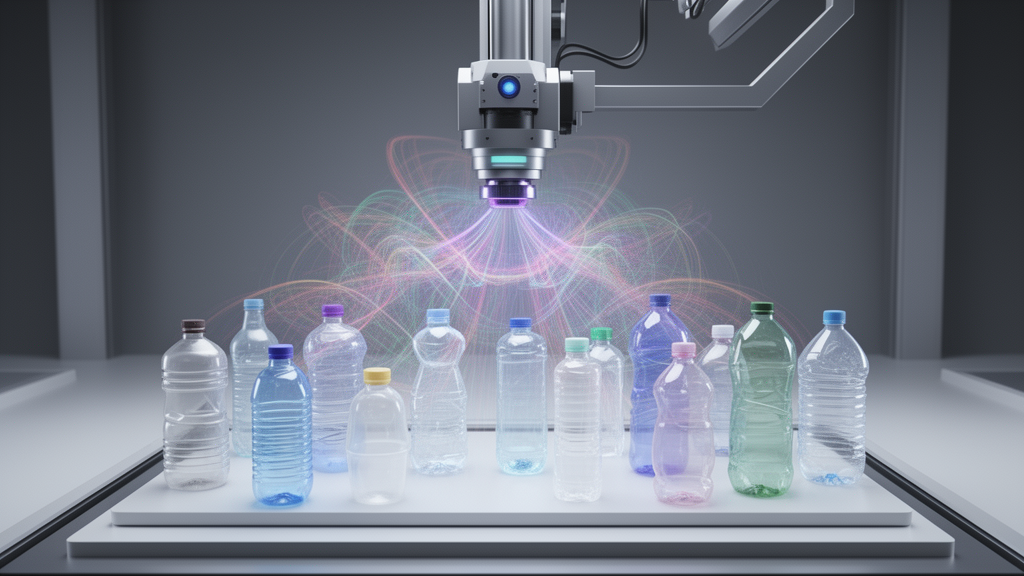
A team of researchers at Shibaura Institute of Technology (SIT) in Japan has developed a design framework that builds terahertz (THz) sensing directly into the geometry of plastic food containers, with the aim of making transparent packaging easier to identify and sort after disposal. The work, led by master’s graduate Mr. Juniya Yoshihara together with Professor Tadao Tanabe and Professor Mitsuhiro Shigeri of the Department of Engineering and Design, focused on transparent soba noodle containers and treated material identification as a design requirement alongside consumer needs, container shape, and transport efficiency. The study was made available online on July 16, 2026, and will be published in Volume 32 of the journal Results in Engineering on December 1, 2026.
The problem the researchers set out to address lies at the heart of plastic recycling. Plastic packaging is typically designed around appearance, convenience, and function, while what happens after disposal is often considered separately. Yet managing packaging waste is central to building a circular economy, because good recycling depends on sorting plastics correctly by type. Transparent polyethylene terephthalate (PET) and polystyrene (PS) are a case in point: the two materials can be difficult to distinguish visually, which makes accurate separation challenging in practice.
Terahertz sensing offers a way to tell visually similar plastics apart. In this study, THz measurements were paired with machine learning and image analysis to recognize plastic type from transmission data. “We wanted to rethink packaging design so that recyclability becomes part of the design process while everyday usability and practical requirements are retained,” says Mr. Yoshihara. The framework the team developed therefore does not treat identification as an afterthought at the waste stage, but as a property that can be engineered into the container itself.
The research began with a community-based collection experiment in Isesaki City, Gunma Prefecture, Japan. Residents brought washed transparent food containers to a collection site equipped with an automated identification system. Among the 383 collected samples, most were correctly identified, but some were misclassified. Analysis suggested that container shape and surface structure contributed to variations in the THz signal. Notably, the fixed identification model was not retrained during the collection, which means the experiment provided an independent field-test evaluation of the system under real-world conditions rather than a performance figure tuned to the training data.
That field result pointed the researchers toward a second question: could container geometry itself be shaped to support more stable identification? To find out, they created different bottom surface shapes and evaluated their THz transmission alongside image-based measures of complexity. The results showed that ribs, slopes, grooves, and other uneven features could affect the measurements, introducing variability into the signal that the identification system had to interpret. A stable, flat region at the center of the container bottom, by contrast, helped provide a more consistent area for THz sensing, particularly when measurements were sensitive to shape.
Using these findings, the team developed four prototype soba containers, each balancing identification performance against practical use in a different way. One prototype emerged as offering a strong balance between the two. It combined a regular triangular bottom pattern with a central flat area, while retaining an uneven surface that could help prevent noodles from becoming soggy. The design also incorporated spaces for condiments and dipping sauce and took into account how the container could be held during recycling. The prototype thus demonstrates the core idea of the framework: the sensing-friendly geometry is not bolted on as a separate feature, but negotiated together with the functions a food container must perform.
A small survey of user impressions indicated favorable responses to the selected design, including its durability, handling, and innovative appearance. The final container was designed for easy handling and for placement that directs the central sensing area toward the identification system, so that the region optimized for THz measurement is the one presented to the sorter. Its stacking arrangement also allowed more containers to be transported together than the general container used for comparison, meaning the recycling-oriented geometry did not come at the cost of logistics efficiency. Taken together, these results indicate that the design maintained stable THz transmission while preserving the practical functions expected of a food container.
“By integrating sensing considerations into product geometry, we can explore packaging that is easier to identify after disposal without giving up its familiar functions,” says Mr. Yoshihara. The study points toward a broader shift in sustainable product development, in which recyclability is considered alongside everyday performance from the beginning of the design process rather than being addressed downstream. In such an approach, the requirements of the sorting system become inputs to product development itself, on the same footing as cost, appearance, and usability. The findings demonstrate that recycling considerations need not come at the expense of usability, appearance, or transport efficiency.
Overall, the study presents a case-based framework that combines THz sensing, machine learning, image analysis, and product design to improve the identifiability of plastics after disposal. The work was partly supported by a grant from the Fuji Seal Packaging Foundation, and the identification technology drew on the terahertz expertise of the Recycle Design Laboratory (Tanabe Lab) at SIT, while Mr. Yoshihara’s design work was carried out in the Design Process Laboratory (Shigeri Lab) within the same department. The authors note that further validation is needed across different packaging types, materials, and real-world conditions before the approach can be generalized. Even so, the case suggests a concrete path toward everyday products designed for more efficient resource recycling and reduced environmental impact, in which the container that carries a meal is also, by design, the container that a sorting machine can read.
Subject of Research: Terahertz-sensing-based design of recyclable transparent plastic food containers
Article Title: Designing plastic containers for easier recycling with terahertz technology
Article References: Designing plastic containers for easier recycling with terahertz technology. Original publication (Bibliographic details unavailable.)
Image Credits: AI Generated
DOI: Not provided
Keywords: terahertz spectroscopy, plastic recycling, packaging design, PET, polystyrene, circular economy, waste sorting, machine learning, sustainable design, Shibaura Institute of Technology, Results in Engineering, food containers
Cite Scienmag News
Bethany Barker. (October 26, 2026). Terahertz-Sensing Design Framework Aims to Make Plastic Containers Easier to Recycle. Scienmag. https://scienmag.com/terahertz-sensing-design-framework-aims-to-make-plastic-containers-easier-to-recycle/
Bethany Barker. "Terahertz-Sensing Design Framework Aims to Make Plastic Containers Easier to Recycle." Scienmag, 26 October 2026, https://scienmag.com/terahertz-sensing-design-framework-aims-to-make-plastic-containers-easier-to-recycle/. Accessed 26 October 2026.
Bethany Barker. "Terahertz-Sensing Design Framework Aims to Make Plastic Containers Easier to Recycle." Scienmag. October 26, 2026. https://scienmag.com/terahertz-sensing-design-framework-aims-to-make-plastic-containers-easier-to-recycle/


