

Monday, October 26, 2026
Science
No Result
View All Result
  • Login
  • HOME
  • SCIENCE NEWS
  • CONTACT US
  • HOME
  • SCIENCE NEWS
  • CONTACT US
No Result
View All Result
Scienmag
No Result
View All Result
Home Science News Chemistry

Nanoparticle Chemistry Revealed in Abbasid Ceramic Luster

October 26, 2026
in Chemistry
Bethany Barker
By Bethany Barker Scienmag Editorial Profile - Catalysis
Reading Time: 2 mins read
0
Nanoparticle Chemistry Revealed in Abbasid Ceramic Luster

Nanoparticle Chemistry Revealed in Abbasid Ceramic Luster

65
SHARES
587
VIEWS
Share on FacebookShare on Twitter
ADVERTISEMENT

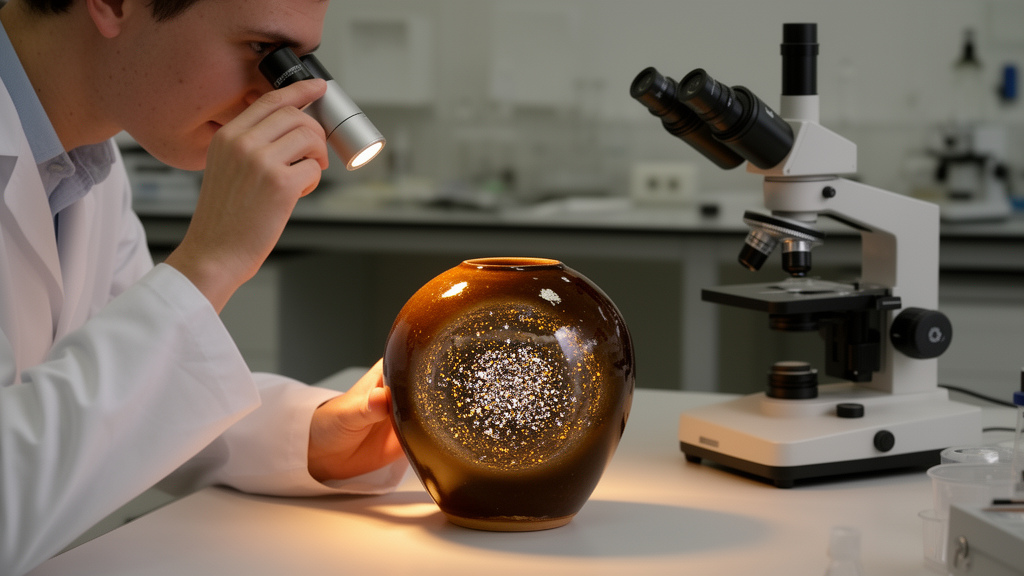
Researchers have identified the chemical reactions that enabled ninth-century Abbasid potters to produce golden, red, brown and yellow ceramic glazes with a metallic, iridescent appearance. The study, led by scientists at Universitat Politècnica de Barcelona and the European Synchrotron Radiation Facility (ESRF), used synchrotron techniques to examine tiny fragments of historical ceramics and showed that the colors arose from silver and copper nanoparticles embedded within the glaze.

Polychrome luster was created by painting a glazed ceramic surface with a mixture containing metallic compounds, notably silver and copper. During firing, those elements diffused into the glassy coating and underwent reactions that included reduction, forming metallic nanoparticles in a thin surface region. The particles were not merely deposited on top of the ceramic: they became integrated into the glaze, producing a nanostructured layer whose composition and morphology controlled how it interacted with light.

The investigation combined X-ray spectroscopy and X-ray fluorescence at the ESRF’s ID21 beamline with X-ray diffraction at the ALBA synchrotron. According to the researchers, the microscopic beam and the ability to examine iron, copper and silver were essential for resolving the chemistry of the luster layers. The analysis found that luster formation involved an ion-exchange process in which copper and silver ions moved from the painted layer into the glaze and replaced alkali ions.

Firing conditions were crucial to this exchange. The luster had to be heated to a temperature between the glass-transition temperature and the point at which the glaze softened, conditions that favored ionic diffusion while helping prevent the painted material from sticking to the glaze. The final appearance was not determined simply by whether silver or copper was present, but by their relative proportions and their interactions with other elements in the glaze. The researchers reported that differences among luster colors primarily reflected different amounts of copper and silver, which affected the types, amounts, distributions and sizes of the resulting nanoparticles.

Marine Cotte, an ESRF scientist and co-corresponding author of the Science Advances paper, said the findings explain a manufacturing process that remains difficult to reproduce today. The study was based on fragments from historical ceramics, so the next phase will involve producing mock-up samples to separate the effects of individual manufacturing parameters. The researchers also plan to investigate the roles of other metals, including iron and tin, in luster formation. The results provide a chemical explanation for how a technology associated with the Abbasid period and later spread across the Islamic world generated its distinctive colors and metallic appearance long before the modern development of nanotechnology.

Subject of Research: Experimental investigation of nanoparticle formation in ninth-century Abbasid polychrome ceramic luster.

Article Title: Unveiling how nanoparticles create iridescence in ancient ceramics

Article References: Unveiling how nanoparticles create iridescence in ancient ceramics. Original publication (Bibliographic details unavailable.)

Image Credits: AI Generated

DOI: Not provided

Keywords: Abbasid ceramics, polychrome luster, nanoparticles, silver nanoparticles, copper nanoparticles, ion exchange, ceramic glaze, X-ray spectroscopy, nanotechnology, Unveiling, create, iridescence

Cite Scienmag News

Bethany Barker. (October 26, 2026). Nanoparticle Chemistry Revealed in Abbasid Ceramic Luster. Scienmag. https://scienmag.com/nanoparticle-chemistry-revealed-in-abbasid-ceramic-luster/

Bethany Barker. "Nanoparticle Chemistry Revealed in Abbasid Ceramic Luster." Scienmag, 26 October 2026, https://scienmag.com/nanoparticle-chemistry-revealed-in-abbasid-ceramic-luster/. Accessed 26 October 2026.

Bethany Barker. "Nanoparticle Chemistry Revealed in Abbasid Ceramic Luster." Scienmag. October 26, 2026. https://scienmag.com/nanoparticle-chemistry-revealed-in-abbasid-ceramic-luster/


Tags: Abbasid ceramic glaze nanostructuresAbbasid ceramicsadvanced imaging techniques for archaeological ceramicsceramic glazechemical reactions in Abbasid luster ceramicscopper nanoparticlescreateion exchangeion-exchange processes in ancient glassiridescencemetallic nanoparticle formation in historical ceramicsnanoparticlesnanostructured surface layers in Abbasid ceramicsnanotechnologynanotechnology in Islamic potterypolychrome lusterproduction of iridescent ceramic finishesrole of metallic compounds in ceramic colorationsilver and copper nanoparticles in ceramic glazessilver nanoparticlessynchrotron radiation analysis of ancient potteryUnveilingX-ray spectroscopyX-ray spectroscopy of historical glazes
Share26Tweet16
Previous Post

Chinese adults show sex-specific links between activity, sitting and obesity

Next Post

Retrospective study links early cranial radiotherapy with improved outcomes in selected EGFR-mutant lung cancer patients

Related Posts

Arginine extends quantum material behavior above room temperature
Chemistry

Arginine extends quantum material behavior above room temperature

October 26, 2026
Armored cells: A mineral shell lets whole-cell biocatalysts run 14 cycles for greener nicotinic acid
Chemistry

Armored cells: A mineral shell lets whole-cell biocatalysts run 14 cycles for greener nicotinic acid

October 26, 2026
Rice study tests MOF recovery of rare earths from wastewater
Chemistry

Rice study tests MOF recovery of rare earths from wastewater

October 26, 2026
Protein Maps Chart Antibodies Across Mouse Brain Tissue
Chemistry

Protein Maps Chart Antibodies Across Mouse Brain Tissue

October 26, 2026
Jena tests flexible photonics research collaboration with €550,000 pilot
Chemistry

Jena tests flexible photonics research collaboration with €550,000 pilot

October 26, 2026
Bikitaite-infused separator improves high-rate lithium-metal battery cells
Chemistry

Bikitaite-infused separator improves high-rate lithium-metal battery cells

October 26, 2026
Next Post
Retrospective study links early cranial radiotherapy with improved outcomes in selected EGFR-mutant lung cancer patients

Retrospective study links early cranial radiotherapy with improved outcomes in selected EGFR-mutant lung cancer patients

  • Mothers who receive childcare support from maternal grandparents show more optimized

    Mothers who receive childcare support from maternal grandparents show more parental warmth, finds NTU Singapore study

    27656 shares
    Share 11059 Tweet 6912
  • University of Seville Breaks 120-Year-Old Mystery, Revises a Key Einstein Concept

    1061 shares
    Share 424 Tweet 265
  • Bee body mass, pathogens and local climate influence heat tolerance

    682 shares
    Share 273 Tweet 171
  • Researchers record first-ever images and data of a shark experiencing a boat strike

    546 shares
    Share 218 Tweet 137
  • Groundbreaking Clinical Trial Reveals Lubiprostone Enhances Kidney Function

    531 shares
    Share 212 Tweet 133
Science

Embark on a thrilling journey of discovery with Scienmag.com—your ultimate source for cutting-edge breakthroughs. Immerse yourself in a world where curiosity knows no limits and tomorrow’s possibilities become today’s reality!

RECENT NEWS

  • Retrospective study links early cranial radiotherapy with improved outcomes in selected EGFR-mutant lung cancer patients
  • Nanoparticle Chemistry Revealed in Abbasid Ceramic Luster
  • Chinese adults show sex-specific links between activity, sitting and obesity
  • Tutorial linked to higher oncology confidence among foundation doctors

Categories

  • Agriculture
  • Anthropology
  • Archaeology
  • Athmospheric
  • Biology
  • Biotechnology
  • Blog
  • Bussines
  • Cancer
  • Chemistry
  • Climate
  • Earth Science
  • Editorial Policy
  • Marine
  • Mathematics
  • Medicine
  • Pediatry
  • Policy
  • Psychology & Psychiatry
  • Science Education
  • Science News
  • Social Science
  • Space
  • Technology and Engineering

Subscribe to Blog via Email

Enter your email address to subscribe to this blog and receive notifications of new posts by email.

Join 5,151 other subscribers

© 2025 Scienmag - Science Magazine

Welcome Back!

Login to your account below

Forgotten Password?

Retrieve your password

Please enter your username or email address to reset your password.

Log In
No Result
View All Result
  • HOME
  • SCIENCE NEWS
  • CONTACT US

© 2025 Scienmag - Science Magazine

Discover more from Science

Subscribe now to keep reading and get access to the full archive.

Continue reading