


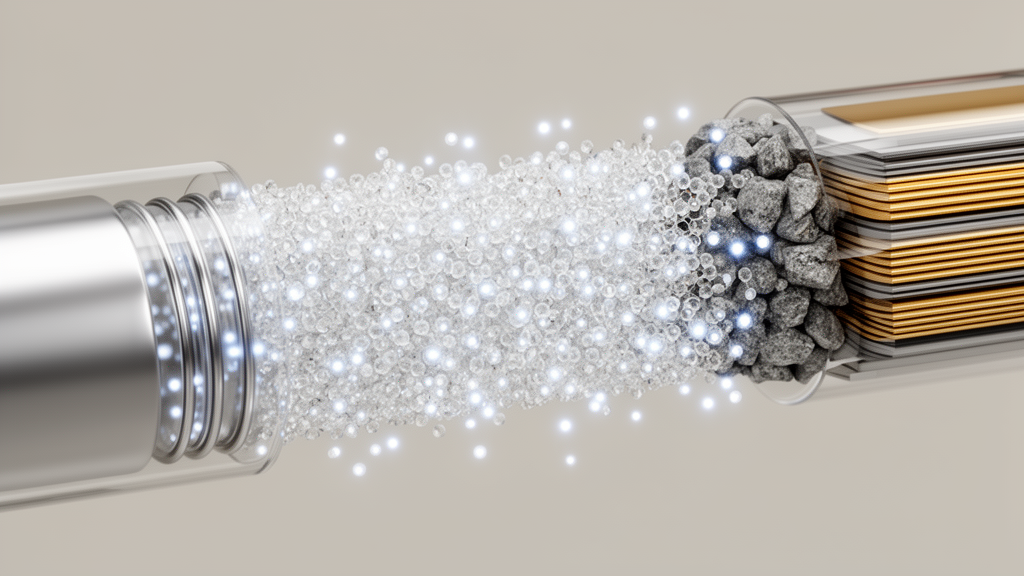
A cellulose separator infused with bikitaite zeolite improved the high-rate performance of laboratory lithium-metal battery cells equipped with an NCM90 cathode, outperforming a conventional polyethylene separator at faster discharge rates while also producing smoother, more uniform lithium deposition at the lithium-metal anode. Researchers led by Professor Sun-Yul Ryou at Hanbat National University in South Korea reported that the composite separator, called CBT, raised NCM90 cathode capacity from 115 to 163 mAh g⁻¹ at 4C, an improvement of approximately 42%. In separate Li||NCM90 cells, CBT supported approximately 60% capacity retention after around 2,500 cycles under 2C charging and 4C discharging, although the release did not report a corresponding long-term cycling comparison with the polyethylene-separator cells. These results provide laboratory evidence that modifying the separator can influence ion transport and performance at both electrodes without changing the underlying cathode and anode chemistry.
Lithium-metal batteries are being investigated for next-generation energy storage because lithium metal offers a very high theoretical capacity and could produce high energy density when paired with a high-nickel cathode such as NCM90. Rapid charging and discharging, however, create challenges on both sides of the cell. At the lithium-metal anode, uneven lithium-ion transport can lead to non-uniform lithium deposition and the formation of needle-like dendrites. These structures may damage the solid electrolyte interphase, continuously consume active lithium and electrolyte, and, in severe cases, penetrate the separator and cause an internal short circuit. Separators have consequently been investigated as a way to regulate lithium deposition and improve interfacial stability, while this study reports an additional effect on high-rate cathode performance.
To address the transport problem, Ryou’s team developed the CBT separator from porous cellulose infused with bikitaite zeolite. The cellulose provides a porous supporting structure, while the zeolite contributes ion-transport properties and interconnected pathways for lithium-ion movement through the separator. The resulting architecture was intended to distribute lithium ions more rapidly and uniformly across the cell, reducing polarization and facilitating electrochemical reactions under demanding high-rate conditions. Unlike approaches focused solely on adding a new cathode or anode composition, the CBT design retains the NCM90 cathode and lithium-metal anode used in the reported cells and modifies the component positioned between them.
The separator’s measured transport properties were an ionic conductivity of 3.45 × 10⁻³ S cm⁻¹ and a lithium-ion transference number of 0.742. In the researchers’ description, these characteristics enabled rapid and more uniform lithium-ion transport through the separator. The effect was linked to reduced polarization and improved electrode reactions, particularly as the discharge rate increased. Ryou said the study showed that battery performance can be improved not only through new electrode materials but also through separator engineering. He emphasized that the modified separator’s influence extended beyond the lithium-metal anode and significantly improved the high-rate performance of the NCM90 cathode.
The cathode comparison showed little separation between the separator types at the lowest reported rate. At 1C, cells using either CBT or conventional polyethylene separators delivered approximately 197 mAh g⁻¹. At 2C, capacity was 187 mAh g⁻¹ with CBT and 165 mAh g⁻¹ with polyethylene. The difference widened at 4C: the NCM90 cathode delivered 163 mAh g⁻¹ with CBT compared with 115 mAh g⁻¹ with the conventional separator. The resulting 48 mAh g⁻¹ difference corresponded to an improvement of approximately 42% at that rate. These measurements concern laboratory cells and the reported cathode-specific capacity; the release does not provide a broader comparison across commercial formats or a full range of electrode loadings and operating conditions.
Real-time observations of lithium deposition showed that CBT did more than improve the cathode response. Cells equipped with the modified separator displayed no visible dendrite growth during the reported deposition observations. Lithium instead formed a smoother, more compact layer, and it was removed more uniformly during stripping. The findings indicate that the separator’s transport behavior was associated with more even lithium handling at the anode interface. The observation of no visible dendrite growth applies to the conditions examined in the study and does not establish that dendrites are absent under every possible cycling, temperature, current-density or manufacturing condition.
The reported electrochemical testing also covered demanding cycling and temperature conditions. Li||NCM90 cells using CBT and operated at 2C charge and 4C discharge retained approximately 60% of their capacity after around 2,500 cycles. At −25 °C, the cells retained approximately 68.9% of their initial capacity after 150 cycles. In a separate assessment, the CBT separator maintained its structural integrity at 200 °C. These results demonstrate performance under the specified laboratory protocols. The university release does not provide every detail of the thermal test or a head-to-head long-term cycling result for CBT and polyethylene, so it would be premature to conclude from the supplied evidence that the modified separator offers superior long-term stability across all tested conditions.
The peer-reviewed experimental study, titled “Fast Charge–Discharge of LiNi0.9Co0.05Mn0.05 Enabled by a Bikitaite-Infused Separator for Li Metal Batteries,” was published in Advanced Functional Materials on July 6, 2026, after being made available online on May 28, 2026. The authors declared no conflicts of interest. The central finding is a coupled cell-level effect: CBT supported greater NCM90 capacity at elevated discharge rates, while direct observations showed smoother and more uniform lithium deposition and stripping at the anode. The study therefore supports the idea that a separator can function as an ion-transport-regulating component rather than merely a physical barrier between electrodes, but the evidence comes from experimental cells rather than a commercial battery demonstration.
Separator engineering may offer a comparatively accessible route to battery development because functional separator modification is already used in commercial battery manufacturing, including ceramic-coated separators. By contrast, introducing an entirely new cathode or anode material can require changes to synthesis, electrode processing, scale-up and manufacturing. The CBT work does not yet demonstrate commercial-scale production, and the researchers noted that validation in larger formats such as pouch or cylindrical cells will be required. Its near-term significance is therefore as a laboratory proof of principle: a bikitaite-infused cellulose separator produced measurable transport, cathode-capacity and lithium-deposition effects in lithium-metal cells, while manufacturability and performance at commercial scale remain unestablished.
For cell designers, the results suggest that controlling lithium-ion transport through the separator could help coordinate reactions at the anode and cathode. Ryou concluded that functional separators should not be viewed only as barriers that prevent the electrodes from contacting or as tools for protecting a lithium-metal anode. By regulating transport across the cell, they could become important design elements for batteries intended to combine high energy density with high-rate operation. The CBT study supplies experimental support for that proposition through its higher NCM90 capacity at 2C and 4C and its observed improvements in lithium-layer uniformity. Its broader value, however, will depend on further validation in larger cells and under manufacturing-relevant conditions not established by the reported experiments.
Subject of Research: Experimental development of a bikitaite-infused cellulose separator for high-rate lithium-metal batteries with NCM90 cathodes.
Article Title: Hanbat University researchers develop a separator to improve lithium-metal battery performance
Article References: Hanbat University researchers develop a separator to improve lithium-metal battery performance. Original publication (Bibliographic details unavailable.)
Image Credits: AI Generated
DOI: Not provided
Keywords: lithium-metal batteries, bikitaite zeolite, cellulose separator, NCM90 cathode, lithium-ion transport, dendrite suppression, high-rate discharge, battery materials, Hanbat, University, researchers, develop
Cite Scienmag News
Faith Mcneil. (October 26, 2026). Bikitaite-infused separator improves high-rate lithium-metal battery cells. Scienmag. https://scienmag.com/bikitaite-infused-separator-improves-high-rate-lithium-metal-battery-cells/
Faith Mcneil. "Bikitaite-infused separator improves high-rate lithium-metal battery cells." Scienmag, 26 October 2026, https://scienmag.com/bikitaite-infused-separator-improves-high-rate-lithium-metal-battery-cells/. Accessed 26 October 2026.
Faith Mcneil. "Bikitaite-infused separator improves high-rate lithium-metal battery cells." Scienmag. October 26, 2026. https://scienmag.com/bikitaite-infused-separator-improves-high-rate-lithium-metal-battery-cells/


