


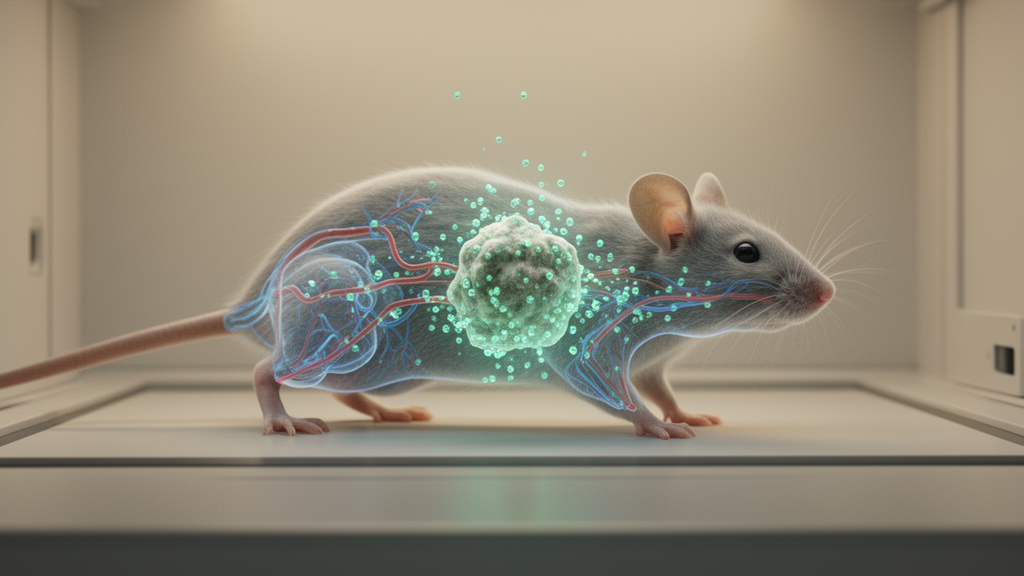
Tumor-derived small extracellular vesicles and cellular nanovesicles showed greater accumulation in mouse xenograft tumors that matched the cancer cell line from which the particles originated, according to a comparative laboratory study. Researchers examined vesicles released by human metastatic breast cancer MDA231 cells and human pancreatic cancer 8988t cells, tracking their uptake, circulation, tumor accumulation and wider biodistribution with fluorescent imaging. The study found similar circulation half-lives of approximately four to five hours across the vesicle types, while both MDA231-derived vesicle classes accumulated more strongly in MDA231 tumors than vesicles originating from 8988t cells.
The researchers isolated small extracellular vesicles, or sEVs, and cellular nanovesicles, or NVs, from MDA231 and 8988t cells. The two classes had comparable particle sizes and surface charges. They labeled the particles either with PbS quantum dots or with the membrane dye PKH26, allowing the investigators to compare their behavior under visible or near-infrared fluorescence imaging. The experimental comparison focused primarily on vesicles from different cellular origins: MDA231-derived particles showed greater uptake by MDA231 cells in vitro than particles derived from 8988t cells. The measured CD9 tetraspanin content also differed, with NVs showing greater CD9 inheritance than sEVs after normalization to the total protein input from the same parental cell. The reported results did not establish which molecular or cellular features accounted for the differences in uptake or tumor accumulation.
In the mouse experiments, fluorescence imaging showed broadly similar circulation profiles for MDA231- and 8988t-derived sEVs and NVs, with half-lives of about four to five hours. Tumor accumulation, however, differed according to the relationship between the vesicle source and the tumor. MDA231-derived sEVs and NVs accumulated more in mice bearing MDA231 tumors than did the corresponding vesicles derived from 8988t cells, indicating a preferential accumulation in the homologous tumor in this model. The choice of fluorescent label also mattered for imaging performance: PbS quantum-dot labeling produced stronger and more stable fluorescence signals than PKH26. These observations are distinct from the biological comparison, because they describe the stability of the imaging signal rather than an additional effect of the vesicles on tumors.
The findings support further investigation of tumor-derived sEVs and NVs as possible targeted delivery platforms for cancer therapy, but they do not demonstrate therapeutic benefit in humans. The work involved particles from two human cancer cell lines, uptake testing in cultured cells and biodistribution studies in MDA231 cell-xenografted mice. It measured physicochemical characteristics, cellular uptake, pharmacokinetics, tumor accumulation and distribution rather than improved treatment outcomes, lower toxicity or effective therapeutic dosing. The results therefore support a measurable origin-associated tumor preference under the tested laboratory conditions, while the extent to which that preference applies across other tumor types and its relevance to patients remain unresolved.
Subject of Research: Comparative imaging of tumor-derived small extracellular vesicles and cellular nanovesicles in breast and pancreatic cancer models
Article Title: Quo vadis? – Visualizing the tropism of tumor-derived cellular nanovesicles
Article References: Guo, Y., Zhou, K., Chen, Y., Zhang, J., & Tao, Z. (2026). Quo vadis? – Visualizing the tropism of tumor-derived cellular nanovesicles. BMC Cancer. https://doi.org/10.1186/s12885-026-16875-6
Image Credits: AI Generated
DOI: 10.1186/s12885-026-16875-6
Keywords: extracellular vesicles, cellular nanovesicles, tumor tropism, cancer cell lines, mouse xenografts, biodistribution, breast cancer, pancreatic cancer, quantum-dot imaging, drug delivery, vadis, Visualizing
Cite Scienmag News
Nathaniel Bowman. (October 26, 2026). Mouse study links tumor-derived vesicle origin to preferential tumor accumulation. Scienmag. https://scienmag.com/mouse-study-links-tumor-derived-vesicle-origin-to-preferential-tumor-accumulation/
Nathaniel Bowman. "Mouse study links tumor-derived vesicle origin to preferential tumor accumulation." Scienmag, 26 October 2026, https://scienmag.com/mouse-study-links-tumor-derived-vesicle-origin-to-preferential-tumor-accumulation/. Accessed 26 October 2026.
Nathaniel Bowman. "Mouse study links tumor-derived vesicle origin to preferential tumor accumulation." Scienmag. October 26, 2026. https://scienmag.com/mouse-study-links-tumor-derived-vesicle-origin-to-preferential-tumor-accumulation/


