


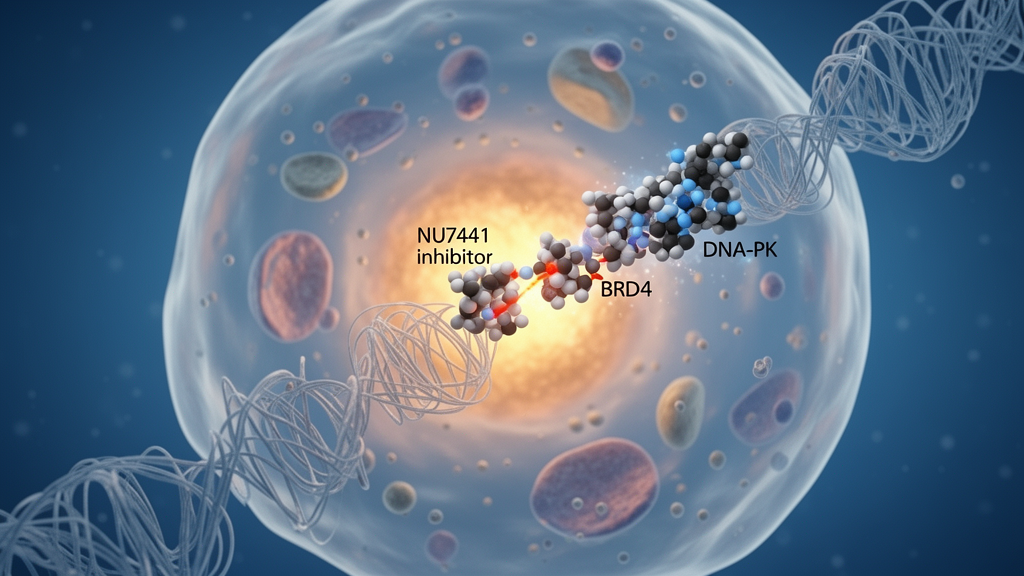
Laboratory assays found that NU7441, a compound traditionally classified as a selective inhibitor of DNA-dependent protein kinase, also acts against bromodomain-containing protein 4, or BRD4, in ovarian cancer models. The study reports that NU7441 directly displaced BRD4 from acetylated chromatin while retaining activity against DNA-PK. Its effects impaired functions associated with both homologous recombination and non-homologous end joining, two DNA-repair pathways.
These findings identify a previously underappreciated multi-target action for NU7441, although the work was conducted in vitro and in cell-based systems rather than in patients. The result matters because BRD4 and DNA-PK have critical roles in regulating DNA repair, genome integrity, cellular growth and proliferation. BRD4 is upregulated in multiple cancers, including ovarian cancer, and the article notes that its expression rises during tumor development and correlates with poorer overall and progression-free survival.
The investigators combined in vitro assays with cell-based experiments to characterize NU7441 and compare its activity with that of AZD7648, a single-target DNA-PK inhibitor. NU7441 showed a different sensitivity profile from AZD7648. The experiments further indicated that the compound could interfere with both homologous recombination and non-homologous end joining, supporting the interpretation that its activity is not limited to DNA-PK inhibition.
The results therefore provide experimental evidence that BRD4 and DNA-PK convergence can be exploited with a single small molecule in the systems examined. The study’s observation that NU7441 removes BRD4 from acetylated chromatin provides a mechanistic basis for describing the compound as a BRD4 inhibitor as well as a DNA-PK inhibitor. The authors present NU7441 as a possible foundation for developing next-generation multi-target inhibitors and biomarker-driven combination therapies.
The compound also offers a new lens through which to interpret earlier NU7441 research: effects previously assigned solely to DNA-PK inhibition may need to be reconsidered in light of its BRD4 activity. The study remains preclinical and does not establish a clinical benefit from NU7441 in ovarian cancer. The reported evidence is limited to laboratory and cell-based assays, with no patient outcomes in the supplied material.
Accordingly, the work identifies a therapeutic vulnerability and a direction for drug development, not an established treatment or proof that combination strategies will succeed in clinical practice.
Subject of Research: Preclinical assessment of NU7441 as a dual inhibitor of BRD4 and DNA-PK in ovarian cancer models.
Article Title: NU7441 reveals DNA-PK and BRD4 convergence as a therapeutic vulnerability in ovarian cancer
Article References: Disharoon, J. A., Johnson, B. C., Ampolini, E. A., Curry, N. L., Quesnelle, A. F., Delaney, J. R., & Long, D. T. (2026). NU7441 reveals DNA-PK and BRD4 convergence as a therapeutic vulnerability in ovarian cancer. BMC Cancer. https://doi.org/10.1186/s12885-026-16860-z
Image Credits: AI Generated
DOI: 10.1186/s12885-026-16860-z
Keywords: ovarian cancer, NU7441, BRD4, DNA-PK, DNA repair, acetylated chromatin, drug discovery, preclinical research, reveals, convergence, therapeutic, vulnerability
Cite Scienmag News
Nathaniel Bowman. (October 26, 2026). NU7441 shows dual BRD4 and DNA-PK activity in ovarian cancer cells. Scienmag. https://scienmag.com/nu7441-shows-dual-brd4-and-dna-pk-activity-in-ovarian-cancer-cells/
Nathaniel Bowman. "NU7441 shows dual BRD4 and DNA-PK activity in ovarian cancer cells." Scienmag, 26 October 2026, https://scienmag.com/nu7441-shows-dual-brd4-and-dna-pk-activity-in-ovarian-cancer-cells/. Accessed 26 October 2026.
Nathaniel Bowman. "NU7441 shows dual BRD4 and DNA-PK activity in ovarian cancer cells." Scienmag. October 26, 2026. https://scienmag.com/nu7441-shows-dual-brd4-and-dna-pk-activity-in-ovarian-cancer-cells/


