


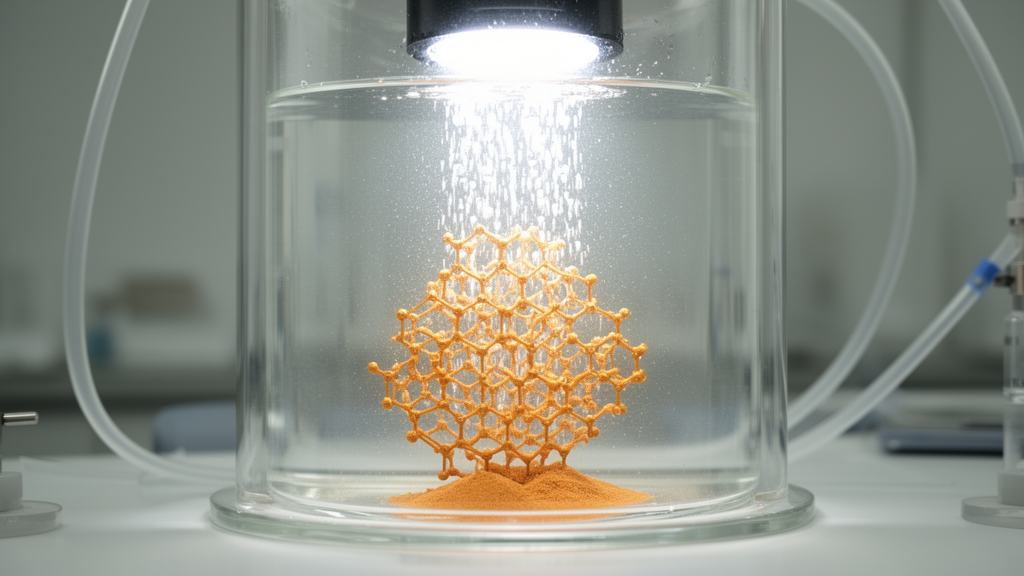
A coumarin-linked covalent organic framework developed by researchers in China produced hydrogen at 531 mmol g−1 h−1 under 440-nanometre irradiation in a laboratory study. The material also achieved a hydrogen-evolution rate of 166 mmol g−1 h−1 under visible light with wavelengths above 420 nanometres. Published in Nature Synthesis on 8 September 2026, the study reports that the framework’s rigid, planar linkage improved the separation and persistence of photogenerated charges compared with an imine-linked counterpart. With platinum nanoparticles serving as a cocatalyst, the researchers measured transfer of photogenerated electrons from the framework to platinum within approximately 407 picoseconds, facilitating proton reduction and hydrogen evolution.
The work was conducted by the Ningbo Institute of Materials Technology and Engineering and the Technical Institute of Physics and Chemistry, both institutes of the Chinese Academy of Sciences. Covalent organic frameworks, or COFs, are crystalline, porous polymers assembled from organic building blocks connected by covalent bonds. Their structures can be adjusted to tune properties relevant to photocatalysis, in which light drives chemical reactions. The researchers focused on a limitation of conventional conjugated COFs: flexible linkages can rotate out of plane, interrupt π-conjugation and increase energy dissipation. That movement can aggravate the recombination of photogenerated electrons and holes, limiting charge separation and photocatalytic efficiency.
To limit this motion, the team introduced a rigid and planar coumarin linkage into a fully conjugated COF through a one-pot polycondensation strategy. Compared with the conventional imine and vinyl linkages examined in the study, the coumarin linkage exhibited substantially higher conformational rigidity. The researchers associated this restricted rotation with promoted π-electron delocalization and suppressed structural fluctuations. The resulting material showed markedly improved charge separation, with its charge-separated state lasting roughly 1,000 times longer than that of the imine-linked counterpart. The platinum cocatalyst provided an additional route for charge transfer: photogenerated electrons moved from the COF to platinum nanoparticles in about 407 picoseconds, while the transferred electrons facilitated proton reduction and hydrogen evolution. These results were obtained in laboratory catalyst systems and do not demonstrate performance in a full-scale solar reactor or under outdoor conditions.
The coumarin-linked COF reached an apparent quantum yield of 37.95% at 405 nanometres. Its hydrogen-evolution rate under 440-nanometre irradiation was higher than the rate measured under visible light above 420 nanometres, showing different outputs under the reported illumination conditions. The findings present a materials-design strategy for controlling charge dynamics in conjugated COFs rather than a demonstration of commercial hydrogen production. “This work provides a facile and effective strategy for tuning charge dynamics in conjugated COFs via linkage engineering,” said corresponding author Prof. Zhang Tao of the Ningbo Institute of Materials Technology and Engineering. He said the approach “sheds light on the design and application of high-performance organic photocatalysts for solar hydrogen production.” The experimental study supports the promise of the coumarin linkage under the tested laboratory conditions, while its implications for practical solar-driven hydrogen production remain prospective.
Subject of Research: Linkage engineering in covalent organic frameworks for photocatalytic hydrogen evolution
Article Title: Researchers boost hydrogen production with novel covalent organic framework photocatalyst
Article References: Researchers boost hydrogen production with novel covalent organic framework photocatalyst. Original publication (Bibliographic details unavailable.)
Image Credits: AI Generated
DOI: Not provided
Keywords: covalent organic frameworks, photocatalytic hydrogen, coumarin linkage, charge separation, water splitting, platinum cocatalyst, solar fuels, conjugated polymers, quantum yield, hydrogen production, Researchers, boost
Cite Scienmag News
Bethany Barker. (October 26, 2026). Rigid coumarin-linked COF boosts photocatalytic hydrogen production in laboratory tests. Scienmag. https://scienmag.com/rigid-coumarin-linked-cof-boosts-photocatalytic-hydrogen-production-in-laboratory-tests/
Bethany Barker. "Rigid coumarin-linked COF boosts photocatalytic hydrogen production in laboratory tests." Scienmag, 26 October 2026, https://scienmag.com/rigid-coumarin-linked-cof-boosts-photocatalytic-hydrogen-production-in-laboratory-tests/. Accessed 26 October 2026.
Bethany Barker. "Rigid coumarin-linked COF boosts photocatalytic hydrogen production in laboratory tests." Scienmag. October 26, 2026. https://scienmag.com/rigid-coumarin-linked-cof-boosts-photocatalytic-hydrogen-production-in-laboratory-tests/


