


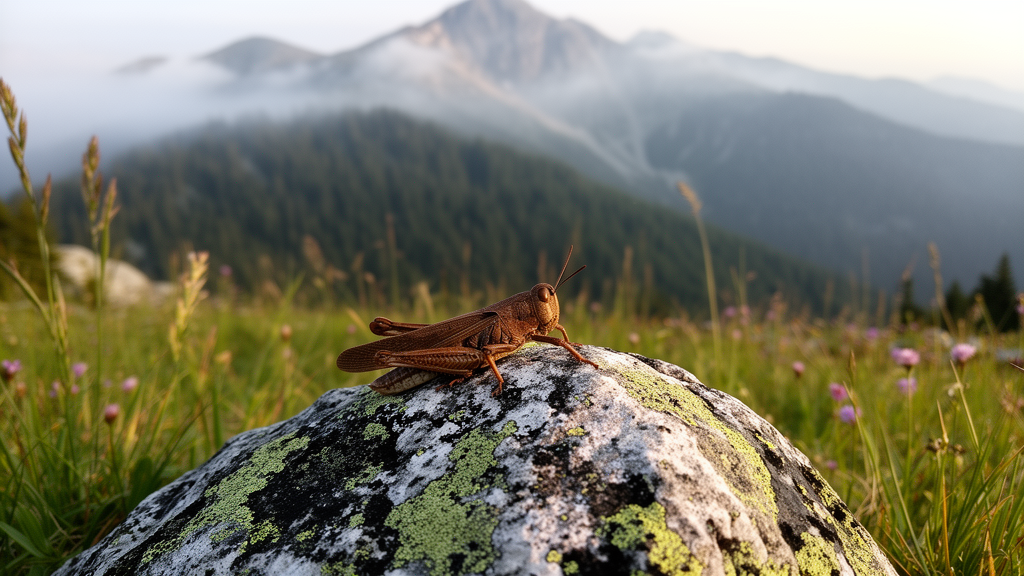
A new species of grasshopper has been described from the Western Tatras of Slovakia, becoming the seventh known European representative of the genus Podismopsis and highlighting how much cryptic diversity still hides on the isolated summits of Central Europe. The insect, named Podismopsis kristini in honour of Slovak orthopterologist Anton Krištín, was found in the upper Žiar Valley at elevations of roughly 1,820 to 1,920 metres, in wind-exposed alpine grasslands above the upper limit of the continuous dwarf pine zone.
The genus Podismopsis belongs to the grasshopper subfamily Gomphocerinae and stretches from Europe across Russia to northeastern Asia, comprising almost 40 species. Its centre of diversity lies in the taiga zone of Siberia and the Russian Far East, where most species inhabit swampy forests with rich hygrophilous vegetation. From this core area, cold-adapted lineages spread westward across the Palaearctic, and in Europe the genus is now represented by six previously known species, four of which are confined to single isolated mountain massifs.
The new species was collected by slowly walking through alpine vegetation and visually searching for individuals, with males also located by their characteristic calling songs. Specimens were captured with sweep nets and preserved partly dried and partly in 95% ethanol. High-resolution imaging used focus stacks of 10 to 20 focal planes combined into single photographs, and male genitalia were cleared in a 10% sodium hydroxide solution for 8 to 12 hours before examination under digital microscopes. Measurements were taken from images captured with digital microscope systems at Masaryk University in Brno.
Morphologically, Podismopsis kristini resembles its European relatives but can be distinguished by a combination of traits. Males differ from Podismopsis styriaca in the relative widths of the costal and subcostal fields of the tegmen, the forewing-like structures used in sound production, and from Podismopsis relicta and Podismopsis transsylvanica in antennal length. The tegmina of the new species are truncated apically with a distinctly emarginated margin, unlike those of Podismopsis styriaca and Podismopsis keisti. Pronotum length along the median line is below 3.1 millimetres in all examined specimens of the new species, whereas it exceeds that value in Podismopsis styriaca and Podismopsis transsylvanica, and tegmen length is at most 8.6 millimetres, compared with longer tegmina in Podismopsis keisti. Females show a particularly distinctive feature: tegmina that extend distally into a conspicuous triangular projection with a deeply concave ventral surface.
The type series comprises a male holotype collected on 9 September 2022 in the Žiar Valley at 1,850 metres, together with 11 male and 10 female paratypes from the same locality. Males average about 15 millimetres in total body length and females about 18.3 millimetres. The holotype and several paratypes are deposited in the National Museum in Prague, with the remaining paratypes distributed among the personal collections of the research team.
Genetic analysis based on the mitochondrial COI barcode region, a 543-base-pair alignment, showed that the new species is a distinct lineage. Its two sequenced specimens formed a well-supported clade with 95% bootstrap support, sister to Podismopsis keisti with 96% support, and that combined lineage was sister to Podismopsis poppiusi. The lowest genetic distance, about 0.7%, was found between the new species and Podismopsis keisti, differing by four mutational steps in the haplotype network. Distances to Podismopsis poppiusi and the Siberian Podismopsis altaica were 1.5% and 1.7% respectively, while the related genus Chrysochraon differed by more than 6%.
Such low mitochondrial divergence among clearly separated species is typical of recently evolved lineages in this grasshopper group. The authors note that interspecific COI distances below 1% occur normally among Gomphocerinae species that diverged during the Pleistocene, and calibration of molecular clocks suggests the split between the new species and Podismopsis keisti corresponds to a lineage separation of roughly 200,000 to 300,000 years ago. The team treats the isolated European populations as distinct species because their large geographic separation, narrow association with specific microclimatic conditions and limited dispersal capacity together provide sufficient reproductive isolation, although they acknowledge these taxa can be interpreted as incipient species, or semi-species, still in the process of divergence.
The calling song of the new species, recorded in the laboratory at 20 to 21 degrees Celsius, consists of short echemes repeated at a rate of roughly 3 to 7 per minute, each lasting 1.8 to 2.3 seconds and containing 9 to 13 syllables. Interestingly, the song does not differ substantially from those of other European Podismopsis species. The authors argue that acoustic conservatism may be a consequence of the allopatric distributions, since selection for interspecific song discrimination is likely weak among geographically isolated lineages, allowing morphological differentiation to accumulate without corresponding acoustic divergence.
The discovery fits a broader biogeographical pattern. All four previously known alpine European species are strictly endemic to small, isolated mountain summits above 1,800 metres, inhabiting cold, wind-exposed grasslands. Because these grasshoppers are flightless, with females strongly short-winged and hind wings vestigial or absent, they depend entirely on walking for dispersal and cannot colonise neighbouring ranges, a distribution pattern classically described as the sky island phenomenon. The new species is geographically isolated from all other European congeners, with the nearest, Podismopsis styriaca, occurring roughly 450 kilometres away in the Austrian Alps.
The prevailing hypothesis holds that Podismopsis entered Europe during the Pleistocene via ice-free steppe corridors from Siberia, and that postglacial warming forced cold-adapted populations to retreat upslope into mountain refugia, where isolation drove speciation. This scenario is supported by subfossil remains of Podismopsis pleistocenica found in Pleistocene woolly rhinoceros deposits in the Carpathians at only 404 metres elevation, confirming the genus once lived in lowlands. Today the new species is known only from an area of about 1.5 square kilometres, smaller than any of its congeners, underscoring both the fragility of these relict populations and the importance of the Carpathian sky islands as reservoirs of Pleistocene evolutionary heritage.
Subject of Research: Description of a new alpine grasshopper species, Podismopsis kristini, from the Western Carpathians of Slovakia
Article Title: A new species of alpine grasshopper of the genus Podismopsis Zubovski, 1900 ( Orthoptera , Acrididae , Gomphocerinae ) from Central Europe
Article References: Kočárek, P., Marhoul, P., Vlk, R., & Holuša, J. (2026). A new species of alpine grasshopper of the genus Podismopsis Zubovski, 1900 (Orthoptera, Acrididae, Gomphocerinae) from Central Europe. ZooKeys, 1295, 303-331. https://doi.org/10.3897/zookeys.1295.205424
Image Credits: AI Generated
DOI: 10.3897/zookeys.1295.205424
Keywords: Podismopsis kristini, grasshopper, new species, Orthoptera, Western Tatras, Slovakia, sky islands, brachyptery, COI barcode, Pleistocene refugia, alpine grasslands, taxonomy
Cite Scienmag News
Gavin Prescott. (October 26, 2026). New flightless grasshopper species discovered on Slovakian sky island. Scienmag. https://scienmag.com/new-flightless-grasshopper-species-discovered-on-slovakian-sky-island/
Gavin Prescott. "New flightless grasshopper species discovered on Slovakian sky island." Scienmag, 26 October 2026, https://scienmag.com/new-flightless-grasshopper-species-discovered-on-slovakian-sky-island/. Accessed 26 October 2026.
Gavin Prescott. "New flightless grasshopper species discovered on Slovakian sky island." Scienmag. October 26, 2026. https://scienmag.com/new-flightless-grasshopper-species-discovered-on-slovakian-sky-island/


