


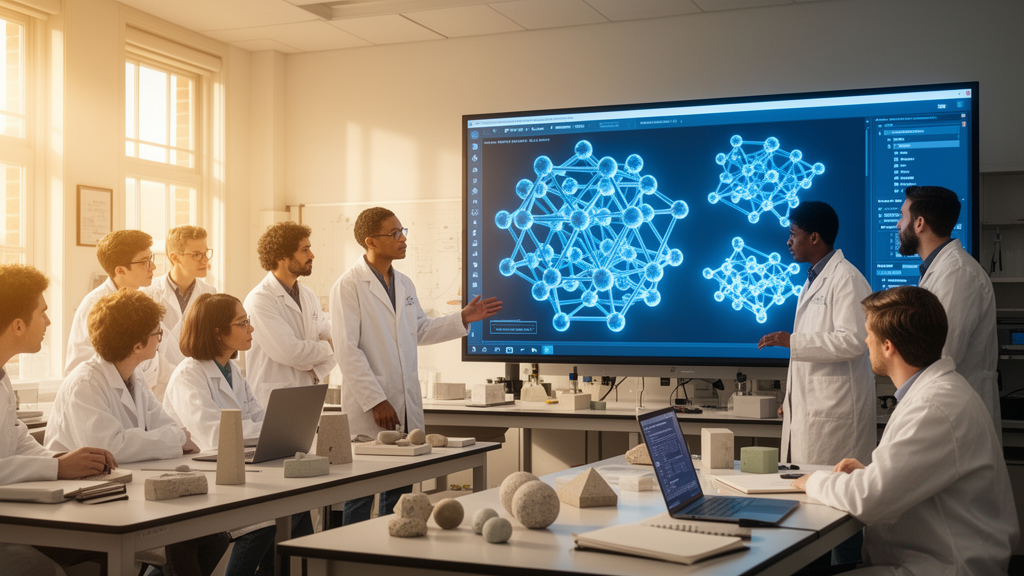
Artificial intelligence has quietly become part of how new materials are found. Machine-learning models now predict properties, screen thousands of candidate compounds, prioritize which experiments to run, optimize processing conditions, and even generate hypotheses in fields ranging from battery electrolytes and electrocatalysts to high-performance alloys. But according to a conceptual analysis published in Frontiers in Education by Dongming Mei of the University of South Dakota, Katherine Moore of MIT, and Ben Sayler of Black Hills State University, the limiting challenge is no longer only algorithmic capability. It is whether students and educators can use these systems with genuine domain-specific scientific judgment. Their argument is striking: a student who can fit a high-performing model but cannot explain where the data came from, justify a descriptor, spot data leakage, interpret uncertainty, or reject a physically impossible prediction is not yet prepared for AI-powered materials discovery. The paper, a workflow-aligned framework for AI literacy in materials-informatics education, does not report a new classroom intervention or analyze new learner data. Instead, it integrates research from AI literacy, cognitive science, materials informatics, and STEM curriculum design to construct a framework and a set of testable educational propositions.
The domain-specific preparation problem the authors describe is technical and concrete. Materials datasets combine composition, crystal structure, processing history, simulations, spectra, images, and measured properties, and they are often small, heterogeneous, noisy, and generated under incompatible laboratory protocols. Students who learn only generic AI tool use may obtain plausible outputs without recognizing data leakage, nonphysical descriptors, distribution shift, uncalibrated uncertainty, or violations of known physical constraints. The authors frame materials informatics as an interdisciplinary field that uses data science, statistics, and machine learning to represent materials, predict properties, and guide experiments, and they insist that this is not a generic coding problem. It demands domain-specific representations of chemistry and structure, careful validation under small-data constraints, and physics-informed methods that respect thermodynamic, structural, and mechanistic limits. Cultural barriers matter too: skepticism of probabilistic models among experimentally trained experts can slow adoption even when methods are useful, and the paper argues that model trust should be taught as an evidence-based practice in which students learn when to trust, when to verify, when to reject, and when to redesign a model.
The organizing model of the analysis treats AI literacy as competence across a closed-loop materials-discovery workflow rather than as generic familiarity with AI tools. The competencies the authors map onto that workflow include data provenance, domain-specific featurization, model validation, uncertainty quantification, physics-informed reasoning, reproducibility, and experimental feedback. Featurization, in their technical sense, means translating physical, chemical, and structural knowledge into machine-readable variables, with a central learning objective of constructing descriptors that preserve relevant invariances such as translation, rotation, atom indexing, and symmetry while enabling reliable performance on materials not seen during training. Students should compare composition-based, structure-based, graph-based, and learned representations and evaluate descriptor quality, sensitivity, and physical interpretability. The machine-learning nuts and bolts matter as well: data cleaning, preprocessing, algorithm selection, baseline construction, hyperparameter tuning, and robust validation, because a model can appear accurate under a random split while failing when asked to generalize to new chemical systems or processing regimes.
Physics-informed AI occupies a central place in the framework. The authors define it as incorporating scientific constraints such as conservation laws, symmetries, thermodynamic bounds, and mechanistic priors into learning and inference, and they argue that students should learn to detect unphysical extrapolations, distinguish correlation from mechanism, and connect predictions to experimentally testable hypotheses. The goal is not only prediction but scientific understanding. Uncertainty-aware decision making is equally important because materials datasets are sparse and expensive to expand. Students need to understand uncertainty quantification, model uncertainty calibration, and active learning, and to ask whether a model is uncertain because a candidate material lies outside the training distribution, whether its uncertainty estimates are calibrated against observed errors, and how uncertainty should guide the next experiment or simulation. The paper draws a deliberate parallel between model uncertainty calibration and learner confidence calibration: in both cases, a stated degree of confidence is checked against outcomes.
On curriculum design, the authors recommend a dual-track educational approach. The first track consists of stand-alone AI foundations teaching data preparation, algorithm design, model selection, validation, uncertainty, bias detection, reproducibility, and responsible use, building transferable competencies so students can reason about model performance, identify failure modes, and communicate limitations. The second track embeds AI inside disciplinary courses in physics, chemistry, biology, engineering, and beyond, so students see how assumptions, data quality, ground truth, metrics, uncertainty, and ethical concerns change by domain. The two tracks should not operate as separate silos: foundational courses provide conceptual and technical tools, while disciplinary integration teaches students how those tools behave in real knowledge-making environments. Evidence from the education literature supports this structure, including reviews of K-12 AI literacy highlighting developmental alignment and project-based learning, and scholarship on closing a new digital divide by bringing AI concepts into computer science education rather than limiting them to well-resourced schools.
The equity argument may be the framework’s most consequential claim. The authors distinguish access equity, which asks whether learners and institutions can obtain devices, broadband, software, datasets, and support, from impact equity, which asks whether AI-enabled instruction produces comparable gains in conceptual understanding, transfer of learning, self-regulation, applied competence, persistence, and research readiness across student subgroups and institutional contexts. Access without learning gains, they warn, can reproduce inequality in a more technologically sophisticated form, while average gains can obscure subgroup harms. Even when all students have access to the same AI platform, the platform may produce unequal benefits if it is better aligned with the language practices, prior knowledge, cultural contexts, or curricular resources of some groups than others. For this reason, they recommend disaggregated evaluation of learning gains, transfer performance, persistence, and learner confidence calibration, not only participation counts or usage logs.
The risks the paper identifies are cognitive as well as ethical. Cited empirical studies indicate that under some task and support conditions, intensive or insufficiently constrained AI assistance can improve performance during supported practice while weakening later unaided performance. A related mechanism is cognitive off-loading, the strategic transfer of mental work to an external tool, which can be productive when it releases resources for higher-level reasoning but becomes educationally harmful when the learner no longer practices the reasoning the course intends to develop. A deeper concern discussed in the emerging literature is cognitive surrender, uncritical deference to AI-generated judgments that bypasses or suppresses learners’ own reasoning. The authors treat cognitive surrender as a conceptual risk label rather than a validated psychometric construct, and they propose operationalizing observable behaviors such as reduced verification, greater acceptance of erroneous AI-labeled claims, or weaker independent justification. They also specify a transfer taxonomy: near transfer as a new item or dataset within the same chemical system, task format, and workflow stage; intermediate transfer as application of the same judgment principle to a different chemical system, processing regime, or data modality; and far transfer as movement to a different workflow stage or decision context, for example from evaluating model validity to designing the next experiment.
To make the framework actionable, the authors provide reusable curriculum artifacts, explicitly described as design resources for evaluation rather than evidence of validation. These include an eight-week module sequence aligned to the materials-discovery workflow, moving from data foundations and featurization through supervised machine learning basics, generalization and leakage diagnosis, uncertainty quantification and calibration, physics-informed AI, active learning, and finally reproducibility, ethics, and deployment with a model card or data sheet. Three representative assignments are feasible in Jupyter notebooks using public datasets: descriptor benchmarking and justification, in which students compare at least three descriptor families on a fixed target property; leakage and dataset-shift diagnosis, in which students intentionally construct a naive split that inflates performance and then correct it with grouped splits by chemical system; and an uncertainty-aware active learning loop, in which students train an ensemble model, compute uncertainty, and implement an acquisition rule for selecting the next experiments or simulations. A compact rubric translates workflow-aligned AI literacy into observable performance indicators, scored on a 0 to 2 scale for each competency.
The proposed primary assessment instrument is a bank of Debug-the-claim items. Each item presents a scientific or model claim with a compact evidence packet, constructed either as a sound control or with one planted flaw at a pre-specified workflow stage: data provenance, representation, validation or leakage, uncertainty, or physical plausibility. For every item, students make a credibility judgment, identify the relevant workflow stage or failure mode, provide a written justification, and rate confidence before feedback. Detection accuracy can be expressed as hit and false-alarm rates, and confidence calibration is proposed through three indices: absolute calibration error, signed bias indicating overconfidence or underconfidence, and relative accuracy, the rank association between confidence and correctness across items. The authors stress that confidence level and calibration accuracy must be reported separately because they represent different constructs; a subgroup that is less confident is not necessarily less well calibrated. A staged validation roadmap runs from instrument development and content validation through single-course pilots, replication across instructors, cross-institution validation with common anchor items, and finally longitudinal testing of whether unaided far-transfer performance predicts later research participation and persistence.
The paper closes with four testable propositions, presented as hypotheses requiring empirical validation rather than established findings. First, curriculum organized around the materials-discovery loop will produce stronger intermediate-to-far transfer to unfamiliar materials-informatics decisions than generic AI-tool instruction. Second, AI supports that require an initial independent attempt, explanation, and verification will produce stronger delayed unaided transfer than always-available answer generation. Third, performance on unaided end-to-end or far-transfer tasks will predict the proposed research-readiness outcome more strongly than self-reported AI confidence or completion metrics. Fourth, access and participation metrics alone will overstate equity unless accompanied by disaggregated evidence on learning gains, transfer, persistence, and calibration. The authors are candid about limitations: this is an integrative conceptual analysis, not a registered systematic review, and the proposed instruments require content validation, reliability testing, and cross-institution replication before high-stakes use. Their central goal, however, is unambiguous. AI education for materials discovery should be judged by the quality of scientific decisions students can make, not by the speed with which they produce an answer or the ease with which they operate a tool. The aim is to prepare students to become better scientists, not merely more efficient users of AI.
Subject of Research: AI literacy framework for materials-informatics education
Article Title: A workflow-aligned framework for AI literacy in materials-informatics education: scientific judgment, equity, and curriculum design
Article References: Mei, D., Moore, K., & Sayler, B. (2026). A workflow-aligned framework for AI literacy in materials-informatics education: scientific judgment, equity, and curriculum design. Frontiers in Education, 11, Article 1957429. https://doi.org/10.3389/feduc.2026.1957429
Image Credits: AI Generated
DOI: 10.3389/feduc.2026.1957429
Keywords: AI literacy, materials informatics, STEM education, machine learning, scientific judgment, uncertainty quantification, curriculum design, educational equity, cognitive off-loading, physics-informed AI, model validation, confidence calibration
Cite Scienmag News
Courtney Benton. (October 26, 2026). Teaching scientists to judge AI: a new framework for materials discovery education. Scienmag. https://scienmag.com/teaching-scientists-to-judge-ai-a-new-framework-for-materials-discovery-education/
Courtney Benton. "Teaching scientists to judge AI: a new framework for materials discovery education." Scienmag, 26 October 2026, https://scienmag.com/teaching-scientists-to-judge-ai-a-new-framework-for-materials-discovery-education/. Accessed 26 October 2026.
Courtney Benton. "Teaching scientists to judge AI: a new framework for materials discovery education." Scienmag. October 26, 2026. https://scienmag.com/teaching-scientists-to-judge-ai-a-new-framework-for-materials-discovery-education/


