


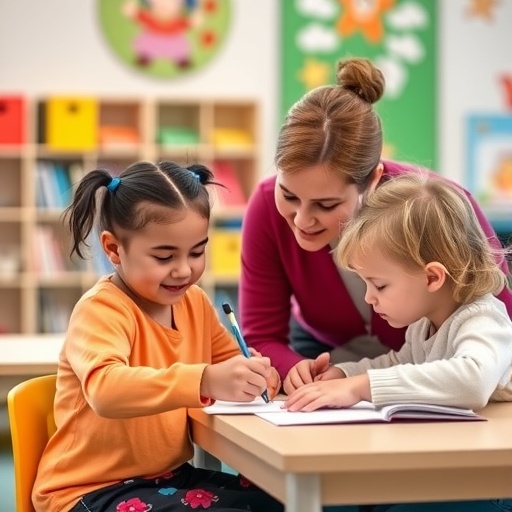
In the realm of early childhood education, there is growing recognition of the critical role social and emotional learning (SEL) plays in shaping children’s lifelong trajectories. While many educational systems prioritize cognitive and language development, they often overlook the social-emotional domain, which underpins children’s capacity to manage emotions, foster relationships, and navigate complex social milieus. Recent empirical research led by Dr. Seema Lasi from Aga Khan University, in collaboration with colleagues from Ball State University, has provided compelling evidence that structured SEL-focused professional development for preschool teachers can markedly enhance classroom environments and elevate the social-emotional well-being of young learners in resource-limited settings like Pakistan.
The study, published in the esteemed ECNU Review of Education, constitutes a quasi-experimental investigation into how targeted teacher training influences pedagogical quality and child outcomes. Conducted across 12 public preschool settings in Karachi, the research engaged 24 educators and observed 410 children, offering a comprehensive analysis over a four-month intervention period. Teachers participating in the treatment arm received an intensive 48-hour training regimen centered on SEL competencies, paired with ongoing mentorship to ensure practical application and pedagogical integration of the approaches in their classrooms.
Methodologically, the study employed a comparison between intervention and control groups to discern statistically significant changes across several dimensions of the classroom experience. Evaluative metrics encompassed emotional support, classroom organization, and instructional support—three pivotal domains that collectively shape the quality of the learning environment. Results were telling; improvements were not only statistically significant with p-values of .036 for emotional support, .009 for classroom organization, and less than .001 for instructional support, but they also translated into observable shifts in teacher-student dynamics and elevated engagement levels.
From the children’s perspective, the intervention yielded a suite of social-emotional benefits. Analytical data indicated a marked reduction in behavioral difficulties, enhanced peer relations, and increased demonstration of prosocial behaviors such as empathy and cooperation. Although specific subdomains like emotional symptoms, conduct problems, and hyperactivity did not achieve statistical significance, the holistic improvement trajectory underscores the efficacy of equipping teachers with SEL tools to manage and nurture early childhood behavioral challenges.
This research enters a broader discourse about the systemic gaps in early childhood education infrastructures, particularly in low- and middle-income countries where socioemotional skills remain insufficiently addressed. The majority of children entering school in such contexts often lack foundational skills in emotional regulation and interpersonal communication, factors which are indispensable for academic and social success. Dr. Lasi and her team highlight that the linchpin for bridging this divide is empowering the teacher workforce with the appropriate training and resources, thereby catalyzing a positive feedback loop for child development outcomes.
Crucially, the study’s findings advocate for the integration of SEL pedagogy within the core curriculum of teacher education frameworks. Embedding SEL content in both pre-service and in-service teaching programs is presented as a strategic lever to institutionalize these practices. Moreover, scaling professional development initiatives across public school systems emerges as a pathway for systemic reform, underscoring not just curriculum content but also the quality of classroom interactions and instructional delivery as dimensions of equal priority.
The cultural context is an important variable discussed by the researchers. The authors caution against one-size-fits-all SEL models imported from Western educational paradigms without adaptation. Instead, the crafting of culturally responsive curricula that resonate with local beliefs, values, and social norms is championed as essential for effective implementation and sustainability. This tailored approach addresses linguistic nuances, community expectations, and prevalent child-rearing philosophies, thus enhancing receptiveness among educators and learners alike.
Technically, the study’s quasi-experimental design strengthens the argument for causality between teacher training and enhanced child outcomes, despite limitations inherent in non-randomized allocations. The rigorous application of validated observational tools and behavioral assessments contributes to reliability and replicability. Importantly, ongoing mentorship was identified as a key mechanism facilitating continuous skill acquisition, reflective practice, and adaptive instruction, components often missing in professional development models globally.
From a policy standpoint, the researchers assert that investment in early social-emotional competencies offers a high return, not only in educational attainment but also in long-term health and social stability. By nurturing emotional intelligence and relationship skills early, children are better poised to avoid risky behaviors, improve mental health trajectories, and engage as constructive citizens. The article fervently calls for governments and educational stakeholders in Pakistan and comparable regions to prioritize SEL, leveraging evidence-based teacher training as a cost-effective intervention.
In conclusion, the study offers a replicable blueprint demonstrating that quality teacher preparation in SEL is feasible even in constrained resource settings and can precipitate significant improvements in preschoolers’ social-emotional development. By transitioning from fragmented curricular attention to integrated, sustained support for educators, early childhood education systems can be transformed into nurturing environments that holistically cultivate children’s potential. As global educational communities seek comprehensive solutions, these findings present a clarion call for reimagining teacher roles as agents of socioemotional change, pivotal for the generation of healthier, more resilient future populations.
News Publication Date: 10-Apr-2026
Web References: http://dx.doi.org/10.1177/20965311261421647
References:
Lasi, S., et al. (2026). Preschool Teacher Professional Development for Promoting Social-Emotional Learning in Pakistan: A Quasi-Experimental Study. ECNU Review of Education. https://journals.sagepub.com/doi/10.1177/20965311261421647
Cite Scienmag News
Courtney Benton. (June 23, 2026). Teacher Training Enhances Preschool Classroom Quality and Boosts Children’s Social-Emotional Well-Being. Scienmag. https://scienmag.com/teacher-training-enhances-preschool-classroom-quality-and-boosts-childrens-social-emotional-well-being/
Courtney Benton. "Teacher Training Enhances Preschool Classroom Quality and Boosts Children’s Social-Emotional Well-Being." Scienmag, 23 June 2026, https://scienmag.com/teacher-training-enhances-preschool-classroom-quality-and-boosts-childrens-social-emotional-well-being/. Accessed 3 September 2026.
Courtney Benton. "Teacher Training Enhances Preschool Classroom Quality and Boosts Children’s Social-Emotional Well-Being." Scienmag. June 23, 2026. https://scienmag.com/teacher-training-enhances-preschool-classroom-quality-and-boosts-childrens-social-emotional-well-being/


