


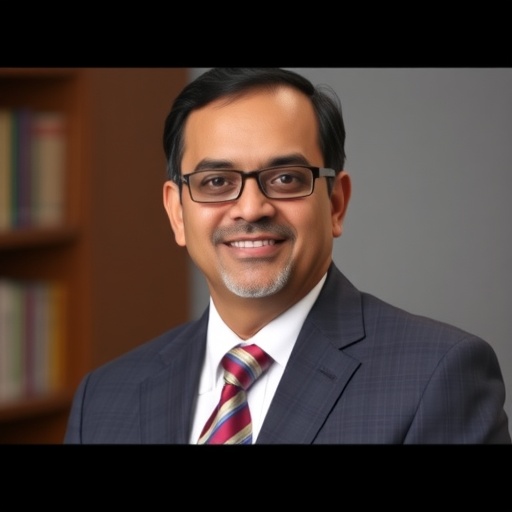
Goutham M. Menon has returned to The University of Texas at Arlington to lead its School of Social Work during a period of rapid expansion in research, enrollment and community engagement. Menon began serving as interim dean on Aug. 1, bringing decades of experience in social work education, academic administration and technology-focused professional training to one of the nation’s most research-active social work schools. His appointment places a nationally recognized scholar and institutional strategist at the center of UTA’s efforts to prepare social workers for a profession increasingly shaped by digital tools, changing labor markets and complex social challenges.
Menon most recently served as dean of the Loyola University Chicago School of Social Work, where he worked with faculty, staff and students to broaden academic programs, strengthen research activity and deepen relationships with community organizations. His leadership focused on connecting classroom learning with the conditions social workers encounter in practice, including public health emergencies, housing insecurity, behavioral health needs and inequitable access to essential services. By expanding student pathways and encouraging collaboration across disciplines, he helped position social work education as a field that combines human-centered care with evidence-based analysis, data-informed decision-making and technological innovation.
At UTA, Menon succeeds during a notable phase of institutional momentum. The School of Social Work has reported record achievements in research, student success, philanthropy and community engagement, while its programs continue to attract students seeking careers in health care, child welfare, mental health, public policy and community development. Faculty members publish more than 200 peer-reviewed articles annually, a level of productivity that places UTA among the top 3% of 319 graduate social work programs nationwide for research output. The figure reflects not only the volume of scholarship but also the growing role of social work research in evaluating interventions, measuring social conditions and translating scientific findings into policies and services.
The school’s Master of Social Work program has also reached record enrollment and is ranked No. 43 in the latest U.S. News & World Report assessment. Graduate social work programs typically combine theoretical instruction with supervised field education, allowing students to apply research methods, clinical frameworks and policy analysis in real-world settings. That combination is becoming increasingly important as social workers are asked to interpret complex data, coordinate services across institutions and respond to populations affected by overlapping economic, medical and social pressures. Menon’s experience in developing innovative academic programs is expected to support the school as it expands access while maintaining professional standards and student support.
Provost and Senior Vice President for Academic Affairs Tamara L. Brown said Menon’s leadership, scholarship and service record would help sustain the school’s progress. She also emphasized his commitment to educational access, student success and preparing social workers for emerging societal needs. Those priorities are closely connected to the changing science of professional education. Digital simulations, online instruction, predictive analytics and technology-assisted case management are reshaping how students learn and how services are delivered. Used responsibly, these tools can expose students to complex scenarios, help educators assess developing competencies and make educational opportunities available to people who cannot relocate or attend traditional programs.
Menon has played a prominent role in national discussions about technology-enhanced education, workforce development and professional preparation. In social work, technology is not simply a matter of convenience; it can influence how clients are screened, how risks are evaluated and how scarce resources are allocated. Electronic records can make it easier for agencies to coordinate care, while telehealth platforms can extend mental health and social services to rural or underserved communities. At the same time, automated systems can reproduce bias if they are trained on incomplete or discriminatory data. Social work education therefore must teach both the practical use of digital systems and the ethical principles needed to protect privacy, informed consent, autonomy and human judgment.
The National Association of Social Workers recognized Menon as a Social Work Pioneer in 2024 for contributions to technology and innovation in social work practice and education. The honor reflects a broader transformation within the profession, where social workers increasingly collaborate with computer scientists, public health researchers, educators and policymakers. These partnerships can produce new tools for identifying unmet needs, evaluating programs and delivering support across geographic boundaries. They also raise difficult questions about surveillance, data ownership and algorithmic accountability. A technically sophisticated social work curriculum must address these issues directly, ensuring that innovation improves access and outcomes rather than widening existing disparities.
Menon previously held leadership and academic positions at the University of Nevada, Reno, the University of Texas at San Antonio and the University of South Carolina. He also served as an assistant professor in UTA’s School of Social Work from 1996 to 1998, making his appointment a return to the university where part of his academic career began. His familiarity with the institution, combined with experience at multiple universities, may help him guide the school through a transitional year. The University plans to begin a national search for a permanent dean this fall, meaning Menon’s immediate responsibility will be to maintain continuity while supporting faculty research, student achievement and the school’s existing strategic priorities.
Menon has described his interim role as an effort to execute the school’s current plan rather than replace it. He said the school already possesses strong programs, dedicated faculty and staff, and a commitment to students and communities, adding that his goal is to help the institution carry out its strategy collectively. That approach places emphasis on organizational stability at a moment when universities are navigating financial pressure, changing enrollment patterns and heightened demand for workforce-ready graduates. In social work, the challenge is particularly urgent: communities need professionals capable of combining scientific evidence, cultural understanding, clinical skill and public-sector coordination.
The appointment arrives as social work education becomes increasingly visible as a scientific and technological discipline as well as a helping profession. Research in the field examines how social environments influence health, how interventions affect families and communities, and how policy decisions shape outcomes across populations. UTA’s expanding research profile and Menon’s background in innovation place the school in a strong position to contribute to those conversations. As the university prepares to select a permanent dean, the interim leadership period will test how effectively the school can build on its research productivity, expand educational opportunity and prepare future social workers for a world in which human services and advanced technology are becoming inseparable.
Cite Scienmag News
Courtney Benton. (August 21, 2026). UTA Appoints Goutham Menon Interim Dean of Social Work. Scienmag. https://scienmag.com/uta-appoints-goutham-menon-interim-dean-of-social-work/
Courtney Benton. "UTA Appoints Goutham Menon Interim Dean of Social Work." Scienmag, 21 August 2026, https://scienmag.com/uta-appoints-goutham-menon-interim-dean-of-social-work/. Accessed 4 September 2026.
Courtney Benton. "UTA Appoints Goutham Menon Interim Dean of Social Work." Scienmag. August 21, 2026. https://scienmag.com/uta-appoints-goutham-menon-interim-dean-of-social-work/


