


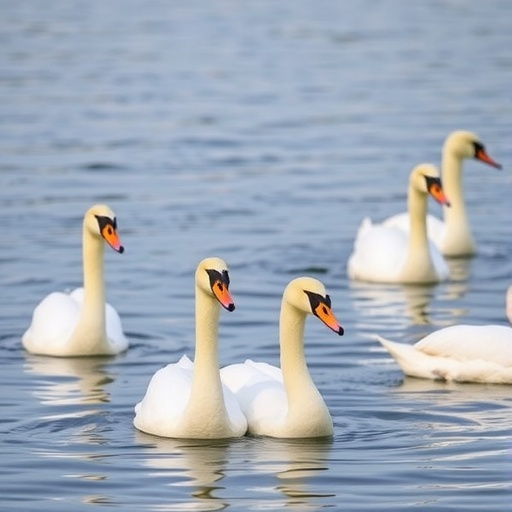
Young Bewick’s swans appear to carry more than family memories into their first migration: they may depend on their parents for the timing, route and social knowledge needed to survive. A new study tracking the movements of juvenile swans has found that birds orphaned during winter left for the Arctic nearly a month later than juveniles that remained with their families. Once they began moving north, many struggled to keep pace with the wider population, and their survival into the following winter fell dramatically. The results suggest that, for a long-lived and highly social bird, family life is not simply a convenient way to travel—it may be a biological requirement during the most vulnerable stage of life.
The research, published in Behavioral Ecology and Sociobiology, combined GPS telemetry with genetic analysis to reconstruct the social lives of 55 Bewick’s swans belonging to 12 complete family groups. The birds included adults and juveniles, allowing researchers to identify biological relationships, monitor how long family groups stayed together and determine what happened after those relationships were disrupted. Of the 24 young swans examined in detail, 10 lost their parents during the winter following disturbances at important feeding and roosting sites. The disruptions were associated primarily with hunters entering a protected nature reserve used by the swans. The orphaned juveniles then faced the spring migration without the adults that normally guide them.
Bewick’s swans breed on the Arctic tundra of European Russia and spend the winter in the Netherlands, Belgium, the United Kingdom and surrounding regions. Their annual journey is a chain of ecological decisions, linking winter wetlands with breeding grounds thousands of kilometres away. Families normally remain together through the winter and well into the first spring migration, when the young are almost one year old. During this period, juveniles can follow experienced adults, learn stopover locations and match the pace of the group. That timing is critical because arriving too late in the Arctic can mean missing the seasonal peak in food availability, reducing the chance of successful breeding later in life.
GPS data revealed a sharp difference between juveniles that retained their family connections and those that became orphaned. The first northward migration of the orphaned birds began, on average, almost a month later than that of juveniles whose family status remained unchanged. Researchers used the date on which the birds crossed 12.5 degrees east as a standardized proxy for migration departure. The delay was not merely a change in calendar timing. Once underway, the orphaned swans also progressed northward more slowly and often remained far behind the main population. One young bird did not leave northern Germany until April, even though other swans had already moved deep into their spring route.
This delay may reflect the loss of social information as much as the loss of protection. Migration in swans is not an entirely pre-programmed process. Young birds develop their route choices through repeated movement with older, more experienced individuals. Adults may identify safe resting places, profitable feeding areas and appropriate weather windows, while juveniles conserve energy by travelling within a coordinated family group. A young swan moving alone must make decisions that it would normally learn gradually. The result can be a later departure, inefficient route selection and an inability to maintain the speed required to reach the breeding grounds at the right time.
The consequences were visible in the birds’ survival records. Juveniles that remained with their parents for most of the migration had a survival rate of about 86 percent into the next winter. Among the orphaned birds, survival fell to approximately 40 percent. Several orphaned swans transmitted signals for only part of the year, while others never reappeared in the tracking data after reaching the northern range. Four orphaned birds and two individuals from the reference group died in the northern part of the range, and additional deaths were inferred when transmitters failed to return to the network. Although the absence of a signal cannot always prove the precise cause of death, the pattern strongly links family separation with elevated first-year mortality.
The tracking system also exposed a technological limitation that makes the birds’ fate especially difficult to follow. The breeding grounds lie in remote Arctic regions without reliable mobile-phone coverage. GPS units can store location data, but they cannot transmit those data continuously when the birds are outside communication networks. During the summer, researchers may therefore receive no information for months. When the swans migrate south in autumn and return to areas with network coverage, the transmitters begin sending data again. A returning signal confirms that a bird survived. Silence, however, can mean either a technical failure or death, forcing researchers to interpret the records cautiously.
One bird, identified as 036T, provided a rare example of resilience after family loss. Her mother was shot at the wintering grounds, after which the juvenile travelled to Great Britain in February and joined another swan family. For roughly two weeks, 036T moved with the foster group across British agricultural landscapes and later toward northern Germany. That association ended in mid-March, and on 26 March she began the spring migration independently—late, but still able to continue. In September, she encountered her biological father in the Russian Arctic. The pair travelled south together for another week, and five years later 036T remained alive. Her story suggests that social bonds may sometimes be rebuilt, although the study indicates that such outcomes are unusual rather than typical.
The findings arrive as the northwest European Bewick’s swan population continues to decline. The species is the smallest of the three swans regularly found in the Netherlands and Belgium, and its winter distribution has shifted over recent decades from traditional concentrations in England and the Netherlands toward northwest Germany. Habitat protection alone may not be enough if birds are repeatedly disturbed during the period when juveniles depend on their parents. The researchers argue that conservation must include quiet, undisturbed wintering and stopover areas, particularly through the first spring migration. Preventing disturbance at feeding and roosting sites could preserve not only individual birds but also the social transmission of migratory knowledge that helps sustain the population across generations.
The study turns a familiar image—young swans travelling behind their parents—into a measurable survival mechanism. Family groups provide guidance, timing, protection and access to information that juveniles cannot easily acquire on their own. When those groups are broken apart at the wrong moment, the effects can extend across thousands of kilometres, from European wetlands to the Arctic tundra. For Bewick’s swans, staying with the family through the first winter and spring journey may determine whether a young bird reaches the breeding grounds, survives the summer and returns the following autumn—or disappears from the migration altogether.
News Publication Date: 20-Aug-2026
Web References: https://link.springer.com/article/10.1007/s00265-026-03787-5
References: Linssen, Hans, and colleagues. “Family life is critical for migration and survival in a long-lived social bird.” Behavioral Ecology and Sociobiology, published 20 August 2026.
Cite Scienmag News
Violet Maxwell. (August 21, 2026). Winter separation of swan families disrupts their spring migration. Scienmag. https://scienmag.com/winter-separation-of-swan-families-disrupts-their-spring-migration/
Violet Maxwell. "Winter separation of swan families disrupts their spring migration." Scienmag, 21 August 2026, https://scienmag.com/winter-separation-of-swan-families-disrupts-their-spring-migration/. Accessed 3 September 2026.
Violet Maxwell. "Winter separation of swan families disrupts their spring migration." Scienmag. August 21, 2026. https://scienmag.com/winter-separation-of-swan-families-disrupts-their-spring-migration/


