


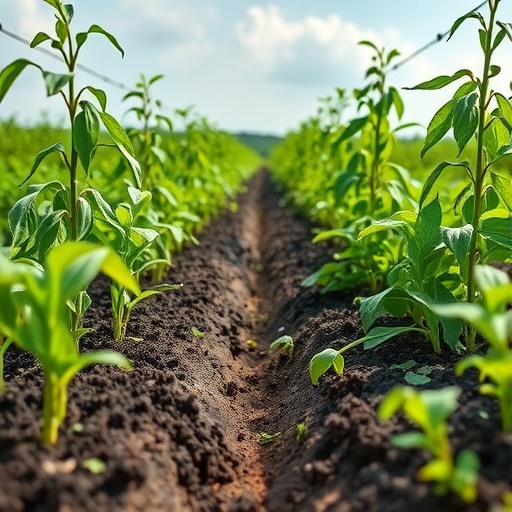
A groundbreaking study published in the journal Biochar unveils the remarkable potential of liquid biochar mineral complex (BMC) fertilizers to revolutionize agricultural productivity and environmental sustainability. By merging advanced biochar technology with micronutrient-enriched mineral formulations, these novel liquid fertilizers demonstrate significant improvements in pasture yield, nutrient use efficiency, and economic viability in large-scale farming systems. This pioneering research addresses urgent global challenges linked to soil degradation, increasing fertilizer demands, and climate change pressures, proposing a new paradigm for agricultural nutrient management that could reshape farming practices worldwide.
The research, conducted in New South Wales, Australia, involved meticulous experimentation with four innovative liquid BMC formulations designed to optimize nutrient availability and soil health. These included two non-enriched micronized BMCs, as well as phosphorus and nitrogen-enriched variants. Their performance was assessed in a pasture cropping system, with treatments applied both independently and alongside conventional co-fertilizers. Rigorous measurements of soil chemical properties, plant nutrient uptake, microbial community dynamics, pasture biomass production, and cost-benefit outcomes provided comprehensive insight into the fertilizers’ multifaceted impacts.
Among the formulations tested, the nitrogen-enriched BMC, referred to as BMC4, emerged as a standout performer. Pasture yields under BMC4 treatment soared to an impressive 42.20 tons per hectare, eclipsing the 18.75 tons per hectare achieved by conventional fertilization and the 11.53 tons per hectare of unfertilized controls. This striking yield enhancement highlights the advanced nutrient delivery systems embedded within the liquid biochar matrix, which not only supply essential nutrients but also facilitate improved nutrient assimilation and retention by plant root systems.
A deeper analysis revealed that BMC4 was unique in sustaining positive nitrogen and phosphorus balances within the soil-plant system, indicating that this formulation supported crop growth without depleting inherent soil nutrient reserves. This finding is critical from both agronomic and ecological perspectives, suggesting that BMC4 use mitigates soil nutrient mining—a common problem in intensive agriculture—thereby promoting long-term soil fertility and resilience. By maintaining nutrient equilibrium, BMC4 holds the promise of enhancing sustainable productivity while reducing reliance on finite mineral fertilizer inputs.
In contrast, the non-enriched BMCs (BMC1 and BMC3) exhibited significant yield improvements only when paired with conventional fertilization regimes. These improvements are hypothesized to stem from the biochar’s capacity to modify soil phosphorus bioavailability, likely through complex interactions involving mineral adsorption-desorption processes and microbial-mediated nutrient cycling. This tailored response underscores the importance of formulation specificity and soil nutrient context when deploying biochar-based fertilization technologies.
The study also investigated the short-term effects of BMC application on soil microbial communities, a vital consideration given the integral role microbes play in nutrient transformation and soil health. Encouragingly, microbial composition and abundance remained stable across treatments, indicating that yield gains were achieved without disrupting microbial ecosystem functions. This stability suggests that liquid BMCs can enhance nutrient cycling and plant growth without compromising the beneficial soil microbiome, an essential element for sustainable agricultural systems.
From an economic standpoint, the research delved into the cost-effectiveness of liquid BMC fertilizers, revealing benefit-cost ratios ranging from 1.94 to 2.54 across tested formulations. This metric demonstrates that benefits, including increased pasture production and nutrient use efficiency, significantly outweighed associated input costs. Notably, BMC4 ranked highest in net income gains, further reinforcing its dual advantages of agronomic efficacy and financial feasibility. Such promising economic returns bolster the practical appeal of integrating liquid biochar mineral complexes into routine farming operations.
Professor Shahla Hosseini Bai, the study’s lead author and a prominent figure in biochar research, emphasized the transformative potential of these liquid fertilizers, stating, “Our findings highlight how the molecular and nutrient composition of liquid biochar fertilizers can be fine-tuned to deliver measurable gains in crop yield and environmental stewardship. BMC4’s ability to increase productivity while preserving soil nutrient stocks represents a critical advance for sustainable agronomy.” Her insights encourage continued innovation and adaptation of biochar-fertilizer technologies within diverse agroecosystems globally.
Looking beyond this initial experiment, the study advocates for extended research across varying soil types, climatic conditions, and crop species to elucidate the broader applicability and long-term impacts of liquid BMC products. Such investigations are essential to fully harness the technology’s promise and to develop guidelines tailored to regional agricultural challenges. The dynamic interplay among biochar physicochemical properties, mineral nutrient formulations, crop-specific nutrient demands, and microbial interactions will likely reveal new pathways for optimizing nutrient management strategies.
The implications of this research extend well beyond pasture systems, suggesting biochar mineral complex fertilizers could be adapted to improve the nutrient efficiency of a wide array of crops including cereals, legumes, and horticultural plants. When integrated into sustainable farming frameworks, these next-generation fertilizers may contribute significantly to mitigation of greenhouse gas emissions from fertilizer use, reduction of nutrient runoff into water bodies, and restoration of degraded soils. This aligns with global initiatives targeting climate resilience and food security in the face of mounting environmental pressures.
In summary, this study marks a significant milestone in the agricultural sciences by demonstrating that liquid biochar mineral complex fertilizers can transcend traditional nutrient delivery paradigms. By coupling the soil-enhancing attributes of biochar with thoughtfully engineered mineral enrichments, the research offers a versatile platform for amplifying crop yields while safeguarding soil health and economic viability. As the agricultural sector grapples with its dual mandate of feeding a growing population and preserving natural resources, liquid BMCs represent a promising beacon of innovation poised to redefine the future of farming.
News Publication Date: 22-Apr-2026
Web References: Biochar Journal, Article DOI
References: Omidvar, N., Joseph, S., Dissanayake, L. et al. Distinct forms of liquid biochar mineral complex fertilisers differently increase crop yield, nutrient balance and economic return. Biochar 8, 94 (2026).
Cite Scienmag News
Alan Morgan. (June 23, 2026). Liquid biochar fertilizer offers farmers higher yields with reduced nutrient loss. Scienmag. https://scienmag.com/liquid-biochar-fertilizer-offers-farmers-higher-yields-with-reduced-nutrient-loss/
Alan Morgan. "Liquid biochar fertilizer offers farmers higher yields with reduced nutrient loss." Scienmag, 23 June 2026, https://scienmag.com/liquid-biochar-fertilizer-offers-farmers-higher-yields-with-reduced-nutrient-loss/. Accessed 3 September 2026.
Alan Morgan. "Liquid biochar fertilizer offers farmers higher yields with reduced nutrient loss." Scienmag. June 23, 2026. https://scienmag.com/liquid-biochar-fertilizer-offers-farmers-higher-yields-with-reduced-nutrient-loss/


