


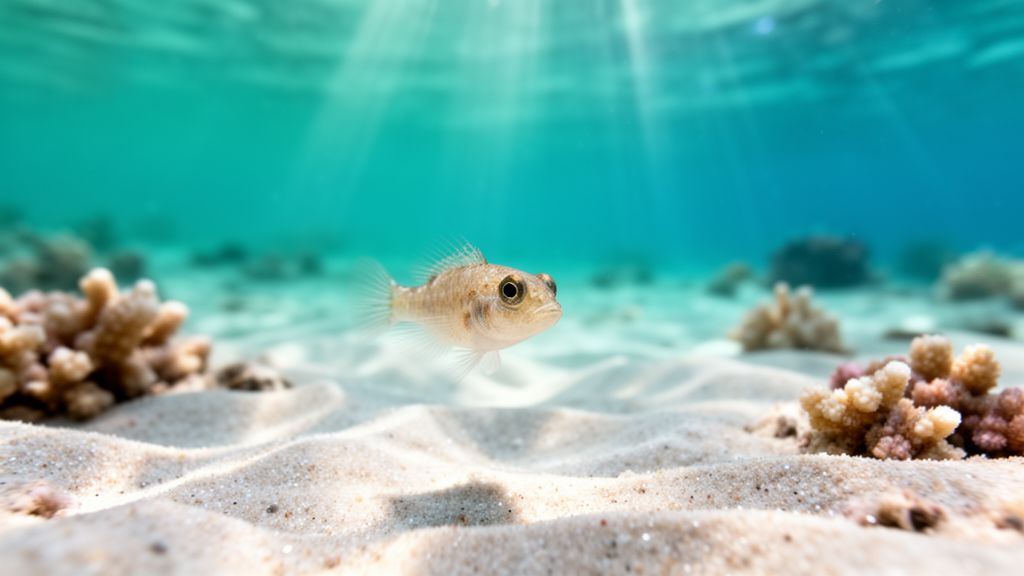
A taxonomic study has formally described Trimma charon sp. nov., a new pygmygoby known from two small specimens collected at a cave entrance on Walih Island in the northern Red Sea. The fish are distinguished by a broad orange-red midlateral stripe interrupted by three pale bars, golden spots on the caudal fin, a scaleless cheek and opercle, and a combination of fin-ray, scale and cephalic sensory papillae characters. The description raises the number of recognized Trimma species recorded in the Red Sea from 10 to 11.
The holotype measures 16.8 mm standard length, and the paratype measures 12.1 mm. Both were collected on 15 May 2023 at 30 m depth on a steep reef slope beside a cave, where they rested on dead carbonate substrate with little living or recently dead coral. The site lies at 27.7897°N, 35.1630°E in Saudi Arabia. The type specimens were deposited in the ichthyology collection of the Royal Ontario Museum as ROMI118236 and ROMI118237.
The diagnosis identifies T. charon by the presence of scales along the predorsal midline in the larger specimen, an unbranched fifth pelvic-fin ray measuring 41–43% of the fourth ray, 14 unbranched pectoral-fin rays, dorsal fins with six spines and eight soft rays, and six papillae in cephalic sensory papillae row c. Its bony interorbital width is 55–62% of the pupil diameter. The smaller paratype lacks the predorsal scales, possibly because of abrasion or incomplete development.
Live coloration also helps distinguish the new species. Its translucent body bears a broad orange-red stripe extending from the eye to the base of the hypural plate. Three narrow pale bars interrupt the stripe, two beneath the second dorsal fin and one on the caudal peduncle. Numerous golden spots occur on the caudal fin and extend onto the caudal peduncle. The iris is divided into four uneven sectors, with white dorsal and ventral portions and orange anterior and posterior portions, the latter smaller. Nearly all of this body coloration fades in preserved specimens.
For the taxonomic analysis, the authors followed standardized morphometric and meristic procedures used in earlier studies of Trimma. Measurements were taken with digital calipers, and preserved anatomical features were examined with a ZEISS stereomicroscope. Live and freshly dead coloration was documented immediately after collection, while images of diagnostic structures were focus-stacked and edited for presentation. Selected specimens were briefly stained with cyanine blue to improve the visibility of cephalic sensory papillae and scales.
Molecular sequences had previously been generated from the type vouchers and were made available through GenBank. The holotype has sequences for the COI, 16S, Ptr and S7I1 loci, while the paratype has a COI sequence. Based on available COI sequences for 93 described species of Trimma, T. anaima was reported as the genetically closest species, with 85–86% pairwise identity. The authors cautioned that broader phylogenetic analysis is needed to establish the new species’ sister lineage, and their evolutionary interpretation depends on whether T. charon is endemic to the Red Sea.
Morphologically, T. charon most closely resembles the Indo-West Pacific T. anaima, which has not been reported from the Red Sea. Both species share an orange-to-red midlateral stripe, an unbranched fifth pelvic-fin ray, VI + I,8 dorsal fins, I,8 anal fins and no elongate dorsal-fin spines. The new species differs by its predorsal scales, 14 rather than 15–17 pectoral-fin rays, pale bars interrupting its midlateral stripe, golden caudal-fin spots and a segmented iris. Within the Red Sea, it differs from T. nubarum and T. fishelsoni because its second dorsal-fin spine is not elongate and filamentous.
The paper also provides a dichotomous identification key for all 11 Trimma species recorded from the Red Sea, together with photographs and qualitative habitat and depth observations. Those observations are based mainly on scuba surveys along the Saudi Arabian coast, from the Gulf of Aqaba south to the Farasan Banks, with more limited information from the southern Red Sea and Gulf of Aden. Because most surveys were restricted to depths of 0–30 m, absence from the observations should not be interpreted as evidence that a species does not occur at greater depths.
Only two specimens of T. charon are known, both from the same 30 m collection site, and extensive surveys of comparable habitats elsewhere in the Red Sea did not yield additional material. The authors therefore state that the species may be genuinely rare, or that 30 m may be the shallowest limit of its distribution and it could be more abundant on deeper reefs. The Red Sea’s mesophotic zone remains comparatively undersampled, and the authors conclude that additional Trimma species are likely to be discovered at 30 m and below.
Subject of Research: Taxonomic description and Red Sea distribution of the pygmygoby Trimma charon
Article Title: Trimma charon , a new species of pygmygoby ( Teleostei , Gobiidae ) from the Red Sea with a key to the Red Sea species of the genus
Article References: Peinemann, V. N., Bogorodsky, S. V., Tietbohl Talas, M. D., & Berumen, M. L. (2026). Trimma charon, a new species of pygmygoby (Teleostei, Gobiidae) from the Red Sea with a key to the Red Sea species of the genus. ZooKeys, 1293, 1-16. https://doi.org/10.3897/zookeys.1293.204097
Image Credits: AI Generated
DOI: 10.3897/zookeys.1293.204097
Keywords: Trimma charon, pygmygoby, Gobiidae, Red Sea, species description, taxonomy, morphology, mesophotic reefs, Walih Island, fishes of Saudi Arabia, Trimma, charon
Cite Scienmag News
Drew Townsend. (October 20, 2026). Taxonomic study describes Charon’s pygmygoby from two Red Sea specimens. Scienmag. https://scienmag.com/taxonomic-study-describes-charons-pygmygoby-from-two-red-sea-specimens/
Drew Townsend. "Taxonomic study describes Charon’s pygmygoby from two Red Sea specimens." Scienmag, 20 October 2026, https://scienmag.com/taxonomic-study-describes-charons-pygmygoby-from-two-red-sea-specimens/. Accessed 20 October 2026.
Drew Townsend. "Taxonomic study describes Charon’s pygmygoby from two Red Sea specimens." Scienmag. October 20, 2026. https://scienmag.com/taxonomic-study-describes-charons-pygmygoby-from-two-red-sea-specimens/


