


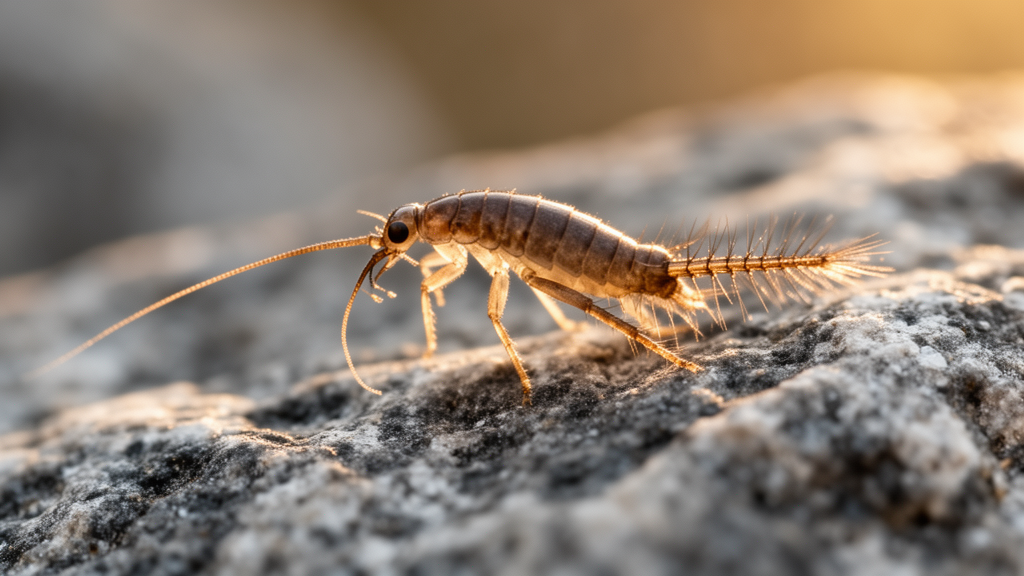
A captive male jumping bristletail, Petrobiellus akkesiensis, was observed cleaning its antenna for several minutes, providing the first documented record of antennal cleaning behaviour in Archaeognatha. The observation was made on 26 October 2021 after the insect had been transferred to a laboratory tray, and the behaviour was subsequently recorded on both its right and left antennae.
The study was a short observational note involving animals rather than an experiment designed to test a physiological or evolutionary mechanism. Researchers collected 65 P. akkesiensis specimens, comprising 25 males and 40 females, from a rocky shore near Cape Washibetsu in Noboribetsu City, Hokkaido, Japan, on 19 October 2021. The specimens were maintained in the laboratory under a previously described rearing protocol, and photographs and video recordings were made with a Ricoh GXR digital camera.
At approximately 23:45 on 26 October, the male was placed in a plastic tray measuring 373 by 273 by 63 mm and lined with black paper. The basal part of the right antennal flagellum was bent so that its distal end pointed posteriorly, and cleaning began along the flagellum. The scapus and pedicellus remained directed anteriorly, and no cleaning of those two antennal segments was detected.
From a dorsal view, the male moved its maxillary palpi through abduction and adduction movements, accompanied by slight movements of the labial palpi and right foreleg. No movement of the mandible could be detected from that viewing angle. Cleaning proceeded from the base of the flagellum toward its distal tip. As the distal portion was cleaned, the middle region of the flagellum became markedly bent. Throughout the sequence, the right foreleg remained near the mouthparts, with its tip directed medially.
Similar cleaning was subsequently observed on the left antenna of the same male, and a video recorded the behaviour. During the left-sided sequence, the left mid-leg was positioned close to the left foreleg, although no movement of that mid-leg was detected during cleaning. Despite continued rearing of this male and other P. akkesiensis individuals until at least 10 May 2022, no additional cleaning observations were recorded in any individual.
Archaeognatha, commonly called jumping bristletails, is an order of wingless ectognathan insects with approximately 600 described species distributed across every continent except Antarctica. The order includes the families Machilidae and Meinertellidae. P. akkesiensis belongs to Petrobiellinae, a subfamily containing the single genus Petrobiellus. Members of Petrobiellus lack scales on the antennae, maxillary and labial palpi, thoracic appendages and styli, distinguishing them from scaled members of Machilinae.
Antennal cleaning had previously been documented in several apterygote hexapod groups, including Collembola, Diplura and Zygentoma, but not in Archaeognatha. A previous interpretation proposed that the behaviour was absent from Archaeognatha because cleaning could damage scales covering the antennae, based on the assumption that a fully scaled antenna represented the ancestral condition within Machiloidea. The observation in P. akkesiensis, whose antenna is unscaled, shows that this interpretation cannot be applied to all archaeognathans. The presence or absence of both antennal scales and cleaning behaviour across the order requires further investigation.
The findings also raise the possibility that cleaning may occur in other archaeognathan groups with reduced or absent antennal scaling, including Petrobiinae, Meinertellidae and Ditrigoniophthalmus, but the study did not test those groups. The position of the forelegs near the mouthparts suggests that they may assist with holding the antenna, although their exact role was not established by the observations. Foreleg use during antennal cleaning also varies among other apterygote insects, including Zygentoma and Diplura. The observation was limited to one captive male, with no comparable behaviour seen in the other individuals maintained through May 2022, so the results establish the first record in Archaeognatha but do not show how frequently the behaviour occurs in nature.
Subject of Research: First captive observation of antennal cleaning behaviour in the jumping bristletail Petrobiellus akkesiensis.
Article Title: First observation on the antennal cleaning behaviour in Archaeognatha ( Insecta )
Article References: Mtow, S. (2026). First observation on the antennal cleaning behaviour in Archaeognatha (Insecta). Deutsche Entomologische Zeitschrift, 73(1), 59-62. https://doi.org/10.3897/dez.73.184404
Image Credits: AI Generated
Keywords: Archaeognatha, Petrobiellus akkesiensis, jumping bristletails, antennal cleaning, insect behaviour, apterygote insects, laboratory observation, animal study, First, observation, antennal, cleaning
Cite Scienmag News
Gavin Prescott. (October 20, 2026). First observation of antennal cleaning behaviour in Archaeognatha. Scienmag. https://scienmag.com/first-observation-of-antennal-cleaning-behaviour-in-archaeognatha/
Gavin Prescott. "First observation of antennal cleaning behaviour in Archaeognatha." Scienmag, 20 October 2026, https://scienmag.com/first-observation-of-antennal-cleaning-behaviour-in-archaeognatha/. Accessed 20 October 2026.
Gavin Prescott. "First observation of antennal cleaning behaviour in Archaeognatha." Scienmag. October 20, 2026. https://scienmag.com/first-observation-of-antennal-cleaning-behaviour-in-archaeognatha/


