


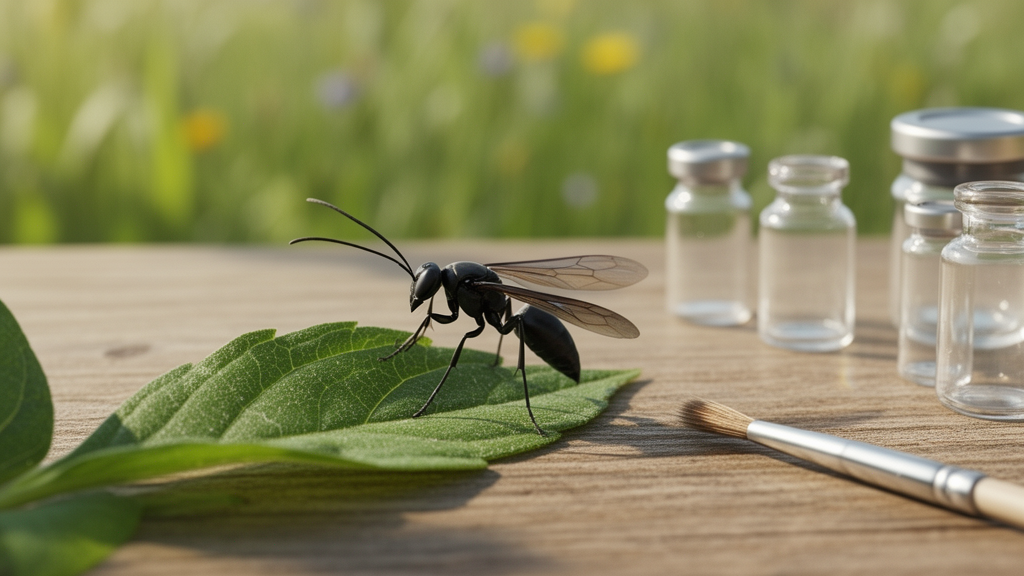
An integrative taxonomic study found at least 23 species in the newly defined Aphanogmus fumipennis species group across the Western Palaearctic and formally described 14 species new to science. The analysis combined detailed morphology, especially male genitalia, with 176 mitochondrial CO1 barcode sequences, demonstrating that the group previously treated as a single widespread species contained multiple distinct lineages.
The study examined 257 ethanol-preserved specimens assigned to the fumipennis group from the Czech Republic, Georgia, Germany, Hungary, Norway, Slovakia, Sweden and Switzerland. Most of the material—123 specimens—was collected in Georgia between 2018 and 2022 through the Caucasus Barcode of Life project. Georgia had previously yielded only three species-level records for Ceraphronoidea, making its material an important focus of the research.
Researchers examined external features and dissected male genitalia, whose structures, including the harpe and gonossiculus, supplied many of the most useful characters for distinguishing species. Selected specimens and anatomical features were also examined using synchrotron X-ray microtomography and confocal microscopy. DNA was extracted non-destructively, and the 619-base-pair CO1 region was amplified and sequenced with Oxford Nanopore and Sanger methods.
The aligned CO1 sequences were analysed in a maximum-likelihood tree and with three species-delimitation approaches: ASAP, objective clustering using SpeciesIdentifier at a 3% threshold, and multi-rate Poisson Tree Processes, or mPTP. These approaches respectively produced 25, 27 and 24 putative species. The differing results were treated as hypotheses rather than automatic species determinations, with formal classifications based on the combined molecular and morphological evidence.
Congruence among all three molecular delimitation analyses and diagnostic morphology supported eight newly described species: Aphanogmus latiharpus, A. digitangulus, A. hafti, A. hamatogonus, A. ventricoharpus, A. zefranki, A. tkheliharpus and A. crispy. Four additional species—A. kintrishi, A. vashlovani, A. trigoharpus and A. bispinatus—were described despite disagreement in one or more molecular analyses, because their morphological diagnoses and other available evidence provided the basis for the taxonomic decisions.
The researchers expanded the diagnosis of Aphanogmus and refined that of the fumipennis species group. A conspicuous posterior mesosomal comb became the group’s principal identification character. It consists of two rows of densely packed setae bordering a smooth, concave area along the posterior metacoxa. Other group characters include a median mesoscutal sulcus, a posteriodistal metacoxal spine, the absence of scattered setae on the posteriomedian metacoxa and a transverse carina on the syntergite. The function of the comb remains unknown.
Distinctive male genitalia supported recognition of Aphanogmus bispinatus, A. crispy, A. digitangulus, A. hafti, A. hamatogonus, A. harpagodalis, A. karlazani, A. kintrishi, A. latiharpus, A. tkheliharpus, A. trigoharpus, A. vashlovani, A. ventricoharpus and A. zefranki. For example, A. bispinatus has basomedian and median spines on the harpe, whereas A. harpagodalis has a pagoda-shaped median spine. A. digitangulus has a rectangular median extension, A. trigoharpus has a triangular apical harpe without spines, and A. ventricoharpus has a broad, convex median extension that gives the harpe a bulbous outline.
Two species, A. harpagodalis and A. karlazani, were described on morphological evidence because no verified CO1 sequence could be assigned to them. A. karlazani was represented by six males from Georgia, Germany and Hungary, but only one barcode was available. A closely related male differed by 1% in sequence distance and had distinctly different genitalia, while molecular delimitation for that specimen was ambiguous. The authors therefore based the description on consistent morphology and stated that additional specimens and sequences were needed to establish its molecular characterization.
The study left Aphanogmus fumipennis as a species inquirenda. Its female lectotype lacks diagnostic characters needed for reliable identification, while the designated male allotype and its dissected genitalia could not be located in the collections searched. Dessart’s published illustration was insufficient to determine the species’ identity, so later geographic records under the name A. fumipennis could not be assigned reliably to species. Beyond the 14 formally described taxa, the researchers identified at least nine additional undescribed putative species, producing a minimum total of 23. Most were represented only by females and lacked sufficiently diagnostic morphology, while several males lacked usable molecular data or had ambiguous delimitation results, so the authors did not formally describe them. The biology of the newly recognized species remains unknown, and host records previously associated with A. fumipennis cannot automatically be transferred to the newly delimited species.
Subject of Research: Integrative taxonomy of the Western Palaearctic Aphanogmus fumipennis species group
Article Title: Known unknowns at our doorstep: Description of 14 Western Palaearctic species within the newly defined Aphanogmus fumipennis species group ( Hymenoptera , Ceraphronoidea , Ceraphronidae )
Article References: Salden, T., Mikó, I., Staverløkk, A., Moser, M., Vasilița, C., van de Kamp, T., Vogel, J., Podsiadlowski, L., Hein, N., Japoshvili, G., & Peters, R. S. (2026). Known unknowns at our doorstep: Description of 14 Western Palaearctic species within the newly defined Aphanogmus fumipennis species group (Hymenoptera, Ceraphronoidea, Ceraphronidae). Journal of Hymenoptera Research, 99, 125-214. https://doi.org/10.3897/jhr.99.178410
Image Credits: AI Generated
Keywords: Aphanogmus, taxonomy, species delimitation, parasitoid wasps, Ceraphronidae, CO1 barcoding, male genitalia, Western Palaearctic, biodiversity, morphology, Known, unknowns
Cite Scienmag News
Margaret Porter. (October 20, 2026). Integrative taxonomy describes 14 new Aphanogmus wasp species in the Western Palaearctic. Scienmag. https://scienmag.com/integrative-taxonomy-describes-14-new-aphanogmus-wasp-species-in-the-western-palaearctic/
Margaret Porter. "Integrative taxonomy describes 14 new Aphanogmus wasp species in the Western Palaearctic." Scienmag, 20 October 2026, https://scienmag.com/integrative-taxonomy-describes-14-new-aphanogmus-wasp-species-in-the-western-palaearctic/. Accessed 20 October 2026.
Margaret Porter. "Integrative taxonomy describes 14 new Aphanogmus wasp species in the Western Palaearctic." Scienmag. October 20, 2026. https://scienmag.com/integrative-taxonomy-describes-14-new-aphanogmus-wasp-species-in-the-western-palaearctic/


