


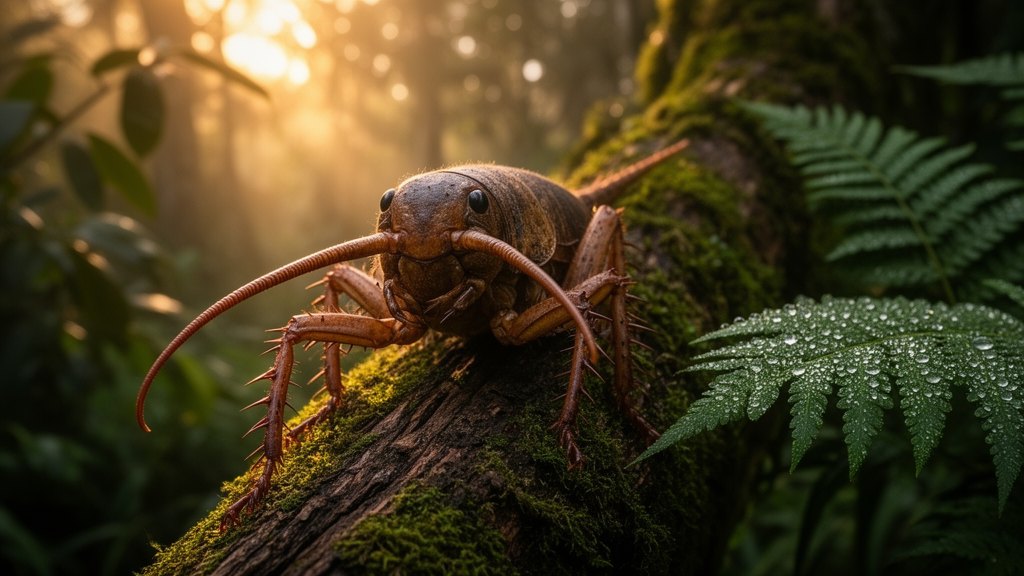
Opportunistic field observations recorded from 2016 to 2023 indicate that Mercury Islands tusked wētā (Motuweta isolata), translocated to Ohinau Island in 2007, expanded from their southern release site to the northernmost monitored seabird colony. The study was an observational field report based on sightings made incidentally during seabird monitoring, rather than a standardized population survey. It also documents scavenging by the wētā on dead seabird chicks and a decline in sightings during a severe drought in the 2019–2020 austral summer.
Ohinau Island is a roughly 43 ha island about 5 km off the east coast of New Zealand’s Coromandel Peninsula. It is owned by Ngāti Hei and co-managed with the Department of Conservation. Kiore, or Pacific rats, and European rabbits were eradicated in 2005. The island supports 12 flesh-footed shearwater colonies, five of which have been monitored since April 2016, with visits generally occurring during egg-laying and incubation in December and January and during chick-rearing and fledging in April and May.
One hundred captive-reared wētā were released at a southern site in November 2007, comprising 44 males and 56 females at least 1.5 cm in body length. Tracking-tunnel surveys in 2011 and 2012 found that the population had dispersed only 60–100 m from the release site. The new observations, covering nine to 16 years after translocation, show a different pattern: wētā were found in monitored colonies across a broad section of the island, with one recorded approximately 830 m from the release site at a temporary research camp in 2020.
The researchers encountered the insects during nocturnal searches of seabird colonies and connecting tracks, and during daytime investigations of burrows. In 2016, wētā were frequently seen only at the southernmost colony and were encountered on few occasions at a central colony, with apparent density decreasing toward the northern end of the southern colony. Sightings farther from the release site became more frequent from 2017. In 2018, researchers recorded wētā at the westernmost colony, on the track linking that colony with the southernmost one, and occasionally at all monitored colonies except the northernmost.
Distribution records extended farther north in 2020, when a single wētā was observed at the temporary camp, about 830 m from the release site. During 2022 and 2023, wētā were encountered more frequently at the camp and within the northernmost monitored colony, while they continued to be found regularly at the other monitored colonies. The authors therefore interpret the observations as evidence of slow initial dispersal followed by more rapid northward expansion and say that the population has likely recolonized the whole island. The southern part of Ohinau Island was not searched, however, so complete island-wide occupation was not directly demonstrated.
Field workers also repeatedly observed M. isolata scavenging on the carcasses of dead seabird chicks in May 2019, primarily flesh-footed shearwater chicks and occasionally grey-faced petrel chicks. The authors state that scavenging had not previously been reported in this species, although it had been proposed as a possible dietary behavior. M. isolata is regarded as an opportunistic carnivore that primarily eats insects, including smaller members of its own species. These observations establish carrion feeding at a monitored colony but do not quantify the contribution of seabird carcasses to the diet or show that carrion enabled establishment.
A severe drought affected the North Island during the 2019–2020 austral summer, and extensive sections of Ohinau Island’s māhoe forest died off. The monitoring team was on the island for six weeks, from 3 to 27 January and 10 to 28 February 2020, without recorded precipitation. Nightly colony searches produced fewer wētā sightings as January progressed into February, and no wētā were seen on the forest floor during the final weeks of February, including around the release site. The observations do not establish the effect of the drought on survival. Wētā were seen in subsequent years and continued to expand, suggesting that some individuals may have remained inactive during the dry period and persisted once conditions improved.
Several features of the island may be associated with establishment. Ohinau lacks tuatara and little spotted kiwi, while morepork are detected infrequently and at low numbers. Duvaucel’s gecko is present at high densities and may prey on the wētā. Burrowing seabirds also modify colony soils and create underground chambers that the wētā use as daytime retreats or in which they excavate galleries. The authors suggest that seabird colonies may have helped the early expansion, but the opportunistic observations cannot establish causal relationships involving predation, habitat conditions, carrion availability or population growth.
The findings come from sightings concentrated around monitored seabird colonies and their tracks, with no systematic measurement of population size, reproductive success or occupancy across the entire island. The authors interpret the expansion as potentially density dependent, in which rapid dispersal begins after a population threshold is reached, but that mechanism was not tested. They recommend standardized surveys on Ohinau and the other islands receiving translocated M. isolata to corroborate the reported range expansion and assess the long-term fate of the populations.
Subject of Research: Range expansion of translocated Mercury Islands tusked wētā on Ohinau Island
Article Title: Recovery and range expansion of the once critically endangered Mercury Islands tusked wētā ( Motuweta isolata ) on Ohinau Island, New Zealand, 16-years post-translocation
Article References: Lamb, S., Olsthoorn, M., Burgin, D., Ray, S., Bell, M., & Crowe, P. (2026). Recovery and range expansion of the once critically endangered Mercury Islands tusked wētā (Motuweta isolata) on Ohinau Island, New Zealand, 16-years post-translocation. Journal of Orthoptera Research, 35(1), 33-40. https://doi.org/10.3897/jor.35.131747
Image Credits: AI Generated
Keywords: Mercury Islands tusked wētā, Motuweta isolata, Ohinau Island, wildlife translocation, range expansion, seabird colonies, drought response, conservation monitoring, New Zealand, Recovery, range, expansion
Cite Scienmag News
Gavin Prescott. (October 20, 2026). Opportunistic observations show Mercury Islands tusked wētā expanding across Ohinau Island after translocation. Scienmag. https://scienmag.com/opportunistic-observations-show-mercury-islands-tusked-weta-expanding-across-ohinau-island-after-translocation/
Gavin Prescott. "Opportunistic observations show Mercury Islands tusked wētā expanding across Ohinau Island after translocation." Scienmag, 20 October 2026, https://scienmag.com/opportunistic-observations-show-mercury-islands-tusked-weta-expanding-across-ohinau-island-after-translocation/. Accessed 20 October 2026.
Gavin Prescott. "Opportunistic observations show Mercury Islands tusked wētā expanding across Ohinau Island after translocation." Scienmag. October 20, 2026. https://scienmag.com/opportunistic-observations-show-mercury-islands-tusked-weta-expanding-across-ohinau-island-after-translocation/


