

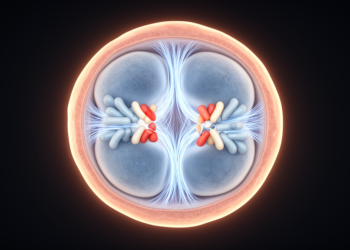
Terminal Breakpoints Shape Chromosome Segregation and Embryo Survival in Translocation Carriers
A study of 399 human embryos from reciprocal translocation carriers shows that terminal breakpoints drive 3:1 segregation and boost blastocyst ...
A study of 399 human embryos from reciprocal translocation carriers shows that terminal breakpoints drive 3:1 segregation and boost blastocyst ...

New research in Science Advances shows that the DREAM complex, long known as a gene-silencing brake in dividing cells, activates ...
A population-wide cytogenetic survey of two Brazilian scorpion species has revealed the lowest chromosome counts ever recorded in the family ...
A cross-species immunocytochemical study of mole voles and mole rats reveals how rare tetraploid spermatocytes form quadrivalents, attempt synaptic adjustment, ...
A new PLOS Pathogens review synthesises the unusual biology of female Cryptosporidium parasites, whose oocyst-building programme underpins transmission of a ...
A CRISPR mutant series in rice reveals that three redundant CDC20 proteins control the metaphase-to-anaphase transition in both mitosis and ...
A cross-species study shows that the width of the mitotic spindle scales with the cube root of genome size because ...
A new review in Cellular and Molecular Life Sciences maps how the epigenome of the postnatal male germline balances the ...
A comparative genomics study reveals that naturally cryptorchid mammals maintain fertility through altered sperm morphology, selection on flagellar and meiotic ...
A new cytogenetic study reveals how individual chromosomes in aneuploid Brassica napus pair and segregate during meiosis, explaining why these ...

Embark on a thrilling journey of discovery with Scienmag.com—your ultimate source for cutting-edge breakthroughs. Immerse yourself in a world where curiosity knows no limits and tomorrow’s possibilities become today’s reality!