


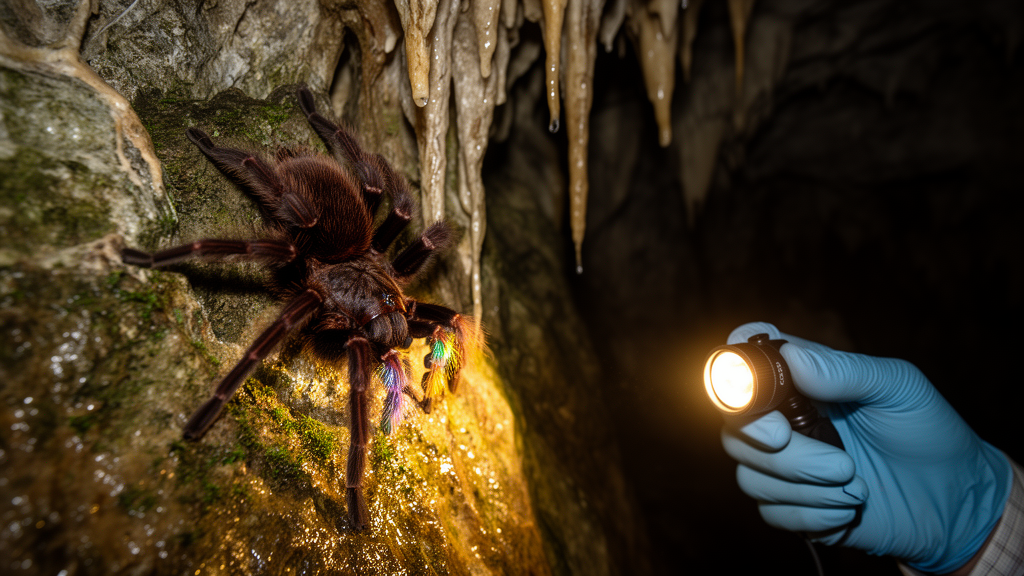
Deep inside a network of limestone caves in the Philippines, a tarantula that has been waiting more than 130 years for scientific attention has finally revealed its secrets. In 1892, the French naturalist Eugène Simon described a pale, strange-eyed tarantula collected from the Culapnitan Caves in Camarines Sur Province, naming it Orphnaecus pellitus. Simon noted in his original description that the species had tiny, widely separated eyes, hinting that life underground might have reshaped it. But for over a century, the species was never revisited, and its true nature remained unconfirmed. Now, a team of arachnologists has returned to the type locality, now part of the Libmanan Caves Natural Park, and confirmed that O. pellitus is a true troglobitic tarantula, the first ever recognized from Asia and only the nineteenth known worldwide.
The rediscovery is remarkable not only because it validates a suspicion first raised in the nineteenth century, but also because it fills a conspicuous biogeographic gap. Until now, all recognized troglobitic tarantulas came from the Neotropics, specifically Mexico, the Dominican Republic, and Brazil, with Mexico’s extensive cave systems hosting the greatest diversity. Sixteen species of the genus Hemirrhagus, one Holothele, and one Tmesiphantes account for the entire global list of cave-obligate tarantulas. The Philippine species, described by Simon from specimens collected in what he called the Calapnitan Caves, was long suspected of being troglobitic based on his notes about its eyes, but its poorly known biology prevented formal recognition. The new study changes that, establishing O. pellitus as the sole Asian representative of this exclusive club of subterranean spiders.
Troglobitic species are obligate cave dwellers that spend their entire life cycle in darkness, and over evolutionary time they develop distinctive traits collectively known as troglomorphism. The researchers collected new specimens of O. pellitus from three interconnected caves within the Culapnitan system, Alinsanay, Kalangkawan, and Laya, at horizontal depths of 30 to 300 meters, in zones where no natural light penetrates. Morphological analysis revealed a suite of classic cave adaptations: reduced eye size, attenuated limbs, shortened tactile setae, and diminished pigmentation. The eyes of O. pellitus are distinctly tiny compared to its surface-dwelling congeners, with the anterior lateral eyes measuring smaller than the anterior median eyes, a reversal of the pattern seen in other Orphnaecus species. This suggests that the visual role of the anterior lateral eyes, which is important in the visual behavior of other spider families, has been lost in the darkness of the cave.
The body coloration of O. pellitus is lighter brown than that of its epigean relatives, and the microstructures of its scales lack the typical purplish to dark blue sheen found in surface Orphnaecus species. Both mature males and females have stout, elongated legs, with leg I shorter than leg IV, and the tactile setae covering the body and appendages are noticeably shorter. These shortened setae may reflect the reduced activity and fewer obstacles in the enclosed cave environment, where the primary function of these touch-sensitive organs becomes less critical. The attenuation of the legs, meanwhile, could be an adaptation to the limited nutrient sources underground, a form of growth regulation observed in both invertebrates and vertebrates through conserved signaling pathways.
Beyond morphology, the researchers observed striking physiological and behavioral adaptations. When live specimens were subjected to hypoxia in a controlled procedure using carbon dioxide, O. pellitus took 5 to 12 minutes to lose consciousness, while surface and troglophile species became unresponsive in less than 2 minutes. The cave tarantulas also recovered faster and showed no fatalities. This heightened tolerance to low oxygen levels suggests adaptation to the putatively lower oxygen concentrations found in subterranean environments. In the field, the spiders displayed remarkable sensitivity to ground movements, retreating into their burrows when approached from more than a meter away, a behavior not observed in their surface-dwelling relatives during sampling. In the laboratory, they demonstrated rapid prey detection and capture, with juveniles able to subdue insects three times their body size. The researchers attribute this enhanced response to the clavate trichobothria, vibration-sensitive organs on the tarsi, though no structural mutations or increases in trichobothria number were found, suggesting the adaptation operates through neurological processes rather than morphological change.
To verify the taxonomic placement and evolutionary relationships of the cave species, the team analyzed 28 sequences of the cytochrome oxidase I gene, including 21 from their Philippine tarantula collection. The Maximum Likelihood tree placed all three species found in the park within the Orphnaecus clade, and a TimeTree analysis calibrated with age estimates for the Selenocosmiinae-Theraphosinae split suggested that O. pellitus diverged first, possibly between 33.5 and 50 million years ago, during the Middle Eocene. The interspecific genetic distances between the park’s Orphnaecus species exceeded 5 percent, with the distance between O. pellitus and the two new species ranging from roughly 10 to 10.8 percent, strongly supporting their status as distinct lineages. Intraspecific distances within each species ranged from 0 to 0.46 percent, confirming that populations from Kalangkawan and Laya caves belong to the same species.
The expedition also yielded two entirely new species from the forest grounds of the park. Orphnaecus libmanan, named after the type locality, is a regular-sized epigean tarantula found in horizontal burrows under and inside large dead logs, under limestone rocks, and even inside piles of coconut husks during the wet season. Orphnaecus tangcongvaca, named in honor of the Tangcong Vaca Guerilla Unit that operated in the area during the Japanese occupation, is a dwarf tarantula known only from the park’s forest floor, where it burrows under fallen branches and stones. The dwarf species is notable for its dramatically reduced stridulatory organ on the maxilla, retaining only a single club-shaped seta, and for being the only species in the genus exhibiting dwarfism. Phylogenetic analysis placed it firmly within Orphnaecus rather than Phlogiellus, the wastebasket genus where dwarf selenocosmiine species are typically dumped, challenging the practice of classifying species with reduced lyra solely on morphological grounds.
The three tarantulas coexist in the park through clear ecological niche differentiation. O. pellitus exclusively occupies the cave floors, preying on abundant cave crickets of the family Rhaphidophoridae, with all life stages found within the cave system and no conspecifics detected outside despite extensive searching. The two epigean species share the forest floor but partition resources differently. O. libmanan requires larger microhabitats covered by logs and rocks, while the dwarf O. tangcongvaca burrows in smaller spaces under litter and stones, and termite carcasses found in its burrows suggest it preys on smaller arthropods outside the diet preferences of its larger congener. This sympatric coexistence, the researchers propose, arose through competition for space and food that drove the dwarf species toward smaller prey and reduced body size, while the cave species colonized an unexploited subterranean habitat in a process consistent with the adaptive shift hypothesis.
The ancient divergence of O. pellitus from its epigean relatives, possibly dating back tens of millions of years, intrigues the researchers, who suggest it may reflect inter-geologic period migration among Philippine tarantulas driven by glaciation-period climatic adaptation. The cave environment created island-like isolation, eventually leading to genetic divergence through parapatric speciation. Meanwhile, the close genetic relationship between O. libmanan and the island-endemic O. kwebaburdeos from Polillo Island, with a genetic distance of 5.4 to 5.9 percent, suggests the most recent split among known Orphnaecus species, possibly shaped by island fragmentation across southern Luzon and Mindanao.
The theraphosid diversity of the Philippines has now increased to 16 species, all endemic, and the global count of recognized troglobitic tarantulas has risen to 19. The rediscovery of O. pellitus confirms that Asia’s karst ecosystems, which cover roughly 35,000 square kilometers in the Philippines alone, harbor evolutionary lineages as specialized as any found in the Neotropics. The researchers call for greater conservation efforts and more biodiversity surveys in the Libmanan Caves Natural Park, particularly for its unexplored caves that might harbor other unique species with subterranean biology waiting to be discovered. The finding also underscores the importance of molecular phylogenetics in resolving problematic taxa within Selenocosmiinae, particularly those with homoplastic traits such as dwarfism, and hints that more troglobitic tarantulas may await discovery across Asia’s vast subterranean ecosystems.
Subject of Research: Revisiting and rediscovering the tarantulas (Araneae, Theraphosidae) of Culapnitan (Libmanan) Caves in the Philippines: troglomorphism, taxonomy, phylogeny and ecological niche
Article Title: Revisiting and rediscovering the tarantulas ( Araneae , Theraphosidae ) of Culapnitan (Libmanan) Caves in the Philippines: troglomorphism, taxonomy, phylogeny and ecological niche
Article References: Acuña, D. C., Ragasa, L. R. P., Santiago-Bautista, M. R., von Wirth, V., & Guevarra Jr, L. A. (2025). Revisiting and rediscovering the tarantulas (Araneae, Theraphosidae) of Culapnitan (Libmanan) Caves in the Philippines: troglomorphism, taxonomy, phylogeny and ecological niche. Subterranean Biology, 52, 143-186. https://doi.org/10.3897/subtbiol.52.142334
Image Credits: AI Generated
DOI: 10.3897/subtbiol.52.142334
Keywords: Revisiting, rediscovering, tarantulas, Araneae, Theraphosidae, Culapnitan, Libmanan, Caves, Philippines, troglomorphism, taxonomy, phylogeny
Cite Scienmag News
Gavin Prescott. (October 18, 2026). Cave tarantula rediscovered in Philippines after 130 years. Scienmag. https://scienmag.com/cave-tarantula-rediscovered-in-philippines-after-130-years/
Gavin Prescott. "Cave tarantula rediscovered in Philippines after 130 years." Scienmag, 18 October 2026, https://scienmag.com/cave-tarantula-rediscovered-in-philippines-after-130-years/. Accessed 18 October 2026.
Gavin Prescott. "Cave tarantula rediscovered in Philippines after 130 years." Scienmag. October 18, 2026. https://scienmag.com/cave-tarantula-rediscovered-in-philippines-after-130-years/


