


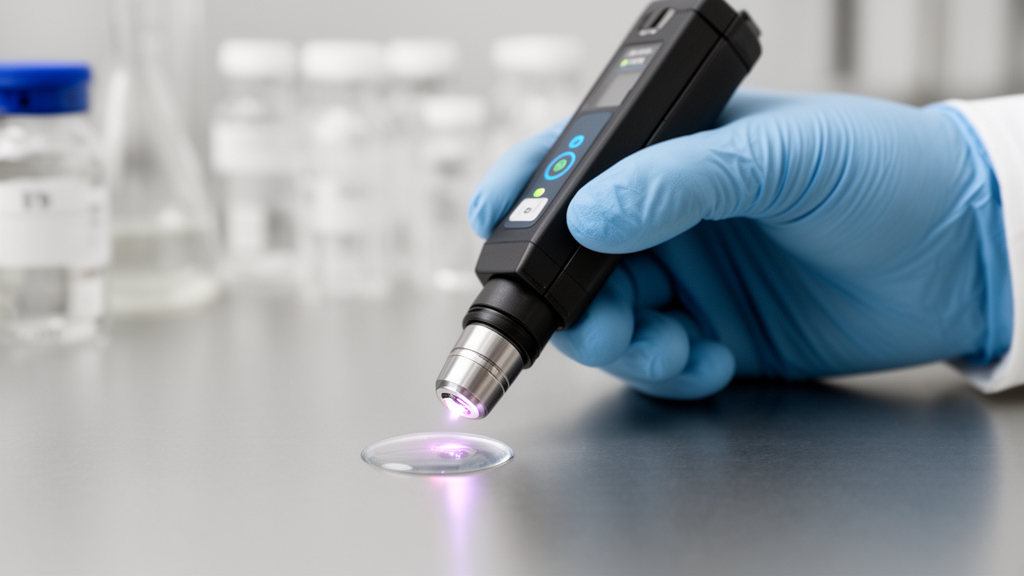
Chinese researchers have unveiled a pocket-sized sensor capable of detecting sarin, one of the deadliest nerve agents known to science, in under twenty seconds. The device, developed by a team led by Professor Zhang Hongwen at the Institute of Solid State Physics, part of the Hefei Institutes of Physical Science within the Chinese Academy of Sciences, relies on surface-enhanced Raman spectroscopy, or SERS, a technique that amplifies the faint vibrational fingerprints of molecules so they can be identified at vanishingly small concentrations. The findings, published in Chemical Engineering Journal, describe a molecular probe engineered specifically to hunt down the chemical signature that unites an entire family of lethal compounds.
Organophosphorus nerve agents, a class that includes sarin, VX and tabun, work by disrupting the enzymes that regulate the nervous system, and even minute quantities can be fatal within minutes. Because of this extreme toxicity, the ability to screen for these substances quickly and reliably has become a pressing priority for public safety officials worldwide. Airports, border checkpoints, subway systems and large public gatherings all represent environments where a rapid, on-site detection capability could mean the difference between a contained incident and a mass casualty event. Yet the analytical instruments traditionally used to confirm the presence of nerve agents, such as chromatography-mass spectrometry and ion mobility spectrometry, while highly accurate, tend to be bulky, expensive and dependent on laboratory infrastructure, which severely limits their usefulness in the field when minutes matter.
The breakthrough hinges on a deceptively simple chemical insight. Every organophosphorus nerve agent shares a defining structural feature: a phosphorus-carbon bond, abbreviated P–C, that sits at the heart of the molecule. Rather than trying to recognize each agent individually, the research team designed a probe molecule that targets this bond directly, creating what they describe as a directed and precise recognition mechanism built on the inherent characteristics of the P–C linkage. This strategy means the sensor is not locked into detecting one specific compound but can, in principle, flag any molecule carrying that telltale bond, which covers the full spectrum of organophosphorus warfare agents.
The probe itself, named pyridylamidoxime-mercapto, or PAOM, is a masterclass in multifunctional molecular design. At one end sits an oxime group, a reactive chemical handle that engages with the target molecules and captures them from the surrounding environment. At the other end, a thiol group performs a crucial anchoring role, bonding the probe firmly to the gold surface of the SERS chip. Gold-thiol chemistry is a well-established workhorse of nanotechnology, and here it ensures the probe layer stays put during measurement. Between these two functional ends lies a pyridine ring, whose job is purely optical: it boosts the Raman signal, amplifying the vibrational spectrum so that even trace amounts of the captured nerve agent become detectable above background noise.
Designing a probe molecule is rarely a one-shot affair, and the team synthesized and tested three different versions of PAOM, distinguished by the positional arrangement of their functional groups on the central ring structure. These variants, known as isomers, differ only in where the reactive groups attach relative to one another, yet that subtle geometric difference has outsized consequences for performance. The researchers found that the para isomer, dubbed p-PAOM, in which the groups occupy positions directly opposite each other on the ring, showed the strongest interaction with organophosphorus agents and the lowest reaction energy barrier. In practical terms, a lower energy barrier means the oxime group reacts with the target more readily and at a faster rate, translating directly into the sensor’s impressive speed.
When the team coupled the p-PAOM-functionalized chip to a portable Raman spectrometer, the results were striking. The sensor detected sarin in liquid samples in less than twenty seconds, achieving a detection limit of ten parts per billion, a concentration so low it corresponds to roughly ten grams of sarin dispersed in a thousand tonnes of liquid. For context, many regulatory thresholds for toxic industrial chemicals sit in the hundreds of parts per billion range, so a ten ppb limit places this sensor firmly in the ultrasensitive category. The speed is equally remarkable; conventional laboratory confirmations of nerve agent exposure can take hours from sample collection to final result, while this device delivers an answer before first responders have finished setting up their perimeter.
Real-world environments are messy, and a sensor that works only on pristine samples would be of limited value. The researchers therefore subjected their device to a battery of interference tests, spiking samples with common substances that might plausibly coexist with nerve agents in field conditions. The sensor maintained good selectivity throughout, correctly identifying the target molecules even in the presence of these interfering compounds. This robustness stems from the probe’s directed recognition mechanism: because the oxime group reacts specifically with the P–C bond chemistry rather than engaging in generic adsorption, unrelated molecules simply do not trigger the same response, leaving the Raman spectrum clean and unambiguous.
Environmental tolerance proved equally impressive. The sensor remained effective at temperatures reaching one hundred degrees Celsius and across a pH range spanning from three to twelve, conditions that cover everything from acidic rainwater to alkaline industrial runoff. This wide operating window suggests the device could function reliably in deserts, tropical climates, contaminated water sources or the aftermath of a chemical release where ambient conditions are far from controlled. For a technology intended for deployment at the sites of potential incidents rather than in climate-controlled laboratories, this kind of environmental resilience is not a luxury but a baseline requirement.
The detection capability extends beyond liquid samples. The team demonstrated that the sensor can identify sarin in the gas phase as well, which is critical because nerve agents released in an attack would primarily exist as vapors or aerosols drifting through the air. A gas-phase detection capability combined with the compact footprint of a portable Raman spectrometer means the device could be carried by security personnel, integrated into fixed screening stations or deployed rapidly to suspected contamination zones, screening the air itself for the presence of lethal compounds before people are exposed.
According to the research team, the technology is now being developed further for technology transfer and industrial applications, signaling a move from the laboratory bench toward commercial production. The work, published under the title Rational design of an oxime-functionalized probe for ultrasensitive and portable SERS detection of organophosphorus nerve agents, appeared in Chemical Engineering Journal on 28 August 2026. As concerns over chemical warfare and industrial chemical safety continue to grow, the marriage of rational molecular design with portable spectroscopy offers a glimpse of a future where the tools to unmask invisible threats fit in a briefcase, respond in seconds and speak a chemical language that no nerve agent can escape.
Subject of Research: Portable SERS sensor for rapid detection of sarin and organophosphorus nerve agents
Article Title: Researchers develop portable sensor for rapid detection of sarin
Article References: Researchers develop portable sensor for rapid detection of sarin. (n.d.). Original publication
Image Credits: AI Generated
DOI: Not provided
Keywords: SERS, sarin, nerve agents, organophosphorus, Raman spectroscopy, chemical detection, public safety, molecular probe, Hefei Institutes of Physical Science, Chemical Engineering Journal, Researchers, develop
Cite Scienmag News
Bethany Barker. (October 18, 2026). Portable Raman Sensor Spots Sarin in Seconds Using Molecular Fingerprinting. Scienmag. https://scienmag.com/portable-raman-sensor-spots-sarin-in-seconds-using-molecular-fingerprinting/
Bethany Barker. "Portable Raman Sensor Spots Sarin in Seconds Using Molecular Fingerprinting." Scienmag, 18 October 2026, https://scienmag.com/portable-raman-sensor-spots-sarin-in-seconds-using-molecular-fingerprinting/. Accessed 18 October 2026.
Bethany Barker. "Portable Raman Sensor Spots Sarin in Seconds Using Molecular Fingerprinting." Scienmag. October 18, 2026. https://scienmag.com/portable-raman-sensor-spots-sarin-in-seconds-using-molecular-fingerprinting/


