


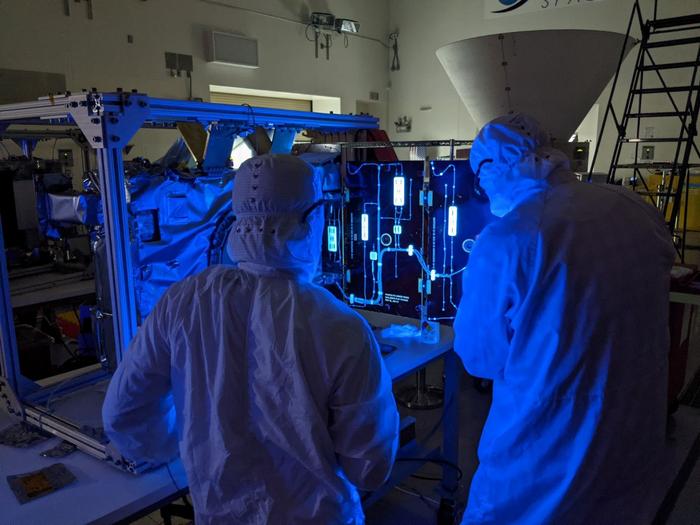
In a significant development in astrophysics, NASA’s Polarimeter to Unify the Corona and Heliosphere (PUNCH) mission is on the cusp of launching four suitcase-sized spacecraft designed to study the Sun’s outer atmosphere. Conducted by the Southwest Research Institute (SwRI), the mission is an ambitious attempt to create a comprehensive understanding of the solar corona and the solar wind. Set to launch no earlier than February 28, 2025, from Vandenberg Space Force Base in California, this mission aims to provide unprecedented insights into the behavior and characteristics of our Sun and its influence on the solar system.
PUNCH represents an innovative approach to solar observation, one that promises to unify previously disparate elements of understanding regarding solar dynamics. Dr. Craig DeForest, the Principal Investigator for the PUNCH mission, emphasizes that this is the first time a holistic view of the solar corona and solar wind will be achieved simultaneously. Utilizing four small, coordinated spacecraft flying in a precise configuration, PUNCH aims to synthetically generate data equivalent to what would be collected by a colossal instrument spanning 8,000 miles—a feat not feasible with any current technology.
Each of the four satellites is outfitted with sophisticated imaging equipment capable of capturing distinct aspects of the solar corona, which is the outer layer of the Sun’s atmosphere. This region, typically obscured by the Sun’s bright disc, holds vital information about solar emissions that can dramatically affect space weather. PUNCH is not intended as a singular observation platform; rather, it is orchestrated to function as a comprehensive sensor network that will operate continuously while maintaining a clear view of the atmosphere surrounding the Sun.
One key scientific tool aboard the PUNCH mission is the Narrow Field Imager, developed by the U.S. Naval Research Laboratory, designed to continuously monitor the solar corona. Meanwhile, the other three satellites will employ Wide Field Imagers engineered by SwRI, specifically configured to detect the faint emissions from the outermost layers of the solar atmosphere and the solar wind. The ambitious undertaking is expected to enhance our understanding of how coronal mass ejections (CMEs) unfold and affect Earth as they travel through the solar system.
The intricate measurements collected by PUNCH will pave the way for the first true observation of how solar wind accelerates and interacts with the solar corona. Particularly, the images captured will shed light on the complex mechanisms at play in solar heating, an area that has baffled scientists for years. By synchronizing observations from multiple vantage points, PUNCH aims to give a three-dimensional perspective on solar dynamics, offering insight that traditional methods—relying on one-dimensional measurements—could never achieve.
PUNCH will operate in a unique orbit along the terminator line, also known as the day-night line. This position will allow the satellites to stay in continuous sunlight, guaranteeing that they maintain operational efficiency while providing a steady stream of observational data. The strategic placement of the satellites is instrumental for continuously capturing the subtle variations in the corona’s behavior, without the interference from the Earth’s atmosphere or varying light conditions.
The technological innovations aboard the PUNCH spacecraft are noteworthy. The deep baffles integrated into the wide-field imagers significantly reduce the light from the Sun itself—effectively more than a trillion times—allowing the faint glimmers of solar wind emissions to be captured. Excitingly, the data processing performed on Earth will further enhance these images, drastically reducing the overwhelming background light to reveal insights into solar activity that have remained hidden for too long.
Central to PUNCH’s mission objectives is the ability to track CMEs in three dimensions as they traverse towards Earth, a significant advancement in the field of space weather forecasting. Dr. DeForest has drawn parallels between the anticipated capabilities of PUNCH and the transformative impact of geosynchronous satellites on terrestrial weather forecasting. As the data accumulates, scientists will potentially have a far more reliable means of predicting space weather events, which can impact satellite operations and even terrestrial power grids.
NASA’s Small Explorers (SMEX) program, known for its ability to facilitate robust and efficient missions, has backed PUNCH, demonstrating the agency’s commitment to advancing heliophysics science. Alongside SwRI, which oversees operations of the four spacecraft, the PUNCH mission encompasses collaborative efforts with the U.S. Naval Research Laboratory, which constructed key imaging instruments, and RAL Space from the United Kingdom, recognized for developing advanced detector systems.
As the launch date approaches, the excitement surrounding PUNCH continues to build. This mission’s novel approach to solar physics holds the promise of a more profound comprehension of fundamental processes that govern not only our solar system but potentially other star systems as well. The insights gathered through this mission could lead to significant breakthroughs, not only informing our understanding of solar dynamics but also aiding in the advancement of technology designed to mitigate space weather risks.
In conclusion, NASA’s PUNCH mission is set to redefine our understanding of solar phenomena and the complex interactions that characterize our relationship with the Sun. As this exciting venture unfolds, it will undoubtedly inspire a new generation of researchers and enthusiasts who share a passion for uncovering the mysteries of the cosmos and its myriad influences on our daily lives. The data produced by PUNCH will not only contribute to the field of astrophysics but could also foster advancements in technological applications focused on space weather, underscoring the mission’s broader significance.
Keywords
- Solar wind
- Spacecraft
- Planet Earth
- Measuring instruments
- Heliosphere
- Cameras
Cite Scienmag News
Bethany Barker. (February 25, 2025). SwRI-Managed PUNCH Spacecraft Ready for Polar Orbit Launch. Scienmag. https://scienmag.com/swri-managed-punch-spacecraft-ready-for-polar-orbit-launch/
Bethany Barker. "SwRI-Managed PUNCH Spacecraft Ready for Polar Orbit Launch." Scienmag, 25 February 2025, https://scienmag.com/swri-managed-punch-spacecraft-ready-for-polar-orbit-launch/. Accessed 4 September 2026.
Bethany Barker. "SwRI-Managed PUNCH Spacecraft Ready for Polar Orbit Launch." Scienmag. February 25, 2025. https://scienmag.com/swri-managed-punch-spacecraft-ready-for-polar-orbit-launch/


