


A survey of 384 pastoral households in Borena, Ethiopia, found that greater drought vulnerability was associated with more intense coping strategies, which in turn were associated with poorer livelihood outcomes. The study used partial least squares structural equation modeling to examine relationships among drought exposure, socio-ecological vulnerability, coping responses, adaptive capacity and livelihood outcomes, describing the pattern as a vulnerability–coping trap.
Drought exposure and resource degradation together accounted for 51.1% of the variance in socio-ecological vulnerability within the model. The authors used PLS-SEM to estimate how these factors were connected to household coping and livelihoods. The result identifies a substantial modeled relationship between drought-related conditions and vulnerability, while remaining an analysis of survey data rather than a demonstration of causal effects.
The model estimated a positive association between socio-ecological vulnerability and coping intensity, with a standardized path coefficient of β = 0.361 and p < 0.001. Greater coping intensity was negatively associated with livelihood outcomes, with β = −0.553 and p < 0.001. Together, the coefficients describe a statistical pathway in which more vulnerable households reported more intense coping, and more intense coping was linked to weaker livelihood outcomes.
Adaptive capacity showed a different association. It was positively related to livelihood outcomes, with β = 0.510 and p < 0.001. The study assessed this capacity through indigenous knowledge, institutional support and technology adoption, all of which had positive standardized path coefficients. Indigenous knowledge had the largest coefficient at β = 0.328, followed by institutional support at β = 0.301 and technology adoption at β = 0.261.
These findings do not show that indigenous knowledge, institutional support or technology adoption caused improved livelihoods. Instead, they show that the three components were associated with adaptive capacity in the structural model, and that adaptive capacity was associated with more favorable livelihood outcomes. The comparison also provides a qualification to technology-centered approaches: in this sample, indigenous knowledge had a slightly stronger modeled association with adaptive capacity than technology adoption.
Livelihood diversification was positively associated with coping intensity, with β = 0.167 and p < 0.05, but diversification alone had limited influence on livelihood outcomes. The authors characterized diversification as distress-driven rather than proactive, meaning that additional livelihood activities were connected to the intensity of coping but did not, by themselves, provide a strong route to better outcomes. Diversification therefore cannot be treated as equivalent to adaptive capacity in this analysis.
By separating coping responses from adaptive capacity, the research extends the Sustainable Livelihoods Framework and offers a more detailed account of how households may respond to drought-related pressure. Coping was associated with poorer livelihood outcomes, whereas adaptive capacity was associated with better outcomes. The results indicate that changing activities alone is not the same as strengthening the knowledge, support and capabilities represented in the study’s adaptive-capacity measure.
The study is an observational analysis based on survey data from pastoral households in Borena, Ethiopia. It offers a regional model of the relationships among drought exposure, resource degradation, vulnerability, coping, diversification, adaptive capacity and livelihoods, but it does not establish that the estimated pathways will hold across other places or over time. The accepted research was published in Discover Sustainability through an early-access format that the publisher said could still be subject to edits before the final version of record.
Subject of Research: Modeling drought vulnerability, coping strategies and adaptive capacity among Borena pastoral households
Article Title: Modeling drought vulnerability and coping traps among pastoral households in Borena Ethiopia
Article References: Hundessa, T., & Bewket, W. (2026). Modeling drought vulnerability and coping traps among pastoral households in Borena Ethiopia. Discover Sustainability. https://doi.org/10.1007/s43621-026-04713-5
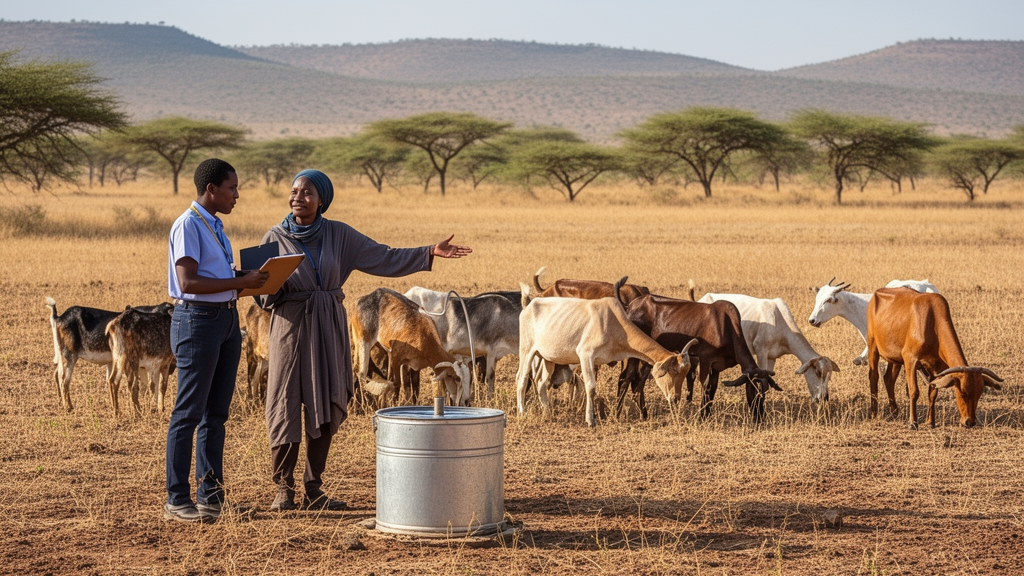
Image Credits: AI Generated
DOI: 10.1007/s43621-026-04713-5
Keywords: drought vulnerability, pastoral households, Borena Ethiopia, PLS-SEM, coping strategies, adaptive capacity, livelihood outcomes, indigenous knowledge, livelihood diversification, resource degradation, Modeling, drought
Cite Scienmag News
Violet Maxwell. (October 26, 2026). Survey links drought vulnerability, coping and livelihoods in Borena. Scienmag. https://scienmag.com/survey-links-drought-vulnerability-coping-and-livelihoods-in-borena/
Violet Maxwell. "Survey links drought vulnerability, coping and livelihoods in Borena." Scienmag, 26 October 2026, https://scienmag.com/survey-links-drought-vulnerability-coping-and-livelihoods-in-borena/. Accessed 26 October 2026.
Violet Maxwell. "Survey links drought vulnerability, coping and livelihoods in Borena." Scienmag. October 26, 2026. https://scienmag.com/survey-links-drought-vulnerability-coping-and-livelihoods-in-borena/


