


In animals, social interactions can have a pronounced influence on circadian rhythm, such as helping to regulate the timing of rest. For the circadian clock to function effectively, it must be entrained by local day-night cycles, a process that employs cues such as light and temperature.

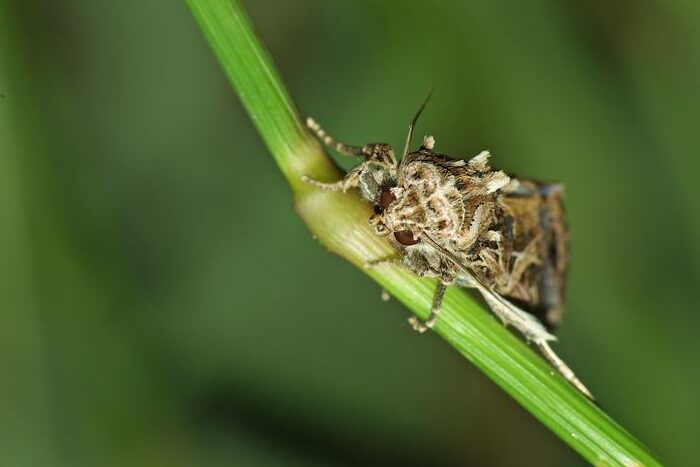
Credit: INRAE – Michel Renou
In animals, social interactions can have a pronounced influence on circadian rhythm, such as helping to regulate the timing of rest. For the circadian clock to function effectively, it must be entrained by local day-night cycles, a process that employs cues such as light and temperature.
Researchers at INRAE have been exploring how sociosexual interactions can modulate circadian rhythm. Elemental social interactions remain essential even in solitary animal species, such as the African cotton moth, Spodoptera littoralis. The latter is an agricultural pest whose caterpillars attack maize and legume crops. Adults live just 7 to 8 days, and thus adult males devote themselves exclusively to mating.
While studying S. littoralis, researchers observed that the circadian rhythm of males changed in the presence of females. Males can perceive female pheromones even across very long distances. Thus, females can remotely modulate the circadian rhythm of males such that the sexes are in synchrony during periods of mating, which favours reproductive success.
In S. littoralis, the pheromone gland synthesises diverse chemical compounds, but only one, (Z,E)-9,11-tetradecadienyl acetate (i.e., Z9E11-14Ac), can attract males. When males are exposed to Z9E11-14Ac, their circadian rhythms are altered, even in broad daylight. This result is the first of its kind: never before in a solitary animal species has a sociosexual interaction been shown to affect the circadian clock, let alone surpass light in its entrainment effects. The study’s discovery paves the way for new research into circadian synchronisation, including in mammals.
The black cutworm, Agrotis ipsilon, is a close relative of S. littoralis and exhibits a significant degree of niche overlap. Interestingly, while pheromones from A. ipsilon can modulate male circadian rhythm in S. littoralis, the two species do not mate.
The researchers are exploring how their findings can inform the development of biocontrol[1]practices targeting S. littoralis. The idea is that, since females do not respond strongly to their own pheromones, males could be exposed to pheromones in the morning (i.e., outside of the natural chemical communication window), which would modify their circadian rhythm for the day. As a result, the two sexes would be out of sync and less likely to meet and mate.
[1] A pillar of agroecology, biocontrol methods utilise knowledge about natural interactions among species to protect crops against pests and diseases.
Journal
Current Biology
Article Title
Pheromone-mediated command from the female to male clock induces and synchronizes circadian rhythms of the moth Spodoptera littoralis
Article Publication Date
8-Apr-2024
Cite Scienmag News
Alan Morgan. (April 9, 2024). Surprising role of female sex pheromone in crop pest: new biocontrol possibilities? Scienmag. https://scienmag.com/surprising-role-of-female-sex-pheromone-in-crop-pest-new-biocontrol-possibilities/
Alan Morgan. "Surprising role of female sex pheromone in crop pest: new biocontrol possibilities?" Scienmag, 9 April 2024, https://scienmag.com/surprising-role-of-female-sex-pheromone-in-crop-pest-new-biocontrol-possibilities/. Accessed 4 September 2026.
Alan Morgan. "Surprising role of female sex pheromone in crop pest: new biocontrol possibilities?" Scienmag. April 9, 2024. https://scienmag.com/surprising-role-of-female-sex-pheromone-in-crop-pest-new-biocontrol-possibilities/

