


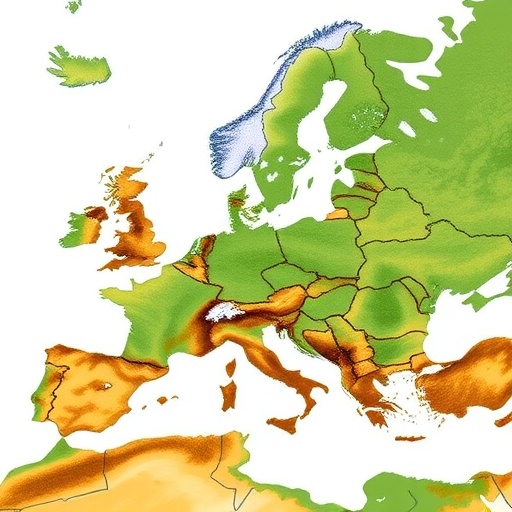
Across Europe, emerging landscapes demonstrate remarkable promise for advancing climate mitigation, climate adaptation, and biodiversity enhancement with minimal socio-economic risk, according to groundbreaking research deploying a novel climate-smart rewilding framework. This integrated approach, introduced by researchers at the German Centre for Integrative Biodiversity Research (iDiv), Martin Luther University Halle-Wittenberg (MLU), and the EU Horizon project WildE, underscores a pivotal strategy for confronting ecological and climatic crises by harmonizing ecosystem restoration with human-centered climate solutions.
Rewilding, traditionally focused on liberating nature by restoring natural processes and expanding wild spaces, now evolves into a more sophisticated paradigm under the climate-smart rewilding banner. This approach intricately weaves ecological restoration with the imperative to generate climate benefits and tangible ecosystem services, such as carbon sequestration, soil stabilization, and water regulation, while simultaneously nurturing community resilience. The framework moves beyond the limitations of pinpointing singular ideal conservation areas to acknowledge and leverage the diverse regional strengths distributed throughout the continent.
Geospatial analysis reveals that Eastern and Southern Europe harbor the most favorable conditions overall for climate-smart rewilding initiatives. These regions exhibit abundant opportunities to integrate biodiversity recovery and climate stabilization. Conversely, Northern Europe is characterized by landscapes that excel in climate adaptation capacities, particularly through the restoration of ecological connectivity, facilitating species’ migration and genetic exchange as climatic zones shift. Western Europe, constrained heavily by intensive land fragmentation and urban development, faces more complex challenges, requiring innovative corridor establishment and land-use planning to enable rewilding interventions effectively.
Dr. Gavin Stark, lead author and ecological expert at iDiv and MLU, elucidates that climate-smart rewilding embodies a dual-focus ambition, seamlessly integrating ecosystem restoration with climate mitigation mandates that the European Union prioritizes. “Our approach recognizes that the pathways to restoration and climate action are not always aligned, but through strategic interventions, we can create synergies to benefit both nature and society,” he explains. This multidimensionality addresses the nuances and sometimes conflicting trade-offs between fostering carbon sinks and preserving ecosystem integrity.
A quintessential illustration of these complexities arises in regions of abandoned farmland. As these lands revert to natural vegetation, they inherently bolster biodiversity and enhance carbon storage capacity, delivering vital ecosystem services. However, the accumulation of biomass under such scenarios may escalate wildfire risks, presenting challenges to land managers. Climate-smart rewilding proposes practical solutions such as leveraging natural grazing dynamics, facilitated by reintroduced wild herbivores or controlled livestock grazing to modulate vegetation growth, thereby reducing wildfire fuel loads. These nuanced interventions underscore the essential balance between promoting carbon capture and reducing ecological hazards.
A critical innovation of the climate-smart rewilding framework lies in its ability to unify often disparate ecological and socio-economic goals. Historically, climate-first restoration tactics have sidelined biodiversity priorities, favoring rapid carbon accumulation through monoculture plantations at the expense of biological diversity. Conversely, biodiversity conservation sometimes progresses at a pace insufficient for meaningful climate mitigation. The framework’s integrative lens identifies intervention points where these objectives symbiotically reinforce each other and guides targeted actions for when trade-offs necessitate careful prioritization.
The restoration of connectivity corridors in the Baltic States, Finland, and parts of Sweden epitomizes the framework’s power to meld climate adaptation with biodiversity resilience. By restoring these critical ecological networks, species are afforded mobility to respond naturally to climate-driven habitat changes. This not only aids in the genetic robustness of populations but also bolsters ecosystem functionality in the face of evolving climatic stressors. Nonetheless, such ecological ambitions demand meticulous planning to reconcile competing interests in agriculture, forestry, and regional development, ensuring durable societal acceptance and benefit.
Professor Henrique Pereira of MLU and iDiv further highlights that climate-smart rewilding transcends isolated ecological restoration efforts, which often adhere to singular goals addressing either biodiversity or climate change. “Our framework addresses multiple objectives holistically, unlocking greater benefits for nature and human communities alike,” he asserts. It equips policymakers, conservationists, and land managers with the tools to discern where rewilding efforts yield maximum impact within specific regional contexts, fostering smarter investments and efficient resource allocation.
The applicability of this framework is inherently context-dependent; its success hinges on tailoring interventions to precise spatial scales and local environmental, social, and economic conditions. This adaptability ensures relevance across Europe’s heterogeneous landscapes, facilitating customized strategies that respect and harness local ecological dynamics and community needs.
To promote transparency and collaborative advancement, the researchers have made the framework and spatial datasets publicly accessible via the WildE website and the forthcoming EBV Data Portal. All supporting data and analytical code are openly archived on Zenodo, inviting practitioners, scientists, policymakers, and land managers to explore, replicate, and adapt the framework to diverse conservation and restoration challenges. This open science approach encourages iterative improvements and regional customization, driving widespread uptake of climate-smart rewilding.
This ambitious initiative redefines how climate mitigation, adaptation, and biodiversity conservation can cohesively evolve within Europe. By enabling nature to reclaim space through carefully calibrated interventions that consider ecological dynamics, climate imperatives, and human welfare simultaneously, the framework offers a visionary pathway. It recognizes that the future of effective environmental stewardship lies in integrated approaches that address the complexities of ecosystem functions and societal viability in a warming world.
Ultimately, climate-smart rewilding stands as a transformative paradigm for ecological restoration—a multifaceted strategy that envisions landscapes capable of buffering climates, sustaining diverse lifeforms, and supporting resilient communities. Its success depends on embracing nuanced ecological knowledge, socio-economic realities, and the active participation of diverse stakeholders, charting a route from isolated restoration projects toward expansive, multifunctional landscapes central to Europe’s climate and biodiversity ambitions.
News Publication Date: 22-May-2026
Web References:
- WildE website: WildE Knowledge Hub
- EBV Data Portal (upcoming)
- Zenodo repository for data and code (soon available)
References:
- Stark, G., Pereira, H. et al. (2026). Towards Climate-Smart Rewilding: An Integrated Framework for Biodiversity, Climate Change, and Society. One Earth. DOI: 10.1016/j.oneear.2026.101704
Cite Scienmag News
Margaret Porter. (May 22, 2026). New Maps Reveal How European Landscapes Can Simultaneously Promote Climate Action and Biodiversity Conservation. Scienmag. https://scienmag.com/new-maps-reveal-how-european-landscapes-can-simultaneously-promote-climate-action-and-biodiversity-conservation/
Margaret Porter. "New Maps Reveal How European Landscapes Can Simultaneously Promote Climate Action and Biodiversity Conservation." Scienmag, 22 May 2026, https://scienmag.com/new-maps-reveal-how-european-landscapes-can-simultaneously-promote-climate-action-and-biodiversity-conservation/. Accessed 4 September 2026.
Margaret Porter. "New Maps Reveal How European Landscapes Can Simultaneously Promote Climate Action and Biodiversity Conservation." Scienmag. May 22, 2026. https://scienmag.com/new-maps-reveal-how-european-landscapes-can-simultaneously-promote-climate-action-and-biodiversity-conservation/


