


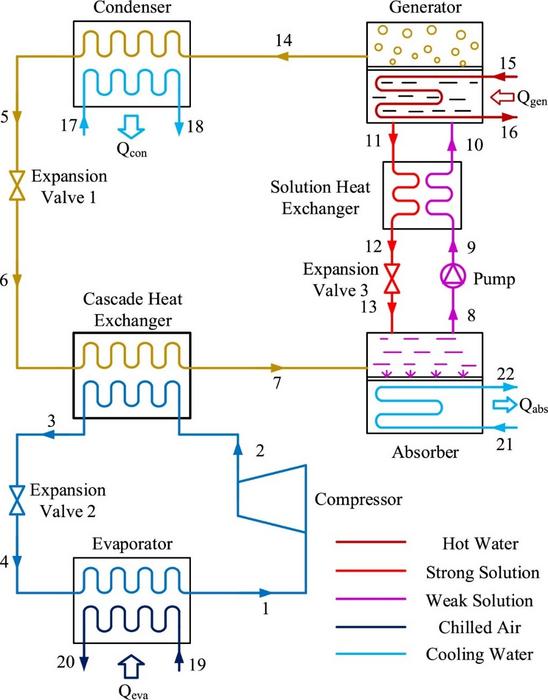
A recent study has unveiled a significant advancement in refrigeration technology. This work introduces an optimized Compression-Absorption Cascade Refrigeration Cycle (CACRC) that remarkably reduces electricity consumption and capitalizes on waste heat, setting new benchmarks in refrigeration efficiency and sustainability.

Credit: Yuhan Du, et al
A recent study has unveiled a significant advancement in refrigeration technology. This work introduces an optimized Compression-Absorption Cascade Refrigeration Cycle (CACRC) that remarkably reduces electricity consumption and capitalizes on waste heat, setting new benchmarks in refrigeration efficiency and sustainability.
The Compression-Absorption Cascade Refrigeration Cycle (CACRC) system, merging Vapor-Compression Refrigeration (VCR) with Absorption Refrigeration Cycle (ARC), presents a promising answer to the pressing energy demands and environmental concerns associated with traditional cooling methods. While the VCR is celebrated for its superior performance and ability to achieve low temperatures at a high energy cost, the ARC, in contrast, operates with minimal electricity, utilizing waste heat. This harmonious combination has generated keen interest in CACRC, recognizing its potential utility in critical areas such as food preservation and district cooling.
Recently, researchers from Xi’an Jiaotong University have fine-tuned the CACRC. Their detailed study (DOI: 10.1016/j.enss.2024.02.003) was published in Energy Storage and Saving in February 2024, highlighting the integration of vapor-compression and absorption refrigeration cycles. This blend achieves considerable reductions in electricity use while efficiently leveraging waste heat.
Exploring a dual-section mechanism that combines vapor-compression with absorption refrigeration technologies, the research team conducted a thorough analysis of 16 distinct refrigerants in the vapor compression section, paired with H2O-LiBr in the absorption section. This meticulous examination aimed to identify the most efficient and eco-friendly combinations, revealing the RE170/H2O-LiBr pair as the standout performer. This pair demonstrated the highest coefficient of performance and exergy efficiency among all candidates. Further investigation into the system’s dynamics, including the impacts of generator and evaporator temperatures, cascade temperature differences, and the effectiveness of the solution heat exchanger, enriched the study’s findings.
Xiaopo Wang, the study’s lead author, noted, “This breakthrough not only marks a significant step towards more sustainable refrigeration practices but also reflects our dedication to pioneering solutions that can revolutionize industries and contribute to the preservation of our planet’s resources.”
The culmination of this research offers a solid foundation for a refrigeration system that not only drastically reduces electricity consumption by harnessing waste heat but also advocates for a sustainable cooling approach across various industries, including food preservation and district cooling. This study heralds the dawn of a new era in refrigeration technology, emphasizing the critical balance between environmental stewardship and economic feasibility.
###
Media contact: Name: Yue Yang / Email: enss@xjtu.edu.cn
The publisher KeAi was established by Elsevier and China Science Publishing & Media Ltd to unfold quality research globally. In 2013, our focus shifted to open access publishing. We now proudly publish more than 100 world-class, open access, English language journals, spanning all scientific disciplines. Many of these are titles we publish in partnership with prestigious societies and academic institutions, such as the National Natural Science Foundation of China (NSFC).
Journal
Energy Storage and Saving
Article Title
Energy, exergy, and economic analysis of compression-absorption cascade refrigeration cycle using different working fluids
Cite Scienmag News
Denise Maddox. (April 9, 2024). Eco-effective cooling: a step forward in sustainable refrigeration. Scienmag. https://scienmag.com/eco-effective-cooling-a-step-forward-in-sustainable-refrigeration/
Denise Maddox. "Eco-effective cooling: a step forward in sustainable refrigeration." Scienmag, 9 April 2024, https://scienmag.com/eco-effective-cooling-a-step-forward-in-sustainable-refrigeration/. Accessed 4 September 2026.
Denise Maddox. "Eco-effective cooling: a step forward in sustainable refrigeration." Scienmag. April 9, 2024. https://scienmag.com/eco-effective-cooling-a-step-forward-in-sustainable-refrigeration/

