


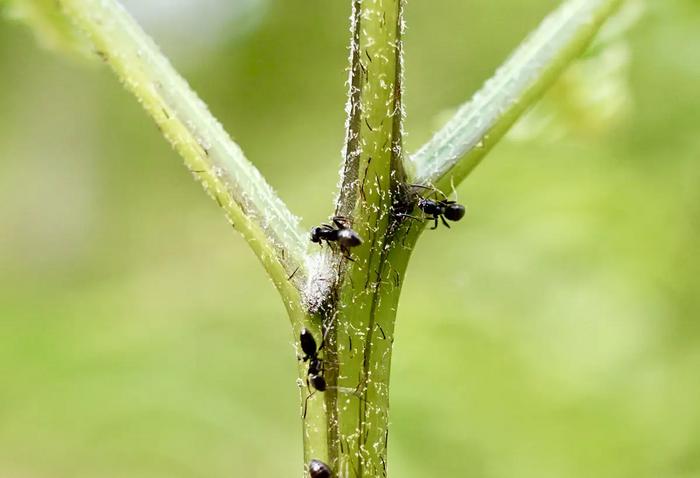
Collaborations across research disciplines can lead to unexpected breakthroughs and discoveries. Collaborations across species lead to unexpected evolutionary paths of mutual benefit.

Credit: University of Tennessee, Knoxville
Collaborations across research disciplines can lead to unexpected breakthroughs and discoveries. Collaborations across species lead to unexpected evolutionary paths of mutual benefit.
For example, some plants have managed to recruit ant bodyguards. They produce sugary nectar on their leaves that attracts the ants, then these very territorial and aggressive ant mercenaries patrol “their” plant and sting or bite herbivores that try to eat it.
These relationships are well-documented in flowering plants, but they also occur in non-flowering ferns. This is weird news for researchers, as it has long been thought that ferns lack the nectaries for such complex biotic interactions.
Jacob Suissa, assistant professor in the UT Department of Ecology and Evolutionary Biology, worked with colleagues at Cornell University, including fern expert Fay-Wei li and ant expert Corrie Moreau, to investigate how this phenomenon developed over the millennia. They recently published findings in Nature Communications about the evolutionary timeline and underlying factors of this interspecies partnership.
“The new elements of this work are twofold,” explained Suissa. “First, we discovered that nectaries—the structures that produce sugary nectar to attract ant bodyguards—evolved in ferns and flowering plants around the same time.”
This happened some 135 million years ago, coinciding with the rise of plant-ant associations in the Cretaceous period.
“This timing is quite spectacular given that it is very late in fern evolutionary history, nearly 200 million years after their origin,” said Suissa. “But it’s very early in flowering plant evolutionary history, nearly at the start of their origin in the Cretaceous.”
The second new element is how it all happened. Ferns originally flourished as terrestrial plants, growing on the forest floor. They transitioned in a major way in the Cenozoic Era, around 60 million years ago, becoming epiphytic, or tree dwelling, plants.
They learned some new habits on their way up.
“We discovered that as ferns left the forest floor and moved into the canopies, either as epiphytes, climbers, or tree ferns, they tapped into the existing ant-flowering plant interactions and evolved nectaries,” said Suissa.
This presents a curious dynamic in the ecological and evolutionary history of these two plant lineages. Ferns and flowering plants diverged from a common ancestor more than 400 million years ago, but then hit their stride in parallel with their nectary evolution and the mutually beneficial ant-plant tradeoff.
“This suggests that there may be some ‘rules of life’ governing the evolution of non-floral nectaries and ant-plant mutualism,” said Suissa. “This work can help future investigations by providing the evolutionary framework or backdrop for ecological, developmental, or genomic analyses.”
Read Suissa’s full paper, “Convergent evolution of nectaries in ferns facilitated the independent recruitment of ant-bodyguard from flowering plants,” in Nature Communications.
Journal
Nature Communications
Article Title
Convergent evolution of fern nectaries facilitated independent recruitment of ant-bodyguards from flowering plants
Article Publication Date
24-May-2024
COI Statement
The authors declare no competing interests.
Cite Scienmag News
Drew Townsend. (June 3, 2024). Suissa study has high hopes for plant-ant partnerships. Scienmag. https://scienmag.com/suissa-study-has-high-hopes-for-plant-ant-partnerships/
Drew Townsend. "Suissa study has high hopes for plant-ant partnerships." Scienmag, 3 June 2024, https://scienmag.com/suissa-study-has-high-hopes-for-plant-ant-partnerships/. Accessed 4 September 2026.
Drew Townsend. "Suissa study has high hopes for plant-ant partnerships." Scienmag. June 3, 2024. https://scienmag.com/suissa-study-has-high-hopes-for-plant-ant-partnerships/

