


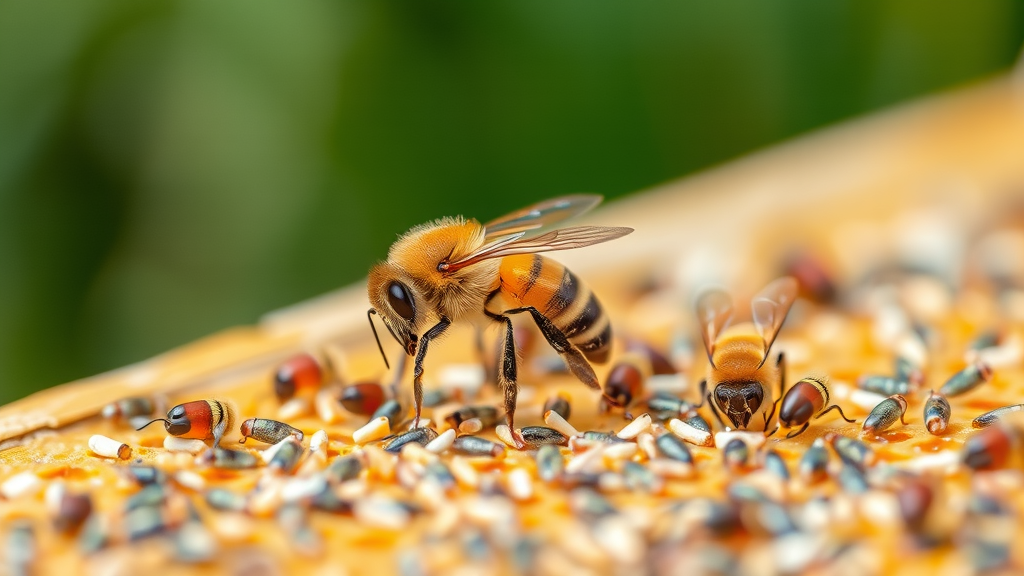
Honey bees pollinate crops worth an estimated $235 billion every year, yet the managed colonies that provide this service are being quietly destroyed by a parasite smaller than a grain of rice. Varroa destructor, a reddish-brown mite that feeds on bees’ fat bodies and vectors at least seven viruses, is now the leading driver of colony collapse worldwide. The U.S. Department of Agriculture reports average annual colony losses of 43 percent between 2019 and 2023, with varroa identified as the dominant cause. A new study published in Smart Agricultural Technology describes a machine learning system that watches, listens to, and measures the air around a beehive around the clock, flagging infestations early enough for beekeepers to act with the gentlest tools available — all for less than $200 per hive and without any internet connection.
The problem with current detection methods is timing. The standard techniques — alcohol wash, sticky board counting, and manual inspection — are invasive, labor-intensive, and deliver results one to three days after sampling. By then, mite populations may have grown past the point where low-impact treatments remain effective. When infestations are caught late, beekeepers often resort to synthetic miticides such as amitraz or coumaphos, which accumulate in beeswax, carry documented resistance risks in multiple countries, and can harm colony health. When mite loads are identified while still low, beekeepers can instead turn to organic acids, which at correct dosage leave no honey residue and have no documented resistance. The economic threshold for action is 2 to 3 mites per 100 adult bees; an alert issued at 1 to 2 mites per 100 bees gives a beekeeper roughly four to six days before that threshold is crossed.
Previous automated approaches have each tackled one piece of the problem. A vision-based system by Bjerge and colleagues achieved 91 percent classification accuracy using a convolutional neural network on hive entrance video, but required a custom GPU workstation and a dedicated optical tunnel, pushing total cost above $500. A microscopy-based method by Babic and colleagues reached 94 percent accuracy but requires physical bee samples and offline laboratory processing. Acoustic research showed that varroa-stressed colonies produce measurably different sound signatures, particularly in the 200–500 Hz band corresponding to disrupted wing-beat and fanning behavior, and environmental studies demonstrated that carbon dioxide concentration and temperature at the hive entrance correlate with mite-induced stress. The new system is, to the author’s knowledge, among the first to fuse all three sensing modalities in a single, affordable, edge-deployed device.
The hardware is deliberately modest. A Raspberry Pi 5 runs all inference locally, paired with a 12-megapixel Arducam mounted horizontally at the hive entrance, an I2S MEMS microphone, and an SCD41 sensor that measures true carbon dioxide using non-dispersive infrared technology rather than cheaper proxy estimates. A custom PCB routes the sensor buses, and a battery-backed power module keeps the unit running through outages. The complete bill of materials came to $189.68, and a proposed mass-production redesign built around a Raspberry Pi Zero 2 W would cut that to an estimated $49.50. The device needs no internet connection, storing records on a microSD card and serving a dashboard to any browser on the local Wi-Fi network.
The software pipeline runs a four-stage inference cycle every 30 seconds. Stage A is a YOLOv8n bee detector that draws bounding boxes around every bee in each video frame, achieving a mean average precision of 0.976 at 512-by-512 resolution. Stage B is a second YOLOv8n model that inspects each bee crop for visible mites — a crop-first architecture that proved essential, because at full-frame resolution a mite occupies roughly 0.3 percent of the image, making direct detection unreliable. Cropping first lifted the F1 score from 0.774 to 0.805. Stage C is a CNN-LSTM that classifies 30-second audio clips as healthy or stressed, using 43 acoustic features including MFCCs, spectral centroid, and chroma features; an earlier 157-feature version overfit at just 74 percent accuracy before the streamlined feature set raised test accuracy to 93.6 percent. Stage D is a Random Forest that classifies colony risk from temperature, humidity, and carbon dioxide readings.
The fusion layer is where the system earns its keep. Each modality’s probability score is combined through confidence-weighted voting, with weights proportional to each sensor’s validation precision: 0.28 for vision, 0.34 for audio, and 0.38 for environmental data. Because the three signals arise from biologically independent mechanisms — visible mites on bee bodies, altered colony acoustics, and metabolic drift in hive air — spurious readings in one modality are unlikely to coincide with spurious readings in the others. The result is dramatic: the false alarm rate falls from 27.0 percent for vision alone to 0.5 percent for the fused system, a reduction confirmed by McNemar’s test at p = 0.0176. Fused precision reached 0.995 with an F1 score of 0.957, and removing any single modality degraded performance, confirming that each contributes independently.
Field validation spanned nine colonies in three infestation categories, three hives each, with mite loads confirmed by alcohol wash sampling. The three healthy hives ran for 30 days apiece and produced median fused scores between 0.0196 and 0.0217, with zero threshold-positive windows and zero alert episodes across 12,920 total observation cycles. Three mildly infested hives carrying 1 to 5 mites per 100 bees also ran 30 days each; their median scores shifted upward to between 0.0759 and 0.0889 without ever crossing the 0.50 alert threshold, showing the system responds to sub-threshold mite pressure without crying wolf. Three heavily infested colonies, each carrying 8 to 10 or more mites per 100 bees, were monitored for one day and produced medians above 0.51, with 34 to 38 alert episodes per hive and threshold exceedances in roughly three-quarters of all inference cycles.
The 25-fold increase in median fused score from healthy to heavily infested colonies, with the mild category falling neatly between, indicates the system tracks infestation severity rather than behaving as a binary switch. A separate 50-hive, 14-day simulation estimated that temporal smoothing detected more than 80 percent of developing infestations before their peak, with a median lead time of 4.6 days — enough to preserve the beekeeper’s full range of treatment options. The system also survived robustness testing under low light, high noise, extreme temperature, and partial sensor failure, averaging 0.875 accuracy across all stress conditions. The full pipeline sustained 28 to 29 frames per second on the Raspberry Pi 5 with power draw under 5 watts and no thermal throttling.
The study is candid about its limitations. All nine hives sat at a single apiary over a single season, so generalization across regions, bee subspecies, and climates awaits multi-site validation. The environmental classifier was trained on a synthetic dataset built from published biological parameter ranges, a workaround made necessary by a striking methodological discovery: the only publicly available labeled real-sensor hive dataset contained a leaky column — cumulative bee weight — that carried 45.7 percent feature importance but cannot be measured at inference time. Any model trained on it without removing that column reports a suspicious 100 percent accuracy and would fail in the field. No controlled infestation experiments were conducted, for ethical reasons; all infestation levels reflect naturally occurring conditions.
What distinguishes this work is less any single algorithm than the demonstration that deployment-grade reliability is achievable at a price individual beekeepers can afford. Most of the world’s beekeepers manage fewer than 25 colonies, and no commercially available system previously offered continuous, non-destructive varroa monitoring below $200 per hive. The complete inference pipeline, trained models, and processed field datasets have been released publicly, and the modular architecture — camera, microphone, environmental sensor, late fusion — extends naturally beyond varroa to livestock respiratory disease monitoring, crop pest surveillance, and coral reef health. For a parasite that has spread to every inhabited continent since jumping from its original Asian honey bee host in the 1970s, and against which the western honey bee has evolved no effective defenses, an affordable early-warning system may be the most practical lifeline apiculture has seen.
Subject of Research: Non-invasive multimodal machine learning detection of Varroa destructor infestations in honey bee colonies
Article Title: A multimodal machine learning system for non-invasive detection of varroa destructor infestations in honey bee colonies
Article References: Gaba, P. (2026). A multimodal machine learning system for non-invasive detection of varroa destructor infestations in honey bee colonies. Smart Agricultural Technology, 15, Article 102354. https://doi.org/10.1016/j.atech.2026.102354
Image Credits: AI Generated
DOI: 10.1016/j.atech.2026.102354
Keywords: varroa destructor, honey bees, machine learning, sensor fusion, precision beekeeping, edge computing, colony collapse, acoustic monitoring, computer vision, Raspberry Pi, apiculture, early detection
Cite Scienmag News
Alan Morgan. (September 24, 2026). Sub-$200 AI Hive Sentinel Catches Deadly Bee Mites Before It’s Too Late. Scienmag. https://scienmag.com/sub-200-ai-hive-sentinel-catches-deadly-bee-mites-before-its-too-late/
Alan Morgan. "Sub-$200 AI Hive Sentinel Catches Deadly Bee Mites Before It’s Too Late." Scienmag, 24 September 2026, https://scienmag.com/sub-200-ai-hive-sentinel-catches-deadly-bee-mites-before-its-too-late/. Accessed 4 October 2026.
Alan Morgan. "Sub-$200 AI Hive Sentinel Catches Deadly Bee Mites Before It’s Too Late." Scienmag. September 24, 2026. https://scienmag.com/sub-200-ai-hive-sentinel-catches-deadly-bee-mites-before-its-too-late/


