


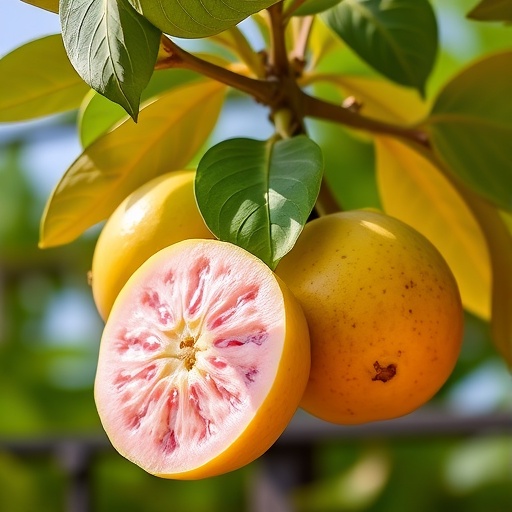
In the relentless pursuit of sustainable agricultural practices, a groundbreaking study has emerged from Brazil that promises to revolutionize the postharvest management of guavas—a tropical fruit highly valued worldwide. Researchers at the Brazilian Agricultural Research Corporation (EMBRAPA) have developed a novel technique using modulated UV-C light to combat anthracnose, a devastating fungal disease caused by the Colletotrichum gloeosporioides complex. This disease significantly reduces the shelf life and marketability of guavas by triggering unsightly dark lesions on the fruit after harvest. The innovation lies in emitting UV-C light in pulses rather than continuously, enhancing efficacy and minimizing damage to the delicate fruit surface.
Anthracnose poses a severe problem for guava producers, especially in developing regions, because the infection typically begins on the fruit skin but can penetrate deeper into the pulp through wounds caused by insect activity, improper handling, or mechanical impacts during transport. These routes of infection are exacerbated by suboptimal postharvest practices, leading to staggering losses estimated between 20% and 40% of total guava production. Traditionally, controlling this fungal pathogen has relied heavily on the application of fungicides through spraying or dipping freshly harvested fruit in chemical solutions, followed by drying and storage under refrigeration.
Despite the effectiveness of chemical fungicides, their use raises serious concerns about human and environmental health. Residual chemicals on treated fruit can be harmful, particularly to vulnerable populations such as children, and contribute to environmental pollution. Responding to this challenge, EMBRAPA’s team, supported by the São Paulo Research Foundation (FAPESP), sought to pioneer a clean, residue-free, and sustainable technology. Their goal was to devise a method that both combats the fungal pathogen efficiently and maintains the fruit’s natural integrity without introducing any toxic substances—a balance of food safety, quality preservation, and environmental stewardship.
Central to this innovation is a sophisticated cylindrical device equipped with a carefully engineered optical system and three internal germicidal UV-C lamps. One of the lamps emits ultraviolet light perpendicularly, creating an intense column of radiation. The second lamp is aligned toward an internal mirror, which reflects and redirects UV-C rays directly onto the fruit. The third lamp shines directly at the guava, ensuring comprehensive coverage by irradiating multiple angles. This multi-lamp configuration maximizes the UV-C dose absorbed on the fruit’s surface, which is crucial because this ultraviolet radiation is known for its powerful germicidal effect.
The UV-C light utilized in this system is characterized by a wavelength range typically between 200 and 280 nanometers, which is lethal to many microorganisms including fungi, bacteria, and viruses. When these rays strike the guava’s surface, the radiation energy is absorbed and converted partially into heat, contributing to the inactivation of the anthracnose-causing fungus by damaging its DNA and cellular structures. However, what sets this technology apart is the modulation of the light into pulsed bursts rather than continuous exposure. This approach allows precise control over the interaction between the fruit and the UV-C radiation, reducing energy losses and preventing excessive damage to the fruit’s epidermis.
Preserving the integrity of the fruit’s skin is essential as it acts as a natural barrier against microbial invasion. The modulated application of UV-C not only disables the pathogen but also stimulates the guava’s own defense mechanisms. This biostimulatory effect enhances the fruit’s natural resistance, creating a functional synergy where the fruit’s innate immune responses are activated in response to controlled stress induced by UV-C exposure. Consequently, the overall quality of the guava is maintained or even improved, while its postharvest shelf life is significantly extended.
While the initial results of these experiments have been very promising, they have thus far been confined to controlled laboratory environments. The transition from lab-scale to industrial-scale application requires carefully designed trials to validate the technology under real-world conditions at fruit processing facilities. This will involve integrating the modulated UV-C system into existing fruit handling and processing lines without disrupting workflow or compromising throughput rates. Such validation is a critical step to ensure commercial viability, operational efficiency, and compliance with food safety regulations.
The potential applications of modulated UV-C light treatment extend beyond guavas. The method may be adapted for various other fruits and perishable commodities that suffer from postharvest fungal diseases. By reducing reliance on chemical pesticides, this technology represents a significant stride toward greener agricultural practices that align with global goals of reducing chemical residues in food chains and minimizing environmental footprints. This innovation also offers economic advantages to producers by decreasing postharvest losses and enhancing fruit quality, thereby increasing profitability and market competitiveness.
EMBRAPA’s device design emphasizes scalability and sustainability. The incorporation of mirrors within the cylindrical chamber to redirect UV-C rays optimizes energy efficiency, ensuring minimal light is wasted during treatment. Moreover, the modulated pulse system lowers electricity consumption relative to continuous irradiation methods, further contributing to a lower operational carbon footprint. This technology could be a cornerstone in sustainable agriculture, reflecting an intelligent fusion of photonics and plant pathology.
Importantly, the impact of this research goes beyond agricultural production; it aligns with public health and environmental preservation. As consumers become increasingly aware of the dangers associated with pesticide residues, demand for cleaner and safer produce is growing. Technologies like EMBRAPA’s modulated UV-C irradiation meet this demand head-on by providing an alternative that eliminates chemical residues, reduces environmental pollution, and enhances food safety. Consequently, the technology holds promise to shape consumer markets and regulatory frameworks by offering a validated, sustainable postharvest treatment option.
Looking forward, interdisciplinary collaboration will be essential to further advance and disseminate this technology. Engineers, plant pathologists, agronomists, and industry stakeholders must work together to refine device parameters, assess long-term effects on fruit physiology, and establish guidelines for widespread adoption. Furthermore, policy support and funding from research foundations like FAPESP are invaluable to catalyze these innovations from laboratory breakthroughs toward mass-market applications. This holistic approach reflects the future of agricultural technology: scientifically grounded, environmentally responsible, and economically feasible.
In sum, the innovative modulated UV-C light treatment developed by EMBRAPA/researchers offers a beacon of hope for the sustainable management of anthracnose in guavas and potentially other fruits. By combining advanced photonic engineering with an understanding of plant-pathogen interactions, this technology exemplifies how modern science can address pressing agricultural challenges while safeguarding human health and the environment. Successful scaling and implementation could herald a paradigm shift in postharvest disease control, reducing chemical dependency and paving the way for greener, safer food production worldwide.
News Publication Date: 10-Nov-2025
Web References:
- https://mdpi.com/2311-7524/11/11/1351
- http://dx.doi.org/10.3390/horticulturae11111351
- www.fapesp.br/en
References: Supported by São Paulo Research Foundation (FAPESP); EMBRAPA scientific research.
Cite Scienmag News
Alan Morgan. (February 6, 2026). Study Reveals Modulated UV-C Light Extends Guava Shelf Life. Scienmag. https://scienmag.com/study-reveals-modulated-uv-c-light-extends-guava-shelf-life/
Alan Morgan. "Study Reveals Modulated UV-C Light Extends Guava Shelf Life." Scienmag, 6 February 2026, https://scienmag.com/study-reveals-modulated-uv-c-light-extends-guava-shelf-life/. Accessed 3 September 2026.
Alan Morgan. "Study Reveals Modulated UV-C Light Extends Guava Shelf Life." Scienmag. February 6, 2026. https://scienmag.com/study-reveals-modulated-uv-c-light-extends-guava-shelf-life/


