


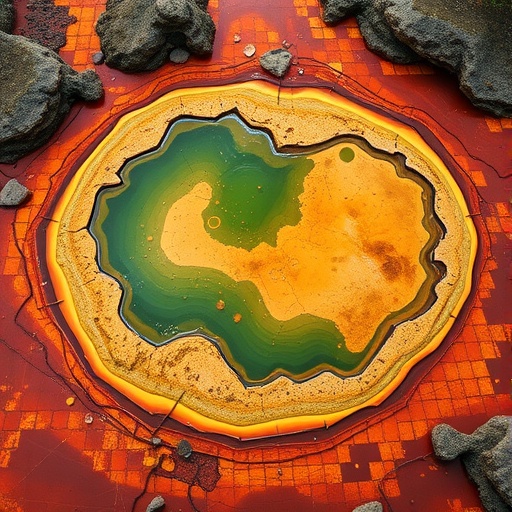
In a groundbreaking study set to reshape our understanding of early Earth’s geological and biological history, researchers have unveiled compelling evidence for stromatolite formation within post-impact hydrothermal lacustrine environments. This discovery, detailed in a recent publication in Communications Earth & Environment, offers a novel glimpse into how microbial life might have thrived in the aftermath of colossal asteroid impacts, illuminating pathways for life’s resilience and evolution on our ancient planet.
Stromatolites, layered sedimentary formations created by the activity of microbial communities—primarily cyanobacteria—represent some of the oldest fossilized evidence of life on Earth. Typically associated with shallow, warm marine environments, these biogenic structures provide critical insights into the early biosphere’s structure and function. However, this latest research pushes the envelope by demonstrating stromatolite genesis tied to hydrothermal lakes formed in the immediate aftermath of impact events, environments previously not considered hospitable for such complex microbial communities.
The team, led by Lim, J., Kim, Y., and Park, S., conducted meticulous fieldwork and multidimensional analyses at impact craters harboring ancient lacustrine deposits enriched with hydrothermal minerals. Their data depict a striking interplay between mineral precipitation and microbial biofilms within post-impact basins, conditions that favored the accretion of stromatolitic formations. These findings suggest that hydrothermal systems, energized by residual heat from an asteroid impact, could serve as cradles for early microbial ecosystems, challenging long-held assumptions about the ecological niches where life flourished billions of years ago.
Post-impact hydrothermal environments are transient by nature, characterized by elevated temperatures, high mineral fluxes, and chemically dynamic waters. This study meticulously characterizes these factors, revealing how they may have conspired to foster unique microbial mat communities capable of trapping and binding sediments, leading to stromatolite accretion. The resultant structures reveal textural and morphological hallmarks consistent with biogenic activity—layered laminae interspersed with mineral precipitates—that solidify the biological origin hypothesis.
One of the core revelations of this study lies in its integration of geochemical signatures and microfossil morphology, supporting a narrative where microbial life rapidly colonized these ephemeral habitats. The authors employed state-of-the-art isotopic analyses to trace carbon and sulfur cycling within these environments, rendering a robust biochemical fingerprint that aligns well with contemporary analogs of microbial metabolism. This biochemical evidence dovetails elegantly with the morphological data, forming a compelling case for biological involvement in stromatolite genesis under these unusual conditions.
Furthermore, the research advances our understanding of the early Earth’s resilience and adaptability, illustrating that life’s footprint extended into more extreme and dynamic settings than conventionally thought. The discovery of hydrothermal lacustrine stromatolites post-impact bolsters theories proposing that these niches could have acted as sanctuaries during periods of planetary upheaval, such as the Late Heavy Bombardment, providing vital refugia that shielded microbial communities from harsh surface conditions.
This novel perspective also holds profound implications for the search for life beyond Earth. Hydrothermal systems, capable of generating habitable environments in otherwise hostile planetary contexts, emerge as prime analogs in astrobiological explorations. Studying stromatolite formation in these settings equips scientists with enhanced criteria for identifying biosignatures on planetary bodies like Mars or the icy moons of the outer solar system, where past or present hydrothermal activity might render sub-surface lakes hospitable to microbial life.
Detailed sedimentological analyses conducted during this study reveal that stromatolite structures exhibit robust preservation potential in lacustrine sediments influenced by hydrothermal fluids. Morphological comparisons drawn between ancient terrestrial stromatolites and the newly identified post-impact varieties underscore the universality of microbial lithification processes across diverse aquatic settings. This universality bolsters the hypothesis that microbial life has harnessed a variety of geochemical environments to perpetuate its existence throughout Earth’s turbulent history.
Integrating interdisciplinary methodologies, ranging from high-resolution microscopy and synchrotron-based spectroscopy to advanced modeling of hydrothermal circulation, the researchers constructed a comprehensive framework elucidating how impact-induced hydrothermal systems evolve and ultimately support biogenic mineral deposition. Such an approach exemplifies the cutting-edge scientific rigor necessary to decode complex paleoenvironmental records and informs the burgeoning field of geomicrobiology in extreme environments.
Moreover, isotopic fractionation patterns discerned in carbonate minerals within these stromatolite deposits offer critical insights into early biogeochemical cycles. The distinct carbon isotope signatures reflect microbial mediation in carbon fixation, while sulfur isotopic data hint at microbial sulfur metabolism operating under fluctuating redox conditions. These findings not only deepen our grasp of primitive metabolic pathways but also aid in reconstructing the atmospheric and oceanic chemistry prevailing during these ancient epochs.
The broader evolutionary narrative derived from this research posits that post-impact hydrothermal lakes acted as ecological incubators, nurturing microbial diversity and complexity in the face of environmental perturbations. By demonstrating that stromatolites thrived in these settings, the study challenges the paradigm that stable, shallow marine environments were the sole cradles of early life, expanding the scope of habitable niches documented in Earth’s deep past.
Importantly, this discovery bridges the gap between geological processes—like asteroid impacts—and biological evolution, reinforcing the concept of Earth as a tightly coupled planetary system where abiotic events can profoundly influence biotic trajectories. The documented temporal coincidence of stromatolite formation with post-impact hydrothermal activity illuminates a synchronicity that underscores the dynamic feedbacks between Earth’s interior, surface, and biosphere.
Given the pace of advances in analytical capabilities and computational modeling, the researchers emphasize that ongoing and future explorations of similar crater-hosted lacustrine deposits worldwide could yield further evidence of early life’s tenacity and diversification across heterogeneous environments. This study paves the way for a new generation of investigations focused on the intricate nexus between planetary impacts, hydrothermalism, and microbial ecology.
In conclusion, the discovery of stromatolite formation within post-impact hydrothermal lakes marks a pivotal stride in unraveling Earth’s primordial biological fabric. It reveals a previously underappreciated synergy between catastrophic geological events and microbial ecosystem establishment, offering fresh perspectives on life’s origins and persistence on our planet. This paradigm shift not only reshapes geobiological models but also invigorates astrobiological missions aimed at detecting signs of life in extraterrestrial hydrothermal habitats.
As humanity’s quest to untangle the mysteries of early life continues, studies like this underscore the necessity of looking beyond conventional environments and embracing the complex tapestry of Earth’s ancient habitats. Understanding how life emerged and adapted amid planetary chaos holds the key not only to our past but also to applications in biotechnology, ecology, and the exploration of life’s potential elsewhere in the cosmos.
Lim, J., Kim, Y., Park, S. et al. Discovery of stromatolite formation in post-impact hydrothermal lacustrine environments and its implications for early Earth. Commun Earth Environ 7, 334 (2026). https://doi.org/10.1038/s43247-026-03206-7
Cite Scienmag News
Violet Maxwell. (April 14, 2026). Stromatolite Formation in Post-Impact Hydrothermal Lakes. Scienmag. https://scienmag.com/stromatolite-formation-in-post-impact-hydrothermal-lakes/
Violet Maxwell. "Stromatolite Formation in Post-Impact Hydrothermal Lakes." Scienmag, 14 April 2026, https://scienmag.com/stromatolite-formation-in-post-impact-hydrothermal-lakes/. Accessed 4 September 2026.
Violet Maxwell. "Stromatolite Formation in Post-Impact Hydrothermal Lakes." Scienmag. April 14, 2026. https://scienmag.com/stromatolite-formation-in-post-impact-hydrothermal-lakes/


