


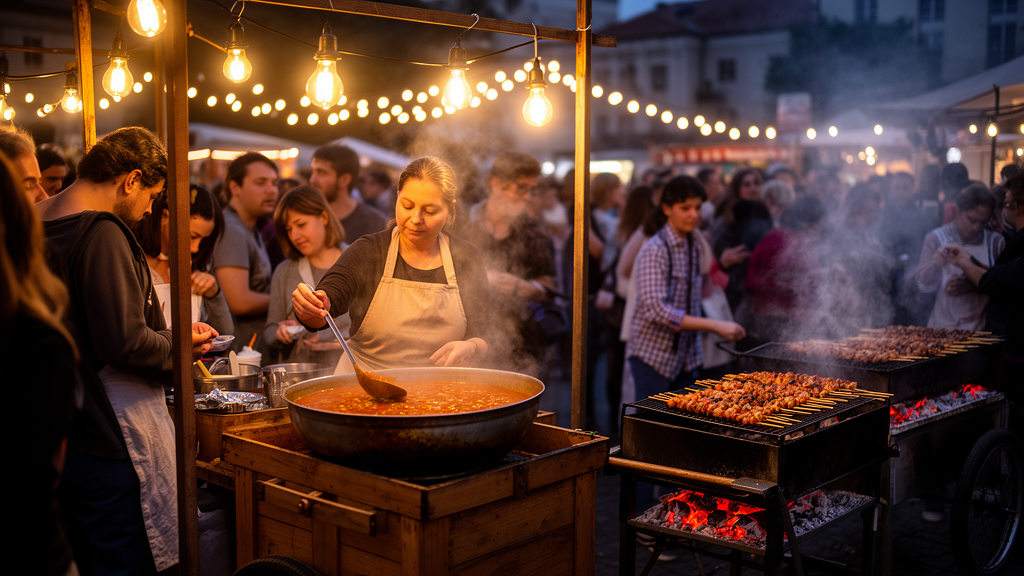
Walk down almost any street in a low- or middle-income city and you will pass the people who quietly keep the world fed: the woman frying fish at a cart, the cyclist balancing a mountain of greens, the kiosk operator selling the only hot meal within walking distance. Food systems worldwide employ an estimated 1.23 billion people, and the majority of those jobs are informal — unlicensed, unregistered, or otherwise outside the reach of formal regulation. In low- and middle-income countries, informal vendors are not a marginal curiosity of urban life. They are a linchpin of food security and livelihoods for more than a billion people. A landmark new study argues that science and policy have been flying half-blind into one of the largest labor forces on the planet.
The research, published in the journal Food Policy by a team spanning the Alliance of Bioversity International and CIAT, Cornell University, the Global Alliance for Improved Nutrition, Purdue University, the Kula Vyema Centre of Food Economics, and collaborators at several other institutions, is a systematic scoping review of extraordinary scale. The team screened 23,250 records and analyzed 327 studies from 64 countries published since 2000. Their questions were deceptively simple: How is informality defined and studied in food environments? What do we know about its links to nutrition and food choice? And what sociopolitical and livelihood factors shape the people who do this work? The answers, it turns out, reveal a field in disarray — and a policy apparatus built on shaky conceptual ground.
The most striking finding is definitional. Fewer than a quarter of the studies reviewed clearly specified what they meant by “informal,” and among those that did, definitions varied wildly. Some anchored informality in location, some in licensing status, some in whether a vendor had a physical stall. That may sound like academic hair-splitting, but the consequences are concrete. A location-based definition leads to place-based policy. An infrastructure-based definition leads to market upgrades. A licensing-based definition leads to formalization drives — campaigns to register and regulate vendors — which have mostly failed in practice because the costs of registration and compliance are rarely designed around how informal work actually functions. As market and community development specialist Mark Lundy of the Alliance of Bioversity International and CIAT put it, the choice of definition “induces certain policy conclusions before the data comes in.”
Lundy also emphasized a blind spot with real regulatory stakes. Informal vendors supply fruits, vegetables, and animal-source foods alongside ultra-processed products, so regulation aimed at one side lands on the other. Agricultural economist Simon Kimenju of the Kula Vyema Centre echoed the point: informal food vendors are not only conduits for nutrient-dense foods but also major outlets for ultra-processed foods in both rural and urban areas. Research on ultra-processed foods, he argued, needs to include informal food environments alongside formal markets — harder to regulate, but unavoidable if governments want policies that actually reach the food people eat.
Gender runs through nearly every strand of the evidence. Women make up the majority of informal food vendors, and the review documented gender-specific patterns in who sells what, where, and under what constraints — from spatial segregation in fish markets to outright exclusion from public space and credit. One of the most vivid examples comes from Dhaka, where researchers documented vendors using what scholars call “quiet encroachment”: when police approached, male vendors would duck under tea tables while their wives took over the stall, because officers were reluctant to arrest women. It is a small, telling illustration of how informal actors navigate, and are shaped by, the sociopolitical realities around them.
Yet the gender findings contain a gap inside themselves. Lundy noted that bribery, harassment, and personal safety are barely studied, and that women are well documented as subjects of policy but far less as agents in it. Public health nutritionist Swetha Manohar of the International Food Policy Research Institute added that gender is a critical but not the only axis of inequality: vendors cluster in poor communities such as informal settlements and areas near low-wage workplaces, so inequality is about where selling happens as much as who sells. Migration status also shapes women’s paths into vending, though it remains understudied — a gap that will likely grow more urgent as climate pressures reshape human movement.
Beneath the economics lies something researchers call “social infrastructure”: the web of informal relationships that stabilizes supply chains, shares risk, and confers legitimacy on work that has none on paper. Informal food environments run on trust and reciprocity, not just transactions. Nutritionist Elizabeth Fox of Cornell University argued that this complexity demands a multidimensional understanding of informality. The widely used International Labour Organization definition, she noted, captures only a limited set of dimensions; infrastructure, types of products sold, spatial characteristics, and visibility are all highly relevant to how informal food systems operate in practice. Without that nuance, she warned, researchers risk “reducing complex social and economic practices to overly narrow categories that obscure the people behind them.”
The evidence base itself has structural weaknesses. Public health nutritionist and statistician Nilupa Gunaratna of Purdue University pointed out that most research has been cross-sectional, capturing vendors at a single point in time even though informal work is precarious and vendors constantly adapt without safety nets. Space matters too: urbanization is proceeding not only in capital cities but in smaller cities and peri-urban and rural areas, where little research has looked. There is also a striking absence of data on vendors’ own health and nutritional well-being — the people who facilitate access to healthy diets cannot be identified, measured, or compared across studies without first agreeing on who they are. Sociologist Rachel Bezner Kerr of Cornell University added that the link between informal vendors and health, diets, and nutrition outcomes is understudied, in stark contrast to the many studies connecting smallholder farm production to household nutrition, and that workplace dynamics such as childcare, migration, and bribery remain under-explored.
For policymakers, the review’s most actionable message comes from the 214 studies that offered recommendations across more than 40 countries. The clearest and most consistent advice was to move beyond the formal/informal binary altogether. Basic infrastructure — water, electricity, designated vending zones, cold storage — was the single most common recommendation, followed by gender-responsive financial inclusion and social protections for informal workers. Avery Sirwatka of Cornell University observed that formalization efforts have largely failed in part because registration, licensing, permitting, and food safety compliance costs are rarely designed with local informal work conditions in mind; the literature instead points toward collaborative governance models and legal recognition of vendors’ economic roles as approaches better suited to meeting both vendor and social needs.
The researchers are candid that ambiguity itself is a policy problem. Agri-food system sociologist Jenny Wiegel of the Alliance of Bioversity International and CIAT noted that unclear classification limits the ability to compare across contexts, generalize into theory, or even conduct coherent policy debates. Nutrition epidemiologist Ramya Ambikapathi, the review’s lead voice, reflected that informal spaces are inherently contested — sites of rich biodiversity and traditional foods but also of illegal bushmeat, main sources of vegetables in some contexts and doorstep delivery of ultra-processed foods in others, sustained by genuine demand because formal food systems leave out most of the population in low- and middle-income countries. Human geographer Jane Battersby of the University of Cape Town found the rapid growth in publications on informality encouraging, and hopes it will translate into governance that supports the sector. Agricultural economist Stella Nordhagen of GAIN said the sheer diversity of how informality was defined and conceptualized — even among the paper’s own coauthors — underscored both the importance of informal actors and the complexity of studying them. The paper, “Informality in Food Environments: A Systematic Review of Nutrition, Livelihood, and Sociopolitical Outcomes and Implications for Food Policy,” is now in press at Food Policy, and its conclusion is hard to escape: informality sits on a continuum, not in a binary, and policy that ignores that will keep missing the people who feed a large share of the world’s poor and urban populations.
Subject of Research: Informality in food environments and its nutrition, livelihood, and policy implications in low- and middle-income countries
Article Title: The invisible backbone of the world's food system: What 327 studies from 64 countries tell us about informal food vendors
Article References: The invisible backbone of the world's food system: What 327 studies from 64 countries tell us about informal food vendors. (n.d.). Original publication
Image Credits: AI Generated
DOI: Not provided
Keywords: informal food vendors, food environments, food policy, food security, systematic review, gender, low- and middle-income countries, street vending, ultra-processed foods, livelihoods, urbanization, social infrastructure
Cite Scienmag News
Courtney Benton. (October 9, 2026). Street Vendors Feed a Billion People, Yet Science Barely Knows Them. Scienmag. https://scienmag.com/street-vendors-feed-a-billion-people-yet-science-barely-knows-them/
Courtney Benton. "Street Vendors Feed a Billion People, Yet Science Barely Knows Them." Scienmag, 9 October 2026, https://scienmag.com/street-vendors-feed-a-billion-people-yet-science-barely-knows-them/. Accessed 9 October 2026.
Courtney Benton. "Street Vendors Feed a Billion People, Yet Science Barely Knows Them." Scienmag. October 9, 2026. https://scienmag.com/street-vendors-feed-a-billion-people-yet-science-barely-knows-them/


