


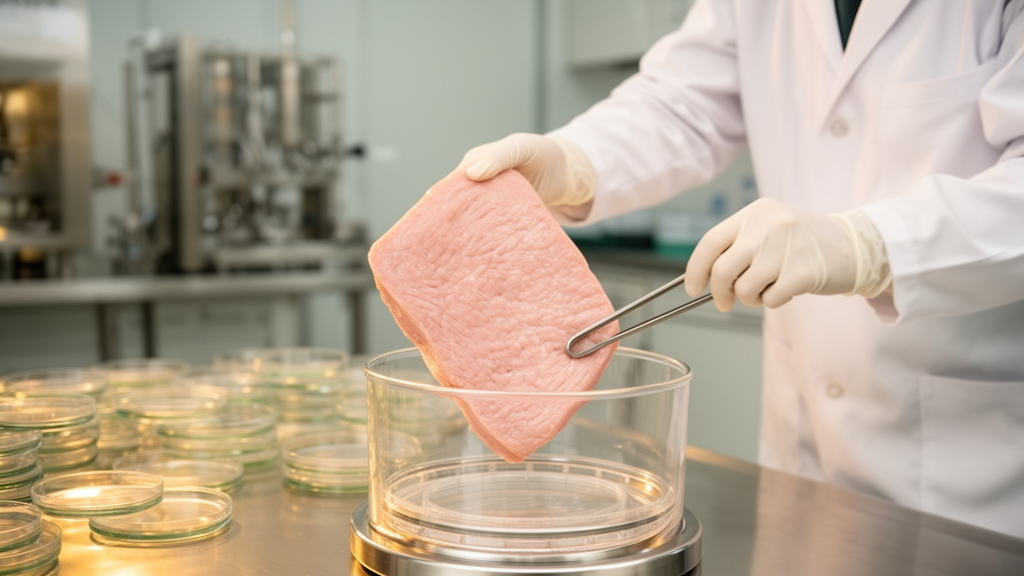
Cultured meat has long been pitched as one of the most consequential food technologies of the century: real animal protein grown from cells in bioreactors, without slaughter, without vast pastures, and, according to its advocates, without the climate toll of conventional livestock. But a new study suggests that the technology’s most powerful product may not be the meat itself. It is the story. Researchers from Freie Universität Berlin, the Leibniz-Institut für Länderkunde in Leipzig, and Universität Leipzig analysed 41 promotional videos produced by cellular agriculture companies and found that these films operate as sophisticated acts of translation, converting invisible cellular processes and planetary-scale anxieties into narratives designed to make lab-grown protein feel credible, morally necessary, and investable.
The study, published in the journal Geographica Helvetica by geographers Frank I. Müller, Frank Meyer, and Judith Miggelbrink, is among the first to move beyond the textual analysis of alternative-protein hype and examine how promises about cultured meat are organised audio-visually. Drawing on Bruno Latour’s concept of translation from actor–network theory, the authors argue that promotional videos do not simply transmit information about a technology. Instead, they align heterogeneous elements, including cells, laboratories, animals, kitchens, investors, and crisis imagery, into coherent stories that reshape how each of those elements is understood. In Latourian terms, translation is not mere communication but a transformation: to translate is to link agents in ways that change them, and the videos, the researchers contend, turn laboratories into scalable futures, cells into commodities, and viewers into potential supporters or investors.
The corpus was assembled from the company database of the Good Food Institute, a non-profit that promotes animal-protein alternatives. The researchers selected short-form, English-, German-, Spanish-, or Portuguese-language videos intended to advertise companies to consumers or investors, excluding interviews and slide presentations in favour of genuine narrative storytelling. Each video was analysed as a single audio-visual unit through a two-stage coding process. The first stage coded material against four analytical entry points derived from the literature on promissory narratives: strategic positioning, material referents, temporal projection, and broader promissory framings linking crisis, ethics, and transformation. The second stage compared the coded material across the corpus to identify recurring narrative configurations. The result was six cross-cutting patterns, which the authors interpret as six translational operations.
The first pattern, which the researchers call narrating CellAg, relies on infographics, comic-style graphics, and interviews with chefs, employees, and chief executives to make complex science digestible. Young scientists in white suits work diligently in gleaming laboratories while founders offer personal testimony, vouching for the technology and its promise of a better world. Statistics and charts sit alongside images of suffering animals, blending economic motivation with ethical storytelling. The authors describe this as a translational act of guided explanation: it renders technical opacity trustworthy through controlled visual explanation and embodied spokespersons, while quietly narrowing the field of interpretation by foregrounding expertise, safety, and optimism and backgrounding uncertainty, conflict, and the difficulties of industrial scale-up.
The second pattern performs what the researchers call scalar translation, entangling the planetary, the microbial, and the domestic in rapid montage. Aerial tracking shots sweep over deforested land and monotonous agriculture before cutting to laboratory scenes; close-ups of petri dishes, test tubes, and microscopes give way to family barbecues and dinner tables; computer-generated cell biopsies are followed by sizzling pans. The laboratory becomes the hinge connecting the micro-scale of the cell to the scale of the planet, framing cell cultivation as a natural response to global crisis. Crucially, the authors note, the montage almost always skips the contested middle step: the upscaled fabrication plant, with its energy demands, infrastructure, and regulatory complexity. What the videos omit, they argue, is as persuasive as what they show.
A third pattern bundles crises together. Climate change, land scarcity, food security, animal welfare, water pollution, and even urban futures are condensed into a single narrative problem space to which cellular agriculture appears as a proportionate answer. One video in the corpus declares that by 2050 the world’s population will exceed ten billion and that cellular agriculture is here to tackle the resulting challenge. The researchers describe this as crisis–solution translation: diffuse collective anxieties are converted into a market-compatible horizon of action, positioning private firms as legitimate responders to anticipated catastrophe and framing investment and entrepreneurship as socially responsible rather than merely profit-seeking.
Perhaps the most striking pattern is temporal. Several videos invoke a nostalgic, pre-industrial past in which people grew their own food, knew the animals they ate, and lived in balance with nature, before contrasting that idyll with the devastation of industrial meat production. One company’s video, styled as a fairy-tale book turned by an invisible hand, moves from cows grazing in alpine meadows to the eroded landscapes of the Amazon, before asking whether technology could restore what has been lost. The researchers call this temporal translation: a promise to bridge an apparent contradiction by using technological progress to recover the virtues of an imagined past. The affective vocabulary of tradition is preserved, they argue, while the material basis of that tradition is replaced, allowing cultured meat to appear both radically novel and culturally continuous.
A fifth pattern moralises cleanliness. Sterile laboratories, spotless microscopes, and controlled interiors are repeatedly juxtaposed with barns, smoke, mud, and smoking chimneys, so that hygiene becomes shorthand for sustainability, safety, and ethical superiority. The researchers describe this hygienic translation as reframing food production as a problem of controlled environments and optimised processes, shifting attention away from questions of energy use, material throughput, and industrial dependency toward an ideal of transparent technical management. The messy materiality of animal agriculture is translated into a seemingly frictionless, governable environment, with the laboratory positioned as the clean successor to the farm.
The final pattern works through emotion. Videos individualise animals, giving them names and close-ups, and stage scenes of family barbecues rendered in nostalgic, 1970s-style footage. One company famously named a chicken Ian; another asks viewers whether cramming animals into barns is even natural. The researchers argue that this emotional translation redistributes responsibility: guilt is displaced onto existing production systems rather than consumption itself, so the viewer is not asked to give up meat but to accept it in a morally repaired form. Regret and compassion are converted into acceptance of technological substitution, legitimising a new production regime that promises ethical continuity without dietary rupture.
Taken together, the six patterns form what the authors call a repertoire rather than a typology, and they reveal a sector that, despite its fragmentation, presents a remarkably coherent audio-visual narrative about its own promise. The researchers are careful about what their findings do and do not show: the analysis does not demonstrate that cellular agriculture companies are already agents of a protein transition, only that their promotional media frame them as such in an effort to stabilise that position with consumers, investors, and regulators. By centring audio-visual material, the study extends scholarship on promissory narratives beyond text-based sources and raises pointed questions about how these translations travel, whether the meanings crafted in industry videos are reproduced, contested, or transformed in policy documents, news coverage, and audience reception. As cultured meat edges toward supermarket shelves, the study is a reminder that the battle for the future of protein is being fought not only in bioreactors, but in storyboards, scripts, and carefully edited frames.
Subject of Research: Promissory narratives and audio-visual storytelling in cellular agriculture promotional videos
Article Title: From lab to table: promissory narratives and the future of protein production in response to global crises
Article References: Müller, F. I., Meyer, F., & Miggelbrink, J. (2026). From lab to table: promissory narratives and the future of protein production in response to global crises. Geographica Helvetica, 81(3), 463-479. https://doi.org/10.5194/gh-81-463-2026
Image Credits: AI Generated
Keywords: cellular agriculture, cultured meat, promissory narratives, actor-network theory, socio-technical imaginaries, food systems, sustainability, multimodal analysis, alternative proteins, science communication, food media, Latour
Cite Scienmag News
Violet Maxwell. (October 9, 2026). How Lab-Grown Meat Companies Turn Planetary Crisis Into a Sales Pitch. Scienmag. https://scienmag.com/how-lab-grown-meat-companies-turn-planetary-crisis-into-a-sales-pitch/
Violet Maxwell. "How Lab-Grown Meat Companies Turn Planetary Crisis Into a Sales Pitch." Scienmag, 9 October 2026, https://scienmag.com/how-lab-grown-meat-companies-turn-planetary-crisis-into-a-sales-pitch/. Accessed 9 October 2026.
Violet Maxwell. "How Lab-Grown Meat Companies Turn Planetary Crisis Into a Sales Pitch." Scienmag. October 9, 2026. https://scienmag.com/how-lab-grown-meat-companies-turn-planetary-crisis-into-a-sales-pitch/


