


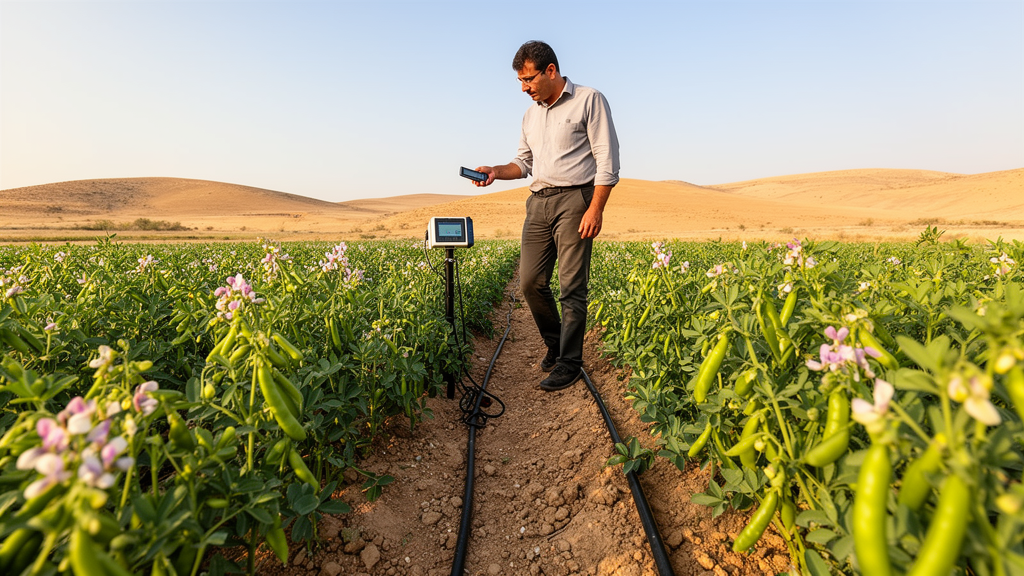
Supplemental irrigation substantially increased chickpea grain yield in a two-year field experiment conducted under arid conditions in southeastern Türkiye, with the strongest gains generally observed when irrigation included flowering and grain filling. The experiment compared winter- and spring-sown chickpea across eight stage-based irrigation treatments, including a rainfed control and combinations of 80-millimeter irrigation events applied at the vegetative, flowering and grain-filling stages. Researchers carried out the field experiment during the 2019/20 and 2020/21 growing seasons.
In the first season, grain yield increased by as much as 64.9% relative to the rainfed treatment. In the second season, the corresponding increase reached 579.6%. The large difference between years shows that the measured response varied substantially across growing seasons, so the two percentage gains should not be treated as a single consistent effect size.
The experiment also recorded changes in biomass and yield components. These measures increased significantly in response to supplemental irrigation, particularly in treatments that included irrigation during flowering and grain filling. The study therefore identified the reproductive stages as the part of the tested irrigation schedule most closely associated with the stronger yield and biomass responses, while the experiment itself did not establish a universal irrigation strategy for chickpea production.
Seasonal crop evapotranspiration varied widely among the treatments. For winter-sown chickpea, it ranged from 203 to 846 millimeters, compared with 107 to 502 millimeters for spring-sown chickpea. Winter sowing produced higher grain yield and biomass, while spring sowing generally produced higher water productivity and irrigation water productivity.
The reported pattern was associated with lower seasonal evapotranspiration and a shorter crop duration for the spring-sown crop. A sowing system could achieve greater total production without also achieving the highest output relative to the water used. Winter-sown chickpea led in grain yield and biomass, whereas the spring-sown treatment generally led in the study’s water-use efficiency measures.
These results distinguish production volume from productivity under the irrigation schedules tested in southeastern Anatolia. The treatment design used a fixed irrigation depth of 80 millimeters for each irrigation event. Irrigation could be applied alone or in combination at the vegetative, flowering and grain-filling stages, producing eight treatment combinations across the two sowing times.
The no-irrigation treatment at all three stages served as the rainfed control, making it possible to compare each stage-based schedule with chickpea grown without supplemental irrigation during the experiment. Across both sowing systems, the results support the narrower conclusion that stage-based supplemental irrigation during flowering and grain filling may help support chickpea grain yield and water productivity under the arid, water-limited conditions of the study. This interpretation comes from observed differences among field treatments, not from a separate estimate of the biological effect of stage timing.
The experiment compared complete irrigation schedules rather than isolating flowering and grain filling from every other possible influence on yield. Seasonal variation remained an important feature of the findings. The maximum yield increases occurred in different years, and seasonal evapotranspiration covered broad ranges in both sowing systems.
The data also showed that spring sowing did not maximize every outcome: its crop generally achieved higher water productivity and irrigation water productivity, but winter sowing generated more grain and biomass. Any comparison of the two systems must therefore consider both output and the water associated with it. The study was limited to one arid region, two growing seasons, two sowing times and a defined set of 80-millimeter irrigation treatments.
Its results may not transfer unchanged to other locations, seasons, cultivars or management conditions. Even with those boundaries, the experiment provides a direct field-based assessment of a practical question: how a limited set of stage-based irrigation schedules affected chickpea production and water productivity in arid southeastern Türkiye.
Subject of Research: Field evaluation of stage-based supplemental irrigation for winter- and spring-sown chickpea under arid conditions in southeastern Türkiye
Article Title: Yield and water productivity of winter and spring-sown chickpea under stage-based supplemental irrigation
Article References: Akin, S. (2026). Yield and water productivity of winter and spring-sown chickpea under stage-based supplemental irrigation. BMC Plant Biology. https://doi.org/10.1186/s12870-026-09926-4
Image Credits: AI Generated
DOI: 10.1186/s12870-026-09926-4
Keywords: chickpea, supplemental irrigation, grain yield, water productivity, evapotranspiration, winter sowing, spring sowing, grain filling, arid agriculture, Türkiye, Yield, water
Cite Scienmag News
Alan Morgan. (October 25, 2026). Stage-based irrigation raises chickpea yields in arid Türkiye. Scienmag. https://scienmag.com/stage-based-irrigation-raises-chickpea-yields-in-arid-turkiye/
Alan Morgan. "Stage-based irrigation raises chickpea yields in arid Türkiye." Scienmag, 25 October 2026, https://scienmag.com/stage-based-irrigation-raises-chickpea-yields-in-arid-turkiye/. Accessed 25 October 2026.
Alan Morgan. "Stage-based irrigation raises chickpea yields in arid Türkiye." Scienmag. October 25, 2026. https://scienmag.com/stage-based-irrigation-raises-chickpea-yields-in-arid-turkiye/


