


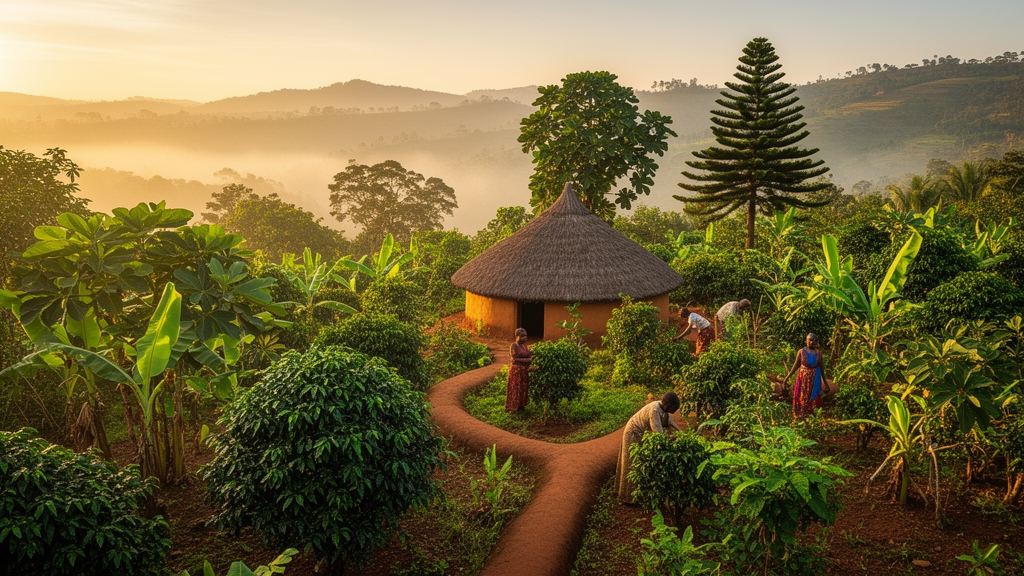
Smallholder homesteads in Ethiopia’s Amhara region are quietly doing the work of nature reserves. A new field survey, published in Discover Plants, inventoried the trees and shrubs growing around 300 farm households across six villages and found 45 woody species belonging to 27 botanical families. More than two thirds of them, 71.1 percent, are indigenous to Ethiopia, and one species, the leguminous tree Millettia ferruginea, is endemic, meaning it grows nowhere else. In a country where natural forest cover has declined severely, the finding positions these intensively managed garden plots as unexpected strongholds of native plant genetic diversity.
The study, led by Desalegn Getnet and Hailie Shiferaw Wolle, set out to answer a deceptively simple question: can farmland that farmers actively manage for profit still function as a reservoir for wild woody flora? The answer, based on standardized ecological sampling, is a qualified yes, with important caveats. The homesteads do preserve mature native trees such as Cordia africana, Juniperus procera and Vachellia abyssinica, but the same intensive management that keeps cash crops productive appears to suppress the natural regeneration of those very trees, leaving the systems acting more as refuges for old individuals than as self-sustaining populations.
The research team worked across three districts chosen to span the region’s ecological and economic variation: Jabitehnan and Gozamen in the west and east Gojjam zones, and Gubalafto in the drier, more densely populated North Wollo highlands. Within each district they screened for villages where homestead agroforestry is widely practiced, then randomly selected two kebeles, the lowest administrative units in Ethiopia, per district. From each kebele they drew 50 households by systematic random sampling, giving 300 households in total: Mankusa and Jiga in Jabitehnan, Chimt and Chertekel in Gozamen, and Gedo and Geshober in Gubalafto.
Each household contributed one sampling plot of 20 by 20 meters, established directly within the managed homestead area. Following national biodiversity conservation guidelines and standard ecological protocols, the surveyors recorded every tree and shrub, defining a tree as a woody perennial with a diameter at breast height of at least 2.5 centimeters and a height of at least 1.5 meters, and a shrub as a multi-stemmed woody perennial meeting the same thresholds. For each individual they noted the species, diameter, height, life form, and whether it had been planted or retained from the existing stock, along with site history and landscape characteristics.
The floristic results were then compressed into standard diversity metrics. The team calculated the Shannon diversity index, which combines species richness with how evenly individuals are distributed among species; the Shannon equitability or evenness index; Simpson’s diversity index, derived from the probability that two randomly drawn individuals belong to different species; and the Sørensen similarity index, which measures how closely the species lists of two sites match. Statistical comparisons across kebeles used one-way analysis of variance with Tukey’s post-hoc tests in R, after verifying normality and homogeneity of variance, and species accumulation curves were generated to check whether the sampling effort had captured the local species pools.
The headline numbers conceal a striking structural story. Although 45 species were recorded, ecological dominance, measured by the Importance Value Index, the sum of relative density and relative frequency, was concentrated in a handful of commercially valuable perennials. Coffee, Coffea arabica, was the single most dominant species in the landscape with an IVI of 55.12 percent, driven by 7,281 individual stems, 41.99 percent of all stems counted, spread across 236 of the 300 plots. Buckthorn, Rhamnus prinoides, a shrub whose leaves are used in traditional beverages, ranked second with an IVI of 42.46 percent and 5,713 stems. Together these two cash species made up 74.9 percent of every woody stem sampled.
Indigenous canopy trees told a different story. Cordia africana ranked third overall with an IVI of 13.36 percent, not because it is abundant, only 3.18 percent of stems, but because it is everywhere, occurring in 183 plots with a relative frequency of 10.18 percent. Khat, Catha edulis, ranked fourth with localized clustering in market-oriented plots. The pattern reveals a deliberate management strategy: farmers retain mature native canopy trees for shade and soil improvement while packing the understory with high-density cash perennials for income. The top 15 species alone accounted for 81.12 percent of the total landscape importance value out of a possible 200 percent.
Dominance shifted sharply from village to village, tracking market access and climate. In Jiga, Mankusa and Geshober, where coffee adoption ranged from 94.4 to 100 percent of households, coffee achieved IVI values of 85.19, 81.20 and 80.47 percent respectively, with Cordia africana consistently serving as the preferred shade tree. In Chimt and Chertekel, lower rainfall and different commercial demand flipped the hierarchy: buckthorn dominated with IVI values of 88.98 and 66.88 percent, and khat rose to prominence. Gedo stood apart with the most balanced co-dominance, coffee and buckthorn jointly accounting for 74.91 percent of stems within a more diversified multi-strata system.
Those structural differences showed up directly in the diversity statistics, which differed highly significantly among kebeles, at P < 0.0001. Gedo recorded the highest Shannon diversity at 1.16 plus or minus 0.38, closely followed by Mankusa at 1.14 plus or minus 0.42, and the two sites also had the highest species richness per plot, 6.92 and 7.32. Jiga, despite a respectable richness of 5.46 species per plot, recorded the lowest Shannon diversity at 0.34 plus or minus 0.36 and an Inverse Simpson value of 1.83, a signature of heavy dominance by a single species, in this case coffee. High evenness, as in Gedo, indicates a mix of functional groups such as nitrogen fixers and shade trees that support nutrient cycling and microclimate buffering, whereas low evenness signals a simplified, economically profitable but ecologically more fragile system.
Sampling adequacy was confirmed by species accumulation curves, which plateaued at roughly 45 plots in every kebele, with 80 to 90 percent of local species captured within the first 40 plots and the final plots adding mostly singletons. Notably, the combined regional curve stabilized only at 250 of the 300 plots, a discrepancy the authors attribute to high species turnover between districts, as each agro-ecological zone contributed species absent from the others. Cluster analysis based on Sørensen similarity reinforced this picture: Chertekel and Chimt grouped together with over 90 percent similarity, distinct from all other sites, while Mankusa and Jiga were nearly identical at 0.96, the highest pairwise value in the matrix. The lowest similarity, between Gedo and Chimt at 0.56, still reflects substantial shared flora, suggesting a broadly homogeneous landscape punctuated by locally distinct assemblages.
The authors are careful about what these numbers do and do not show. The 45-species total exceeds counts of 11 to 44 species reported from several other Ethiopian regions but falls below the 48 to 120 species documented in the more humid, enset-dominated homesteads of southern Ethiopia, and the comparison is complicated by differing plot designs, since this study used a uniform 20 by 20 meter layout that yields a more conservative, localized count. Exotic species, 28.9 percent of the flora and including fast-growing trees such as Eucalyptus grandis, provide rapid income, poles and fuelwood but carry ecological risks, including soil moisture depletion and allelopathic suppression of native understory plants. The authors also flag a regeneration gap: frequent weeding, pruning and soil preparation for cash crops suppress seedling recruitment of native timber trees, so the long-term conservation value of these systems depends on active management that allows younger cohorts to establish. They recommend policies that support retaining native species alongside commercial crops, tailored to these mid-to-high altitude settings rather than applied region-wide, and call for future research into the functional traits, foliar nitrogen, litter decomposition, root architecture and canopy shade, of both dominant natives and exotics, to quantify what these farm gardens actually contribute to soil fertility, pollinator support and agricultural resilience.
Subject of Research: Woody species diversity and conservation in homestead agroforestry systems of the Amhara region, Ethiopia
Article Title: Diversity of woody species in homestead agroforestry practices in Amhara National Regional State, Ethiopia
Article References: Getnet, D., & Wolle, H. S. (2026). Diversity of woody species in homestead agroforestry practices in Amhara National Regional State, Ethiopia. Discover Plants, 3(1), Article 492. https://doi.org/10.1007/s44372-026-00989-z
Image Credits: AI Generated
DOI: 10.1007/s44372-026-00989-z
Keywords: agroforestry, Ethiopia, woody species diversity, homestead gardens, biodiversity conservation, Shannon diversity index, indigenous trees, Coffea arabica, Rhamnus prinoides, Amhara region, in-situ gene banks, species composition
Cite Scienmag News
Margaret Porter. (October 25, 2026). Ethiopian Homestead Gardens Shelter 45 Woody Species, Most of Them Native. Scienmag. https://scienmag.com/ethiopian-homestead-gardens-shelter-45-woody-species-most-of-them-native/
Margaret Porter. "Ethiopian Homestead Gardens Shelter 45 Woody Species, Most of Them Native." Scienmag, 25 October 2026, https://scienmag.com/ethiopian-homestead-gardens-shelter-45-woody-species-most-of-them-native/. Accessed 25 October 2026.
Margaret Porter. "Ethiopian Homestead Gardens Shelter 45 Woody Species, Most of Them Native." Scienmag. October 25, 2026. https://scienmag.com/ethiopian-homestead-gardens-shelter-45-woody-species-most-of-them-native/


