


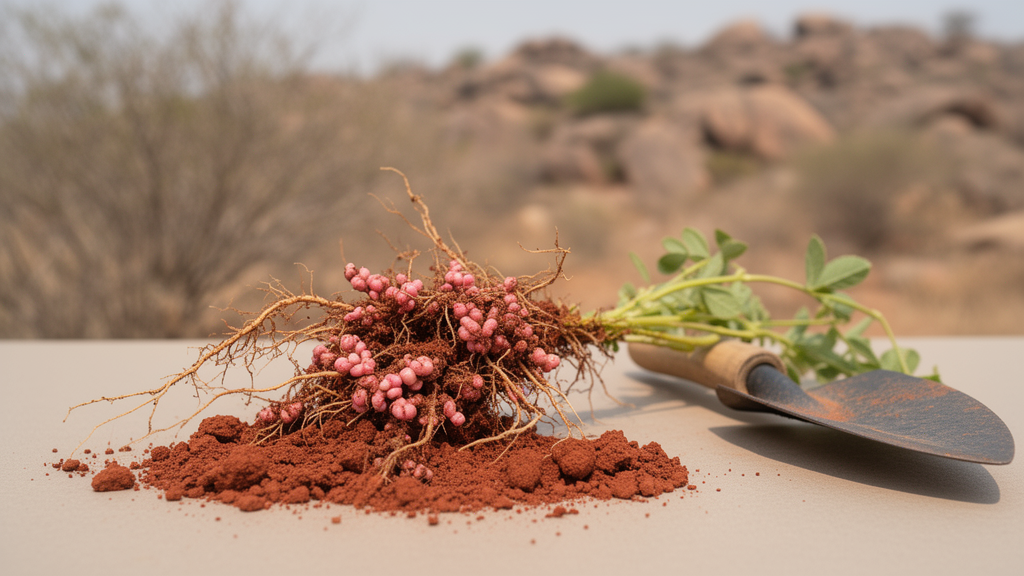
Deep in the semi-arid hills of Rajasthan, a modest wild legume has been quietly partnering with soil bacteria to pull nitrogen from the air, and a new study has finally identified who those bacterial partners are. Researchers surveyed twelve sites across the Jaipur and Ajmer districts of the central Aravalli range between 2021 and 2024, excavating plants of Tephrosia strigosa, a native papilionoid legume for which no prior symbiotic data existed from this region. The average nodule count per plant varied sharply between sites, from 5.50 at Pushkar to 13.75 at Jhalana, a spatial pattern the authors link to differences in soil organic carbon and available phosphate, factors known to stimulate rhizobial activity and nodule formation.
The team collected nodules from plants growing across the twelve sites and surface sterilized them using sequential ethanol and mercuric chloride washes before crushing them onto Congo red yeast mannitol agar plates. From these preparations, 83 purified root nodule bacterial strains were isolated. Soil analysis conducted by the Rajasthan Agricultural Research Institute showed that the rhizosphere pH ranged from 7.8 at Pisangan to 8.4 at several sites including Amer, Achrol, Jamwa Ramgarh and MDSU, placing all locations in the slightly to moderately alkaline range typical of arid and semi-arid landscapes.
Nodule morphology itself shifted with development, from globose light-brown structures in their initial stage to elongated, branched, dark-brown nodules at maturity, echoing descriptions from other Thar Desert legumes such as Crotalaria burhia and Indigofera. To probe the genetic diversity of these 83 strains, the researchers extracted genomic DNA from every isolate and subjected it to BOX-PCR fingerprinting, a technique that amplifies repetitive extragenic palindromic sequences scattered across bacterial genomes and yields banding patterns unique to each genotype. The results revealed substantial variation: 48 isolates fell into sixteen distinct groups containing two or more members, while the remaining 35 isolates each displayed a unique banding profile, effectively representing individual genotypes.
The largest group, Group II, contained eleven isolates sharing a similar genetic profile. This degree of genetic heterogeneity points to a rich reservoir of ecological roles and functional proficiencies within the root nodule bacterial community, a finding consistent with fingerprinting studies on native legumes across the Indian Thar Desert. Based on the fingerprint groups, the team selected 30 representative isolates for 16S rRNA gene amplification and sequencing, using the universal primers 18F and 1492R and sending the purified products to Eurofins Genomics India in Bangalore.
Sequence comparison against type strains in NCBI GenBank showed that 23 of the 30 isolates belonged to rhizobial genera, while 7 were non-rhizobial bacteria. Phylogenetic analysis, performed with MEGA11 using the maximum likelihood method and the GTR+G+I model with 1000 bootstrap replicates, placed 15 isolates within the genus Sinorhizobium and 8 within Rhizobium. The Sinorhizobium isolates were closely related to S. aridi, S. mexicanus, S. kostiense, S. adhaerens and S. terangae, while the Rhizobium isolates clustered with R. pongamiae, R. bangladeshense, R. pakistanense and R. oryzihabitans.
The phylogenetic structure of the Sinorhizobium population proved remarkably complex, with the fifteen strains distributed across seven distinct clades, a polyphyletic pattern suggesting multiple evolutionary origins and possible horizontal gene transfer events among lineages adapted to arid and semi-arid soils. Clade I isolates TS40, TS54 and TS64 shared 100 percent sequence identity among themselves and with the recently proposed species Sinorhizobium aridi TW10, originally isolated from Tephrosia wallichii in the Thar Desert. These isolates also clustered with strains from geographically distant hosts, including Retama monosperma in Morocco, Cicer arietinum in Pakistan and Zornia gibbosa in the Aravalli range, indicating a wide distribution and ecological adaptability of this lineage.
Clade II isolates TS28, TS30, TS76 and TS83, also 100 percent identical to each other, grouped with a Thar Desert strain from Tephrosia purpurea and shared 99.85 percent sequence similarity with Clade I, suggesting a closely related subclade of the S. aridi lineage potentially shaped by host-associated microhabitats. Clade III, comprising isolates TS13, TS50, TS55 and TS79, showed complete sequence identity with Sinorhizobium mexicanus APP107, a strain previously recovered from pigeonpea in Uttar Pradesh, and high similarity to the type strains S. mexicanus ITTG-R7 from Mexico and S. terangae LMG 7834 from Senegal. Isolate TS70 matched S. kostiense LMG 19227, originally isolated from Acacia senegal in Sudan, at 100 percent, underscoring the promiscuous nature of certain Sinorhizobium lineages that associate with taxonomically distant legumes across continents.
Isolate TS77 stood out as the most divergent strain, sharing only 98.77 percent sequence identity with S. adhaerens LMG 20216, a soil isolate from the United States, hinting at a divergent lineage with genomic plasticity and potential symbiotic versatility. The authors caution that 16S rRNA gene data alone cannot establish species-level delineation, and that multilocus sequence analysis together with genome-based approaches such as average nucleotide identity and digital DNA–DNA hybridization will be needed for robust taxonomic confirmation. The Rhizobium isolates told a complementary story of diversity and host adaptation.
Four isolates, TS10, TS22, TS44 and TS75, clustered with the type strain Rhizobium pongamiae VKLR-01, originally described from Pongamia pinnata in India, with sequence similarities ranging from 99.55 to 99.7 percent, suggesting they may represent strains of R. pongamiae or closely related genotypes adapted to distinct legume hosts within the same region. Isolate TS11 matched R. bangladeshense BLR175, described from lentil in Bangladesh, at 100 percent, while also showing 99.8 percent similarity to R. etli CFN 42. Isolate TS78 proved genetically divergent, sharing only 97.63 percent sequence similarity with R. pakistanense BN-19, a peanut-associated strain from Pakistan, and clustering instead with Rhizobium sp. IHSR from Sesbania rostrata in Tamil Nadu, a pattern the authors interpret as evidence of geographical and host-specific adaptation within the Rhizobium lineage.
Perhaps the most intriguing finding concerned two isolates, TS3 and TS16, which failed to nodulate their original host in greenhouse authentication tests despite being recovered from functional nodules. Phylogenetic analysis revealed that these non-nodulating strains were closely related to Rhizobium oryzihabitans, a species typically isolated from rice roots rather than legume nodules. The authors propose several explanations for their symbiotic failure: the strains may have lost nodulation-related genes through mutation or inactivation, or symbiotic plasmids carrying nod genes may have been shed during laboratory cultivation.
This finding underscores the genomic plasticity of Rhizobium and its capacity to occupy diverse ecological niches, and it parallels reports of non-rhizobial endophytes, including Enterobacter species, previously documented in Tephrosia nodules of the Thar Desert. The seven non-rhizobial isolates identified through 16S sequencing belonged to diverse genera including Priestia, Roseateles, Paenibacillus, Pseudarthrobacter and Caulobacter, each showing greater than 99 percent sequence similarity to their closest type strains. Their presence within nodules may reflect co-infection with natural symbionts, opportunistic root colonization, or attraction to the nutrient-rich nodule environment, though their functional roles remain to be elucidated.
Phenotypic characterization of the sequenced rhizobial strains showed that most tolerated the full pH range of 5 to 10 and grew at NaCl concentrations up to 2 to 3 percent, with three isolates, TS10, TS16 and TS70, tolerating up to 4 percent, placing them in the moderately to highly salt-tolerant category. Antibiotic resistance patterns were equally diverse, with isolates highly resistant to co-trimazine and nitrofurantoin yet sensitive to gentamicin, kanamycin and ofloxacin, and sugar utilization assays revealed dextrose and sucrose as the most metabolized carbon sources while melibiose was the least utilized. The dominance of Sinorhizobium across the sampled sites suggests it serves as the primary microsymbiont of native legumes in the central Aravalli range, a pattern the authors attribute to combined environmental and host-associated selection pressures in the alkaline, hot and water-limited conditions of the region.
Genomic adaptations to osmotic and alkaline stresses, including gene clusters involved in osmoregulation, the pha2 cation/proton antiporter system associated with sodium resistance, and the bet gene cluster for glycine betaine biosynthesis, may underpin the ecological success of this genus under such conditions. Horizontal gene transfer, a major driver of bacterial evolution, may further facilitate the acquisition of adaptive traits, and the phenotypic variation among Rhizobium and Sinorhizobium strains may partly reflect plasmid-based traits acquired through this mechanism. As the first molecular study of microsymbionts associated with T. strigosa in the central Aravalli, this work establishes a foundation for investigations into symbiotic efficiency, nitrogen fixation and interspecific interactions, and it positions this wild legume as a promiscuous host and important reservoir of genetically diverse, stress-adapted rhizobial strains that could inform the development of effective bioinoculants for sustainable agriculture.
Subject of Research: Rhizobial diversity associated with Tephrosia strigosa in the central Aravalli region
Article Title: Phenotypic and molecular characterization of microsymbionts associated with Tephrosia strigosa in the central Aravalli region
Article References: Yadav, A., Choudhary, S., & Sankhla, I. S. (2026). Phenotypic and molecular characterization of microsymbionts associated with Tephrosia strigosa in the central Aravalli region. Discover Plants, 3(1), Article 490. https://doi.org/10.1007/s44372-026-00949-7
Image Credits: AI Generated
DOI: 10.1007/s44372-026-00949-7
Keywords: rhizobia, Sinorhizobium, Tephrosia strigosa, biological nitrogen fixation, Aravalli range, legume symbiosis, 16S rRNA, BOX-PCR, soil microbiology, root nodules, microsymbionts, Rajasthan
Cite Scienmag News
Morgan Morrow. (October 25, 2026). Sinorhizobium emerges as the dominant microsymbiont of a wild Aravalli legume. Scienmag. https://scienmag.com/sinorhizobium-emerges-as-the-dominant-microsymbiont-of-a-wild-aravalli-legume/
Morgan Morrow. "Sinorhizobium emerges as the dominant microsymbiont of a wild Aravalli legume." Scienmag, 25 October 2026, https://scienmag.com/sinorhizobium-emerges-as-the-dominant-microsymbiont-of-a-wild-aravalli-legume/. Accessed 25 October 2026.
Morgan Morrow. "Sinorhizobium emerges as the dominant microsymbiont of a wild Aravalli legume." Scienmag. October 25, 2026. https://scienmag.com/sinorhizobium-emerges-as-the-dominant-microsymbiont-of-a-wild-aravalli-legume/


