

Sunday, October 25, 2026
Science
No Result
View All Result
  • Login
  • HOME
  • SCIENCE NEWS
  • CONTACT US
  • HOME
  • SCIENCE NEWS
  • CONTACT US
No Result
View All Result
Scienmag
No Result
View All Result
Home Science News Agriculture

Fuzzy multi-trait screening identifies nine salt-tolerant pea genotypes

October 25, 2026
in Agriculture
Alan Morgan
By Alan Morgan Scienmag Editorial Profile - Precision Agriculture
Reading Time: 2 mins read
0
Fuzzy multi-trait screening identifies nine salt-tolerant pea genotypes

Fuzzy multi-trait screening identifies nine salt-tolerant pea genotypes

65
SHARES
587
VIEWS
Share on FacebookShare on Twitter
ADVERTISEMENT

A fuzzy multi-trait evaluation of 150 pea genotypes identified nine candidates with the strongest measured salinity tolerance at the seedling stage. The study classified the nine as salt tolerant, 73 as moderately sensitive and 68 as sensitive. Researchers combined eight seedling traits with correlation analysis, principal component analysis and fuzzy comprehensive evaluation to distinguish the responses of the tested collection. Vigour index-I and seedling length showed the strongest associations with the mean fuzzy membership value, making them the leading indicators identified for early screening.

The researchers first screened 33 pea genotypes in vitro at six sodium chloride concentrations ranging from 50 to 300 mM. During this calibration, they assessed eight seedling traits and calculated a salt injury index. An average index value of 0.5 across the traits identified 100 mM NaCl as the optimal concentration for differentiating genotype tolerance at this screening stage. The studied parameters showed an average reduction of 57.8% at that concentration, after which the researchers screened 150 pea genotypes using the same eight seedling traits.

The multi-trait analysis found coordinated relationships among the measured seedling characteristics. Principal component analysis also indicated that salinity response was expressed through multiple interacting traits rather than a single isolated measurement. The researchers then used fuzzy comprehensive evaluation to determine a membership function value for every genotype based on its combined trait data. The nine salt-tolerant candidates were VRPL-15, with a membership value of 0.93; VRPE-27 and VRPE-60, both at 0.85; VRPM-107, VRPE-36 and VRPM-2214, each at 0.80; VRPL-18, at 0.79; and VRPE-19 and VRPM-2440, each at 0.78. These values were the highest in the screened set.

Vigour index-I and seedling length had the strongest relationships with mean membership function value. Their coefficients of determination were R² = 0.789 and 0.696, respectively, while their corresponding beta coefficients were β = 0.139 and β = 0.298. The researchers therefore identified these two traits as reliable indicators for early-stage screening. The tolerant group included two field pea types, VRPL-15 and VRPL-18, and seven vegetable pea advanced lines. The study presents the nine genotypes as promising material for further validation and potential use as donor candidates in pea breeding programmes, but the reported evidence concerns the relative salinity responses of the tested genotypes at the seedling stage rather than field yield or broader agricultural performance.

Subject of Research: Early-stage screening of pea genotypes for salinity tolerance using seedling traits and fuzzy multi-trait evaluation.

Article Title: Identification of salinity-tolerant pea (Pisum sativum L.) genotypes through morphophysiological traits and fuzzy-based multi-trait evaluation for future breeding towards climate resilience

Article References: Singh, P. M., Devi, J., Maurya, B. K., & Kumar, R. (2026). Identification of salinity-tolerant pea (Pisum sativum L.) genotypes through morphophysiological traits and fuzzy-based multi-trait evaluation for future breeding towards climate resilience. BMC Plant Biology. https://doi.org/10.1186/s12870-026-09895-8

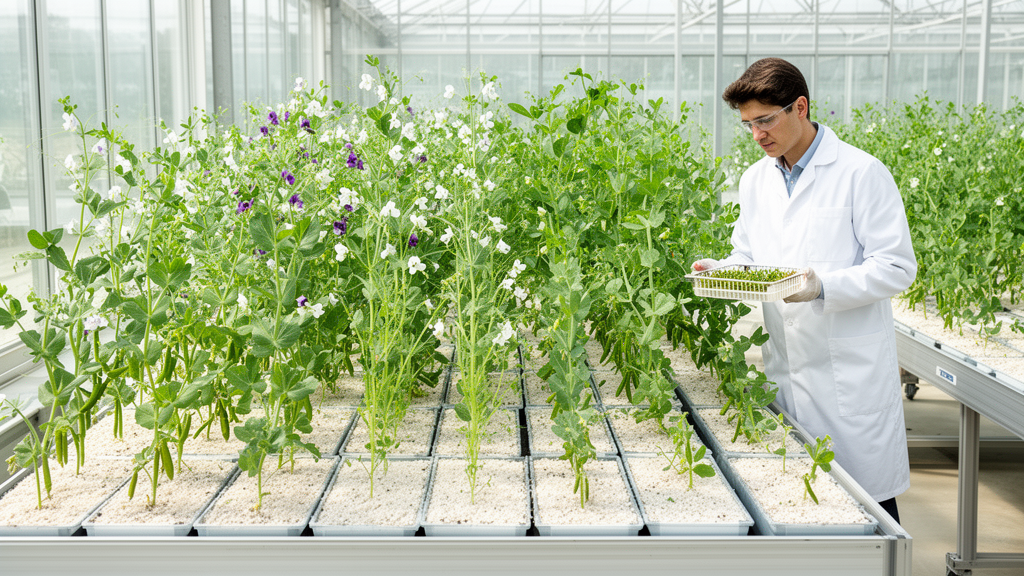
Image Credits: AI Generated

DOI: 10.1186/s12870-026-09895-8

Keywords: pea, salinity tolerance, seedling screening, sodium chloride, fuzzy evaluation, morphophysiological traits, crop breeding, field pea, vegetable pea, Identification, salinity-tolerant, Pisum

Cite Scienmag News

Alan Morgan. (October 25, 2026). Fuzzy multi-trait screening identifies nine salt-tolerant pea genotypes. Scienmag. https://scienmag.com/fuzzy-multi-trait-screening-identifies-nine-salt-tolerant-pea-genotypes/

Alan Morgan. "Fuzzy multi-trait screening identifies nine salt-tolerant pea genotypes." Scienmag, 25 October 2026, https://scienmag.com/fuzzy-multi-trait-screening-identifies-nine-salt-tolerant-pea-genotypes/. Accessed 25 October 2026.

Alan Morgan. "Fuzzy multi-trait screening identifies nine salt-tolerant pea genotypes." Scienmag. October 25, 2026. https://scienmag.com/fuzzy-multi-trait-screening-identifies-nine-salt-tolerant-pea-genotypes/


Tags: correlation of seedling vigor with salinity tolerancecrop breedingfield peafuzzy evaluationfuzzy multi-trait evaluation for salinity stressgenetic diversity in pea salt toleranceidentificationidentification of salt-tolerant pea seedlingsin vitro screening of pea genotypes under salt stressmorphophysiological traitsmulti-trait modeling for early plant stress detectionpeaPisumprincipal component analysis in plant stress researchsalinity tolerancesalinity-tolerantsalt injury index for plant salt toleranceSalt tolerance screening in pea genotypesseedseedling screeningseedling traits for salt stress assessmentsodium chloridesodium chloride concentration impact on pea seedling growthvegetable pea
Share26Tweet16
Previous Post

US vaping became more frequent and widespread from 2013 to 2023

Next Post

Surgery and radiotherapy linked to longer survival in grade 4 brain tumors

Related Posts

Process Mining Reveals Hidden Delays in Farm Software Development
Agriculture

Process Mining Reveals Hidden Delays in Farm Software Development

October 25, 2026
Hormone Recipe Unlocks Rapid Callus Growth in Papaya Tissue Culture
Agriculture

Hormone Recipe Unlocks Rapid Callus Growth in Papaya Tissue Culture

October 25, 2026
Stable wheat locus on chromosome 4BS linked to drought tolerance at germination
Agriculture

Stable wheat locus on chromosome 4BS linked to drought tolerance at germination

October 25, 2026
Chloroplast genomes support Petrocodon phylogeny on China’s Guizhou karst plateau
Agriculture

Chloroplast genomes support Petrocodon phylogeny on China’s Guizhou karst plateau

October 25, 2026
How Long You Stew Pork Intestine Decides Its Aroma, Chemistry Reveals
Agriculture

How Long You Stew Pork Intestine Decides Its Aroma, Chemistry Reveals

October 25, 2026
AI Spots Which Pig Is Coughing in Crowded Pens, Even at Night
Agriculture

AI Spots Which Pig Is Coughing in Crowded Pens, Even at Night

October 25, 2026
Next Post
Surgery and radiotherapy linked to longer survival in grade 4 brain tumors

Surgery and radiotherapy linked to longer survival in grade 4 brain tumors

  • Mothers who receive childcare support from maternal grandparents show more optimized

    Mothers who receive childcare support from maternal grandparents show more parental warmth, finds NTU Singapore study

    27656 shares
    Share 11059 Tweet 6912
  • University of Seville Breaks 120-Year-Old Mystery, Revises a Key Einstein Concept

    1061 shares
    Share 424 Tweet 265
  • Bee body mass, pathogens and local climate influence heat tolerance

    682 shares
    Share 273 Tweet 171
  • Researchers record first-ever images and data of a shark experiencing a boat strike

    546 shares
    Share 218 Tweet 137
  • Groundbreaking Clinical Trial Reveals Lubiprostone Enhances Kidney Function

    531 shares
    Share 212 Tweet 133
Science

Embark on a thrilling journey of discovery with Scienmag.com—your ultimate source for cutting-edge breakthroughs. Immerse yourself in a world where curiosity knows no limits and tomorrow’s possibilities become today’s reality!

RECENT NEWS

  • Digital NeuroEpiTool lets non-specialists assess neurological signs in population studies
  • Collapsing Stars May Power Gamma-Ray Bursts While Erasing Black Hole Singularities
  • Surgery and radiotherapy linked to longer survival in grade 4 brain tumors
  • Fuzzy multi-trait screening identifies nine salt-tolerant pea genotypes

Categories

  • Agriculture
  • Anthropology
  • Archaeology
  • Athmospheric
  • Biology
  • Biotechnology
  • Blog
  • Bussines
  • Cancer
  • Chemistry
  • Climate
  • Earth Science
  • Editorial Policy
  • Marine
  • Mathematics
  • Medicine
  • Pediatry
  • Policy
  • Psychology & Psychiatry
  • Science Education
  • Science News
  • Social Science
  • Space
  • Technology and Engineering

Subscribe to Blog via Email

Enter your email address to subscribe to this blog and receive notifications of new posts by email.

Join 5,151 other subscribers

© 2025 Scienmag - Science Magazine

Welcome Back!

Login to your account below

Forgotten Password?

Retrieve your password

Please enter your username or email address to reset your password.

Log In
No Result
View All Result
  • HOME
  • SCIENCE NEWS
  • CONTACT US

© 2025 Scienmag - Science Magazine

Discover more from Science

Subscribe now to keep reading and get access to the full archive.

Continue reading