

Monday, October 26, 2026
Science
No Result
View All Result
  • Login
  • HOME
  • SCIENCE NEWS
  • CONTACT US
  • HOME
  • SCIENCE NEWS
  • CONTACT US
No Result
View All Result
Scienmag
No Result
View All Result
Home Science News Earth Science

Spring plankton production in the Barents Sea ice zone has fallen 45 percent

October 26, 2026
in Earth Science
Violet Maxwell
By Violet Maxwell Scienmag Editorial Profile - Natural Hazards
Reading Time: 2 mins read
0
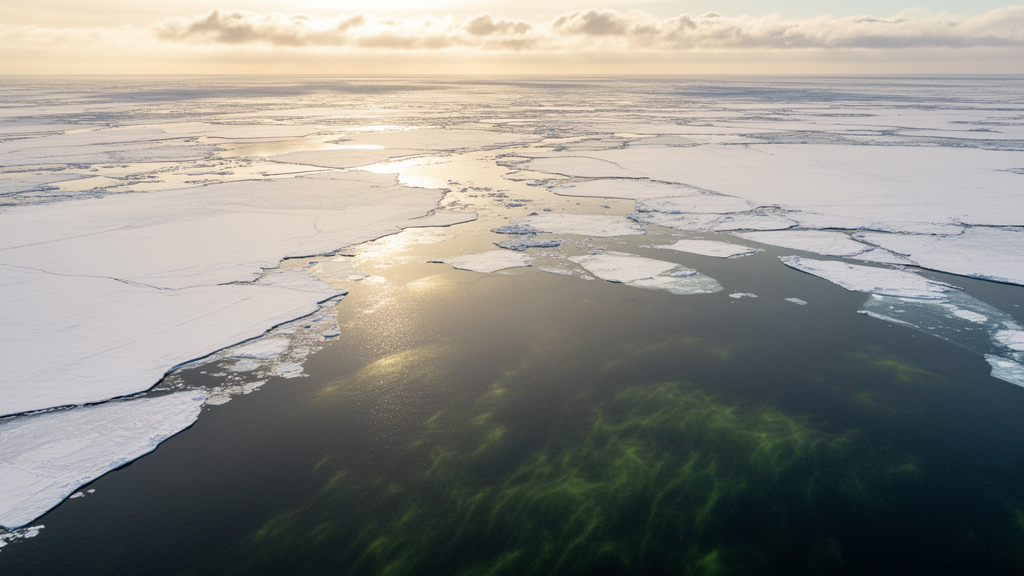
Spring plankton production in the Barents Sea ice zone has fallen 45 percent

Spring plankton production in the Barents Sea ice zone has fallen 45 percent

65
SHARES
587
VIEWS
Share on FacebookShare on Twitter
ADVERTISEMENT

Spring primary production in the nitrate-limited Barents Sea ice zone has declined by 45 percent between 1998 and 2023, according to a satellite-based analysis published in Nature Communications. The study, led by Chao Zhang and colleagues, used satellite ocean color data to quantify the trend and found an average reduction of 90.43 milligrams of carbon per square meter per day for each decade, a statistically significant decrease reported at p < 0.05.

The finding stands out against the broader picture of the Barents Sea, where long-term greening and increased annual production under anthropogenic climate forcing are well documented. The authors note that seasonal differences in production trends have been less clear, and their results reveal that the spring bloom, a critical pulse of food for Arctic ecosystems, is moving in the opposite direction to the annual average.

The researchers attribute the decline primarily to reduced nitrate availability during spring. Three linked processes appear responsible: slower replenishment of nitrate over winter, increased consumption of nitrate upstream of the ice zone, and a net export of nitrate out of the region. These mechanisms are linked to Atlantification, which the study identifies as reshaping the region’s nutrient environment.

Light availability has also diminished. The study identifies a North Atlantic-Arctic atmospheric wave train, together with reduced freshwater input, as factors that have deepened the surface mixed layer, lowering light availability and further limiting spring production on top of the nutrient constraint.

Because the analysis is based on satellite ocean color observations, it captures large-scale changes in surface production rather than direct measurements throughout the water column, and the reported trend applies specifically to the nitrate-limited ice zone during April and May. Within that scope, the signal is clear enough for the authors to draw a forward-looking conclusion: continued warming will likely suppress spring production in the Barents Sea ice zone further.

The ecological stakes are considerable. A weakened spring bloom reduces the seasonal pulse of carbon that underpins Arctic marine food webs, and the authors warn that nutrient-driven cascading effects on food webs and biodiversity could follow if the trend continues. The Barents Sea ice zone thus offers a clear illustration of how climate forcing can reverse productivity in a season even while annual production in the region increases overall.

Subject of Research: Declining spring primary production in the Barents Sea ice zone under climate-driven nutrient and light limitation

Article Title: Declining spring production in the Barents Sea ice zone under climate forcing

Article References: Zhang, C., Duan, A., Liang, M., Fu, G., & Achterberg, E. P. (2026). Declining spring production in the Barents Sea ice zone under climate forcing. Nature Communications. https://doi.org/10.1038/s41467-026-79272-4

Image Credits: AI Generated

DOI: 10.1038/s41467-026-79272-4

Keywords: Barents Sea, primary production, spring bloom, nitrate limitation, Atlantification, satellite ocean color, mixed layer, Arctic food webs, climate change, biodiversity, Declining, spring

Cite Scienmag News

Violet Maxwell. (October 26, 2026). Spring plankton production in the Barents Sea ice zone has fallen 45 percent. Scienmag. https://scienmag.com/spring-plankton-production-in-the-barents-sea-ice-zone-has-fallen-45-percent/


Violet Maxwell. "Spring plankton production in the Barents Sea ice zone has fallen 45 percent." Scienmag, 26 October 2026, https://scienmag.com/spring-plankton-production-in-the-barents-sea-ice-zone-has-fallen-45-percent/. Accessed 26 October 2026.

Violet Maxwell. "Spring plankton production in the Barents Sea ice zone has fallen 45 percent." Scienmag. October 26, 2026. https://scienmag.com/spring-plankton-production-in-the-barents-sea-ice-zone-has-fallen-45-percent/

Tags: Arctic food websArctic spring bloom declineAtlantificationBarents Seabiodiversityclimate changeclimate forcing and nutrient cycling in the Barents SeaDecliningeffects of climate change on nitrate availabilityimpact of Atlantification on Arctic ecosystemsimpact of reduced light availability on phytoplanktonimplications for Arctic food webslong-term trends in Arctic marine productivitymixed layernitrate limitationnitrate limitation and nutrient dynamicsprimary productionsatellite analysis of ocean color datasatellite ocean colorsatellite-based monitoring of Arctic ocean healthseasonal variation in Arctic primary productivityspringspring bloomSpring plankton production decline in Barents Sea ice zone
Share26Tweet16
Previous Post

Quantum gate sets 6.8-nanosecond speed record with 99.98% accuracy

Next Post

Infrared Cameras Reveal How Flat-Faced Dogs Struggle to Shed Heat During Exercise

Related Posts

Remote-Controlled Ships Test the Limits of Coastal State Pollution Powers
Earth Science

Remote-Controlled Ships Test the Limits of Coastal State Pollution Powers

October 26, 2026
Study Links Household Size to Wildlife Conflicts in Tanzania
Earth Science

Study Links Household Size to Wildlife Conflicts in Tanzania

October 26, 2026
One Laser, 744 Sediments: China’s Shelf Seas Mapped in a Single Grain-Size Dataset
Earth Science

One Laser, 744 Sediments: China’s Shelf Seas Mapped in a Single Grain-Size Dataset

October 26, 2026
AI Pushes Nigerian Vocational Lecturers to Redefine What Authentic Teaching Means
Earth Science

AI Pushes Nigerian Vocational Lecturers to Redefine What Authentic Teaching Means

October 26, 2026
Price Position Signals Stress Shifts in EU Carbon Futures
Earth Science

Price Position Signals Stress Shifts in EU Carbon Futures

October 26, 2026
Green finance meets FinTech and AI: mapping a fast-growing research field
Earth Science

Green finance meets FinTech and AI: mapping a fast-growing research field

October 26, 2026
Next Post
Infrared Cameras Reveal How Flat-Faced Dogs Struggle to Shed Heat During Exercise

Infrared Cameras Reveal How Flat-Faced Dogs Struggle to Shed Heat During Exercise

  • Mothers who receive childcare support from maternal grandparents show more optimized

    Mothers who receive childcare support from maternal grandparents show more parental warmth, finds NTU Singapore study

    27656 shares
    Share 11059 Tweet 6912
  • University of Seville Breaks 120-Year-Old Mystery, Revises a Key Einstein Concept

    1061 shares
    Share 424 Tweet 265
  • Bee body mass, pathogens and local climate influence heat tolerance

    682 shares
    Share 273 Tweet 171
  • Researchers record first-ever images and data of a shark experiencing a boat strike

    546 shares
    Share 218 Tweet 137
  • Groundbreaking Clinical Trial Reveals Lubiprostone Enhances Kidney Function

    531 shares
    Share 212 Tweet 133
Science

Embark on a thrilling journey of discovery with Scienmag.com—your ultimate source for cutting-edge breakthroughs. Immerse yourself in a world where curiosity knows no limits and tomorrow’s possibilities become today’s reality!

RECENT NEWS

  • Sexual Violence and Unequal Screening Mark Health of Women on Illegal Gold Mining Sites in French Guiana
  • Rat hippocampus study reveals how witnessed danger becomes anchored to place in memory
  • Infrared Cameras Reveal How Flat-Faced Dogs Struggle to Shed Heat During Exercise
  • Spring plankton production in the Barents Sea ice zone has fallen 45 percent

Categories

  • Agriculture
  • Anthropology
  • Archaeology
  • Athmospheric
  • Biology
  • Biotechnology
  • Blog
  • Bussines
  • Cancer
  • Chemistry
  • Climate
  • Earth Science
  • Editorial Policy
  • Marine
  • Mathematics
  • Medicine
  • Pediatry
  • Policy
  • Psychology & Psychiatry
  • Science Education
  • Science News
  • Social Science
  • Space
  • Technology and Engineering

Subscribe to Blog via Email

Enter your email address to subscribe to this blog and receive notifications of new posts by email.

Join 5,151 other subscribers

© 2025 Scienmag - Science Magazine

Welcome Back!

Login to your account below

Forgotten Password?

Retrieve your password

Please enter your username or email address to reset your password.

Log In
No Result
View All Result
  • HOME
  • SCIENCE NEWS
  • CONTACT US

© 2025 Scienmag - Science Magazine

Discover more from Science

Subscribe now to keep reading and get access to the full archive.

Continue reading