


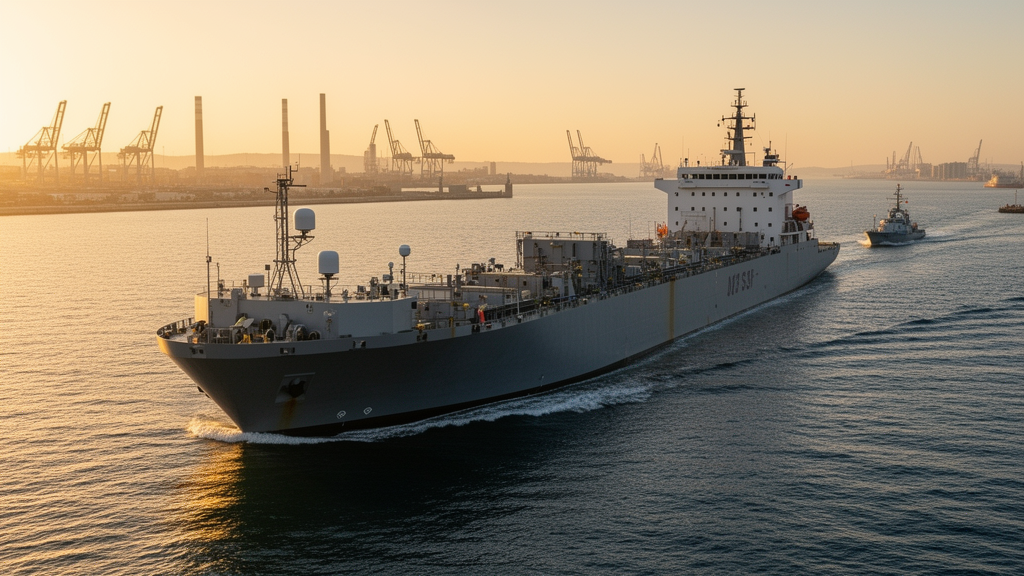
As remotely operated and autonomous ship technologies move beyond the hypothetical stage, a new legal analysis argues that the central regulatory challenge is not granting coastal states new powers over crewless vessels, but clarifying how existing marine environmental protection and enforcement functions can operate when the people performing them are ashore. The study, published in Frontiers in Marine Science, examines remotely operated Maritime Autonomous Surface Ships (MASS) that carry no persons on board, focusing on how the pollution-prevention, reporting, emergency-response and cooperation duties traditionally carried out by a master and seafarers are redistributed among shipboard systems, a Remote Operations Centre, remote operators and external support arrangements. The authors, Yourak Jang of Korea Maritime and Ocean University and Yongung Yu of Chonnam National University, frame their analysis around two questions.
First, can the environmental protection functions required under the existing international framework be maintained at an equivalent level under this distributed operational structure? Second, to what extent may coastal states regulate before an incident and enforce after one in the territorial sea, without impairing innocent passage or shifting the allocation of jurisdiction established by the United Nations Convention on the Law of the Sea (UNCLOS)? The timing of the analysis reflects a shifting regulatory landscape.
Although the scale and schedule of commercial deployment remain uncertain, the international community has adopted a non-mandatory MASS Code in 2026, alongside a planned experience-building process at the International Maritime Organization. These developments signal that remotely operated shipping is now a matter of active rule-making rather than pure speculation, even as binding obligations for crewless vessels remain unsettled. Using doctrinal and interpretive analysis of UNCLOS, relevant IMO instruments, the MASS Code and international case law, the study distinguishes measures available under existing law from areas that would require further normative development.
Its central argument is that functional equivalence should not be treated as an independent basis of coastal state jurisdiction. Instead, it should serve as an analytical criterion for assessing whether the existing level of marine environmental protection is effectively maintained when human and informational functions are performed remotely rather than on board. At the pre-incident stage, the authors propose common international criteria for judging whether the pollution-response chain remains intact: effectiveness, timeliness, continuity and reliability, fallback capability, and external verifiability.
Under this framework, coastal state measures must remain within existing jurisdictional limits and satisfy the established requirements of necessity, proportionality, non-discrimination and consistency with innocent passage. The post-incident picture is more granular. The study treats orders to stop a vessel, the measures used to compel it to stop, remote verification and physical inspection, detention, and the preservation and acquisition of digital evidence as legally distinct actions.
Each, the authors argue, requires its own legal basis, triggering conditions and procedural safeguards, rather than being bundled into a single enforcement power. The article's conclusion is deliberately restrained: the principal regulatory task is not to create new coastal state powers for MASS, but to clarify how existing environmental protection and enforcement functions can operate effectively when the relevant human and informational roles are performed remotely.
Subject of Research: Legal analysis of innocent passage and coastal state jurisdiction over remotely operated autonomous ships under UNCLOS
Article Title: Innocent passage and marine environmental protection of remotely operated MASS: functional equivalence and coastal state jurisdiction
Article References: Jang, Y., & Yu, Y. (2026). Innocent passage and marine environmental protection of remotely operated MASS: functional equivalence and coastal state jurisdiction. Frontiers in Marine Science, 13, Article 1980641. https://doi.org/10.3389/fmars.2026.1980641
Image Credits: AI Generated
DOI: 10.3389/fmars.2026.1980641
Keywords: Maritime Autonomous Surface Ships, MASS Code, UNCLOS, innocent passage, coastal state jurisdiction, marine environmental protection, ship-source pollution, remote operations centre, International Maritime Organization, territorial sea, maritime law, autonomous shipping
Cite Scienmag News
Violet Maxwell. (October 26, 2026). Remote-Controlled Ships Test the Limits of Coastal State Pollution Powers. Scienmag. https://scienmag.com/remote-controlled-ships-test-the-limits-of-coastal-state-pollution-powers/
Violet Maxwell. "Remote-Controlled Ships Test the Limits of Coastal State Pollution Powers." Scienmag, 26 October 2026, https://scienmag.com/remote-controlled-ships-test-the-limits-of-coastal-state-pollution-powers/. Accessed 26 October 2026.
Violet Maxwell. "Remote-Controlled Ships Test the Limits of Coastal State Pollution Powers." Scienmag. October 26, 2026. https://scienmag.com/remote-controlled-ships-test-the-limits-of-coastal-state-pollution-powers/


