


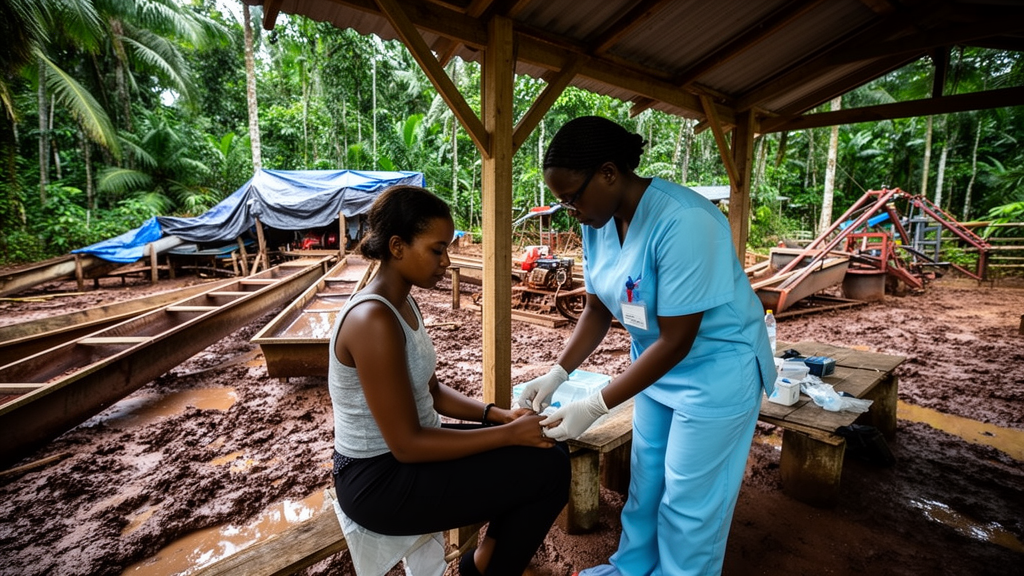
Women involved in illegal gold mining in French Guiana report high levels of sexual violence and intimate partner violence, according to a multicentric cross-sectional survey published in Frontiers in Global Women’s Health. Among 115 women recruited at logistical bases on the borders with Suriname and Brazil, 14.0 percent reported having experienced sexual assault or rape, with a 95 percent confidence interval of 8.2 to 21.8 percent, and 19.1 percent reported intimate partner violence. The study, led by Maylis Douine and colleagues from the Centre Hospitalier Universitaire de Guyane and partner institutions in Brazil and Suriname, is one of the first quantitative efforts to document the sexual and reproductive health of this hard-to-reach population.
The researchers conducted a descriptive cross-sectional survey among women involved in illegal gold mining, a population shaped by intersecting vulnerabilities related to migration, informality, and precarious living and working conditions, which the authors note heighten exposure to sexual and gender-based violence. After providing informed consent, participants were interviewed by trained field investigators using a standardized questionnaire. The instrument collected information on sociodemographic characteristics, exposure to sexual and gender-based violence, engagement in transactional sex, obstetrical history, access to gynecological care, and testing for sexually transmitted infections. Data were analyzed using descriptive statistical methods.
One of the study’s notable findings concerns transactional sex, which the authors report appeared less aligned with commonly held stereotypes about mining communities. Only 9.5 percent of the women surveyed were currently engaged in sex work, and 8.7 percent reported past involvement. Among those with past involvement, 80.9 percent reported systematic condom use.
Reproductive health indicators revealed a mixed picture. Overall, 15.6 percent of participants reported a history of induced abortion, with a 95 percent confidence interval of 9.5 to 23.6 percent, and half of those abortions had been performed by a healthcare provider. The authors describe abortion rates in the population as remaining high despite relatively good access to gynecological care, and they highlight this as a key area of concern alongside violence.
Access to routine gynecological services was relatively high for this marginalized group. Most participants, 80.0 percent, reported up-to-date gynecological follow-up, with a 95 percent confidence interval of 71.5 to 86.8 percent. This coverage indicates that contact with health services is reported by most women in the sample even in the context of illegal mining sites.
Screening for sexually transmitted infections, however, lagged behind. Previous HIV testing was relatively common at 65.2 percent, but testing for other infections was far less frequent: 33.9 percent of women reported prior testing for hepatitis B, 28.7 percent for hepatitis C, and 35.6 percent for syphilis. The authors conclude that STI screening coverage could be improved in this population, pointing to a gap between HIV-focused services and broader screening for bloodborne and sexually transmitted pathogens.
The study’s design carries limitations that shape how the findings should be read. As a cross-sectional descriptive survey of 115 women recruited at logistical bases, it provides prevalence estimates for a specific sample rather than a nationally representative picture of all women involved in illegal gold mining in the region. The confidence intervals around several estimates are wide, reflecting the modest sample size, and the descriptive analysis cannot establish causal relationships between mining work, violence, and health outcomes.
Nevertheless, the survey fills a significant evidence gap. Quantitative data on sexual and reproductive health among women in illegal gold mining areas of French Guiana have been scarce, even though these women face heightened exposure to sexual and gender-based violence driven by migration status, informal work, and precarious conditions. By recruiting participants at logistical bases at the borders with Suriname and Brazil, using trained field investigators and a standardized instrument, the research team was able to reach a population that conventional health surveys rarely capture.
The authors’ central recommendation is that screening for gender-based violence be promoted systematically within sexual and reproductive health services. Given that one in seven women in the sample reported sexual assault or rape and nearly one in five reported intimate partner violence, while many already attend gynecological follow-up, integrating violence screening into existing care contacts could reach women who might otherwise go unidentified. The findings also underscore the need to expand hepatitis B, hepatitis C, and syphilis testing beyond the HIV testing that currently dominates screening practice in this setting.
For health planners, the study offers a baseline of measured prevalence estimates for a population usually described only in terms of its invisibility to public services. It documents both the burden of violence and the reported patterns of care-seeking and screening among women working in illegal gold mining sites, providing quantitative grounding for future sexual and reproductive health interventions in the region.
Subject of Research: Sexual and reproductive health, gender-based violence, and STI screening among women involved in illegal gold mining in French Guiana
Article Title: Sexual and reproductive health of women living on illegal gold mining sites in French Guiana: a multicentric cross-sectional survey
Article References: Douine, M., Sanna, A., Bardon, T., Petit-Sinturel, M., Plessis, L., Carboni, C., Le Querriou, R., Miller, J., Bordallo-Miller, J., Lucarelli, A., Van Melle, A., Michaud, C., Basurko, C., Nacher, M., Adenis, A., Vreden, S., Suarez-Mutis, M., & Lambert, Y. (2026). Sexual and reproductive health of women living on illegal gold mining sites in French Guiana: a multicentric cross-sectional survey. Frontiers in Global Women's Health, 7, Article 1887897. https://doi.org/10.3389/fgwh.2026.1887897
Image Credits: AI Generated
DOI: 10.3389/fgwh.2026.1887897
Keywords: French Guiana, illegal gold mining, sexual and reproductive health, gender-based violence, intimate partner violence, sexually transmitted infections, HIV testing, induced abortion, transactional sex, hard-to-reach populations, cross-sectional survey, women's health
Cite Scienmag News
Ophelia Keating. (October 26, 2026). Sexual Violence and Unequal Screening Mark Health of Women on Illegal Gold Mining Sites in French Guiana. Scienmag. https://scienmag.com/sexual-violence-and-unequal-screening-mark-health-of-women-on-illegal-gold-mining-sites-in-french-guiana/
Ophelia Keating. "Sexual Violence and Unequal Screening Mark Health of Women on Illegal Gold Mining Sites in French Guiana." Scienmag, 26 October 2026, https://scienmag.com/sexual-violence-and-unequal-screening-mark-health-of-women-on-illegal-gold-mining-sites-in-french-guiana/. Accessed 26 October 2026.
Ophelia Keating. "Sexual Violence and Unequal Screening Mark Health of Women on Illegal Gold Mining Sites in French Guiana." Scienmag. October 26, 2026. https://scienmag.com/sexual-violence-and-unequal-screening-mark-health-of-women-on-illegal-gold-mining-sites-in-french-guiana/


