


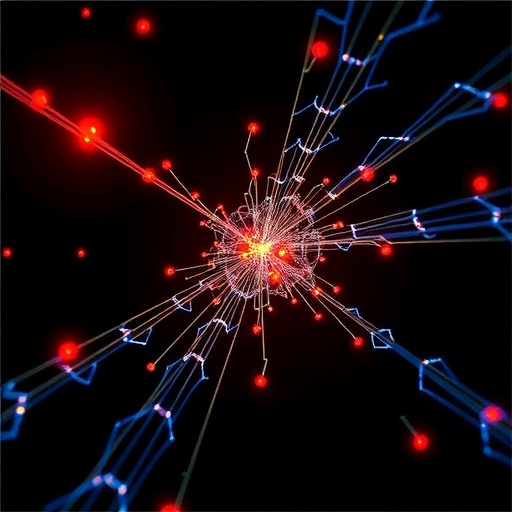
A new study in Light: Science & Applications reports that a ferroelectric crystal can spontaneously generate a striking “woven” pattern of electric polarization domains—and that those intertwined structures can be steered and reshaped using light. The work, published online on 14 July 2026, highlights how optical control could be used not only to write functional patterns, but also to manipulate complex internal order in materials without mechanically processing them.
Ferroelectrics are famous for their switchable polarization: the direction of internal electric dipoles can be changed by an external influence. What has been challenging is achieving highly structured, spatially intricate domain architectures in a reliable way. Here, the researchers observe that, under appropriate conditions, the material does not merely form isolated domains. Instead, it assembles into a fabric-like network in which domain walls weave through the crystal, producing a labyrinth of coupled regions.
The team demonstrates that light can act as a tuning knob for this emergent domain fabric. By illuminating the crystal, they can locally alter the state of the polarization landscape, effectively steering how the woven structure evolves. This introduces a level of programmability: optical signals can be used to nudge a complex domain pattern toward desired configurations rather than treating the material as a passive host.
A key technical aspect of the study is the coupling between photo-excitation and the energetics of domain formation. Illumination changes the local conditions that stabilize certain polarization variants, shifting the balance between competing domain states. As the system relaxes, the intertwined network self-organizes, reflecting both the initial conditions and the optical perturbation.
The optical manipulation is particularly relevant for next-generation photonic and electronic devices, where rapid, contactless switching is valuable. Woven domain fabrics suggest a route toward reconfigurable functional “micro-architectures” embedded inside a single crystal—potentially enabling new ways to control optical response, signal routing, or field-assisted performance.
Beyond device promise, the phenomenon offers a fresh lens for condensed-matter physics. It shows that complex topologies in ferroelectric order can arise from intrinsic dynamics, not only from externally imposed templates. The spontaneous emergence of the fabric-like arrangement suggests an underlying interplay between domain-wall motion and energy minimization that can be disrupted—or guided—by light.
Overall, this viral science development points to a future where illumination can do more than illuminate: it can sculpt the internal order of advanced materials. With further refinement, optical “domain weaving” could become a practical method for fabricating and tuning polarization textures at scales compatible with modern experimental and technological workflows.
Cite Scienmag News
Denise Maddox. (July 15, 2026). Spontaneous Creation and Optical Control of Woven Domain Patterns in Ferroelectrics. Scienmag. https://scienmag.com/spontaneous-creation-and-optical-control-of-woven-domain-patterns-in-ferroelectrics/
Denise Maddox. "Spontaneous Creation and Optical Control of Woven Domain Patterns in Ferroelectrics." Scienmag, 15 July 2026, https://scienmag.com/spontaneous-creation-and-optical-control-of-woven-domain-patterns-in-ferroelectrics/. Accessed 4 September 2026.
Denise Maddox. "Spontaneous Creation and Optical Control of Woven Domain Patterns in Ferroelectrics." Scienmag. July 15, 2026. https://scienmag.com/spontaneous-creation-and-optical-control-of-woven-domain-patterns-in-ferroelectrics/


