


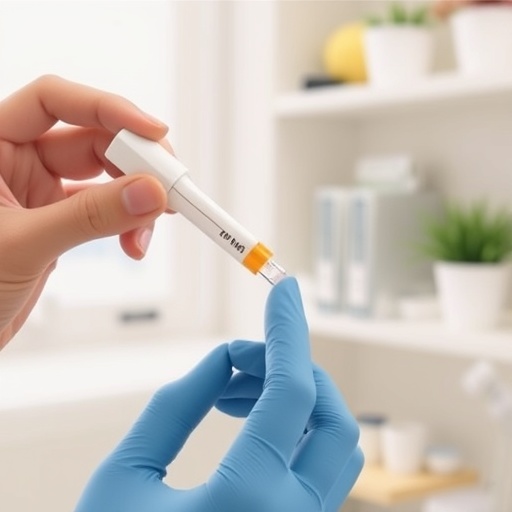
A portable blood-testing system developed by King’s College London spinout Algocyte could allow patients to monitor important changes in their health without visiting a hospital or GP surgery each time a test is required. The PROXIMA™ Mobile Health Station connects to a digital platform through Bluetooth and uses artificial intelligence to interpret biological measurements, creating a longitudinal picture of a person’s health rather than relying solely on isolated laboratory results.
The device is designed for small blood samples collected through minimally invasive methods, including finger pricks. Once a sample is placed inside the testing unit, integrated sensors measure properties of the blood. Those measurements are processed by computational models that generate results and transmit them digitally to patients and healthcare professionals. By moving part of the testing process closer to the patient, the system could eventually support more frequent monitoring in homes, clinics and other community settings.
Traditional blood testing usually produces a snapshot of physiology at a particular moment. That snapshot can be clinically valuable, but it may not reveal subtle changes that emerge between appointments. Algocyte’s approach is intended to build a time series from repeated measurements. Artificial intelligence can compare new results with an individual’s previous readings, potentially helping identify gradual shifts in blood-cell levels or other physiological signals before they become obvious through symptoms or a single conventional test.
This capability could be especially important for people receiving treatments that require regular surveillance. Patients undergoing chemotherapy, for example, may need repeated blood tests to assess how treatment is affecting their blood cells and whether their immune system is being compromised. Similar monitoring is required for people taking medicines such as clozapine, which can cause serious changes in white blood cell counts in a small proportion of patients. A convenient testing system could reduce the burden of repeated hospital visits while allowing clinicians to maintain closer oversight.
The technology combines several technical disciplines. Bioengineering is used to create a compact platform capable of handling a blood sample and measuring its characteristics, while computational biology helps relate those measurements to biological processes. Artificial intelligence algorithms then analyse patterns in the data. Rather than treating every result as an isolated number, the software is intended to interpret measurements in the context of an individual’s previous results, potentially improving the detection of clinically meaningful trends.
However, the system is not designed to replace medical expertise. Blood results can be affected by factors including infection, medication, hydration, recent treatment and the quality of the sample. AI-generated outputs must therefore be evaluated against established laboratory methods and interpreted alongside a patient’s symptoms and clinical history. The technology’s current development programme includes further testing and evaluation in commercial deployment, as well as the collection of scientific evidence needed to determine how reliably it performs in different healthcare environments.
The device has achieved the UKCA regulatory mark, indicating that it meets relevant UK requirements for health, safety and environmental protection. This milestone allows the technology to progress towards wider use, but it does not by itself establish that the system can replace every laboratory test or make autonomous medical decisions. Algocyte is continuing to work through additional regulatory steps and clinical evaluation as it explores applications in routine monitoring and, potentially, predictive healthcare.
The possible impact extends beyond individual patients. Millions of blood tests are carried out in the United Kingdom each year to diagnose disease, monitor treatment and assess general health. Many require appointments, sample transport and laboratory processing, placing demands on clinical staff and healthcare infrastructure. A reliable point-of-care system could help redistribute some of this workload, allowing healthcare professionals to focus laboratory resources on complex analyses while routine measurements are collected closer to the patient.
The PROXIMA™ Mobile Health Station was officially launched at the Royal Society of Medicine in London on 29 June, following the achievement of its UKCA marking. The event brought together researchers, clinicians, industry partners and healthcare leaders to discuss the device’s future development, clinical validation and potential applications. Hector Zenil, Algocyte’s founder and chief executive and an associate professor in healthcare engineering at King’s College London, described the project as an example of how academic research in artificial intelligence, cell biology and medicine can be translated into technologies with potential social impact. If further testing confirms its accuracy and clinical value, the system could help transform blood monitoring from an episodic hospital procedure into a more continuous and personalised part of healthcare.
References: King’s College London and Algocyte announcement concerning the PROXIMA™ Mobile Health Station and its UKCA marking
Keywords
Portable blood testing, artificial intelligence, home healthcare, remote monitoring, point-of-care diagnostics, chemotherapy monitoring, clozapine monitoring, bioengineering, digital health, King’s College London, Algocyte, PROXIMA Mobile Health Station
Cite Scienmag News
Denise Maddox. (August 5, 2026). New technology enables at-home blood test analysis. Scienmag. https://scienmag.com/new-technology-enables-at-home-blood-test-analysis/
Denise Maddox. "New technology enables at-home blood test analysis." Scienmag, 5 August 2026, https://scienmag.com/new-technology-enables-at-home-blood-test-analysis/. Accessed 6 September 2026.
Denise Maddox. "New technology enables at-home blood test analysis." Scienmag. August 5, 2026. https://scienmag.com/new-technology-enables-at-home-blood-test-analysis/


